The Future of Industrial Robotics May Be Teams of Robots, Not Individual Machines
For decades, industrial automation has largely followed a simple model.
The Future of Industrial Robotics May Be Teams of Robots, Not Individual Machines
For decades, industrial automation has largely followed a simple model.
One robot.
One workstation.
One repetitive task.
A robotic arm welds.
Another assembles.
Another paints.
Each machine operates largely independently.
As Physical AI advances, that model is beginning to change.
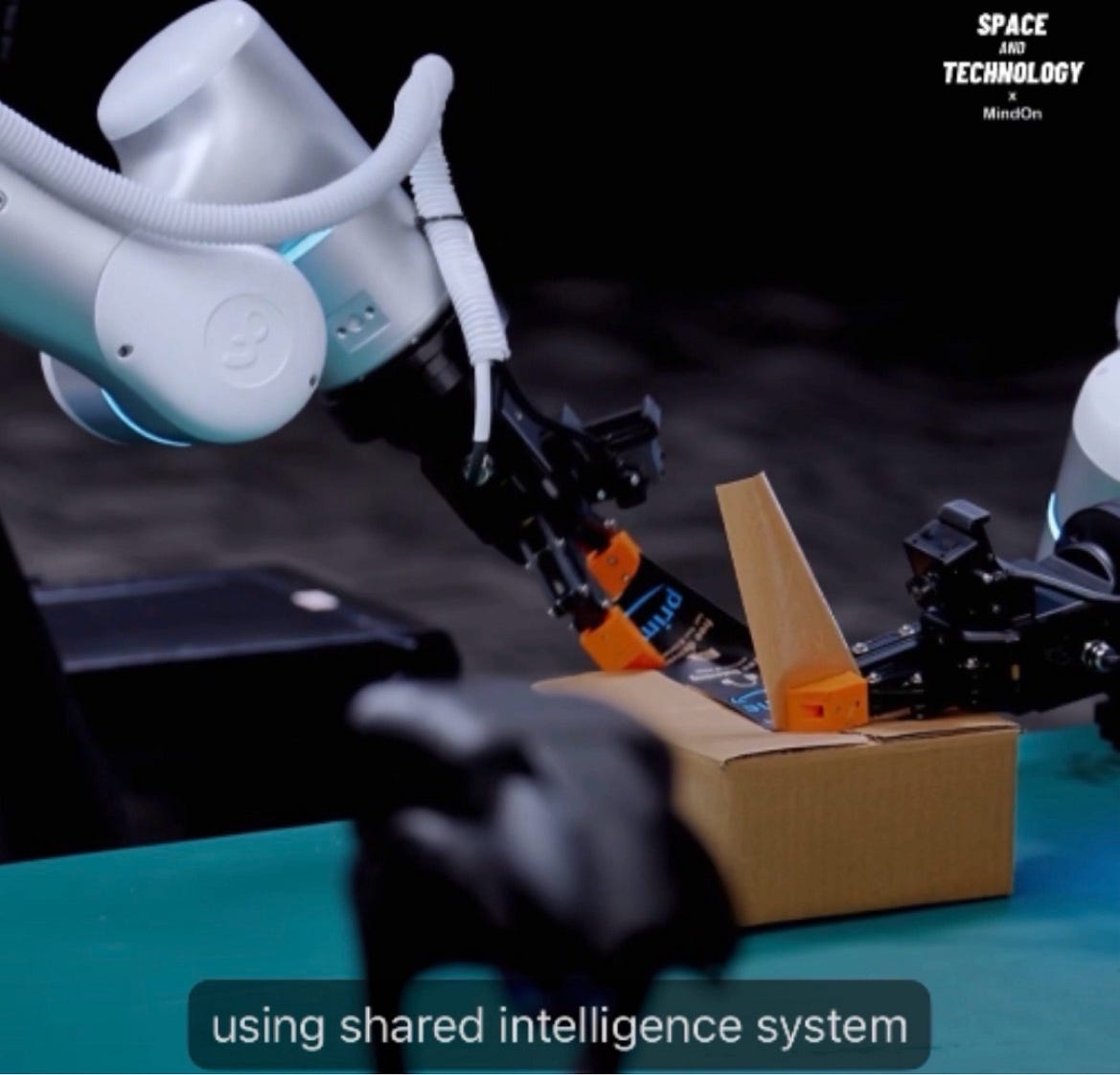
A recent demonstration by Shenzhen-based Mind On showcases a different approach: multiple robot types collaborating throughout an entire logistics workflow, each performing the tasks best suited to its design while sharing the same underlying AI system.
Rather than creating a single robot capable of doing everything, Mind On demonstrates something arguably more practical — an intelligent robotic team.
Different Bodies, Different Strengths
Not every task requires the same kind of robot.
Humanoid robots excel at moving through environments built for people.
They can navigate hallways, transport objects, and interact with existing infrastructure without major modifications.
Dual-arm robots, on the other hand, are optimized for precision.
Sorting.
Packing.
Manipulating products.
Performing repetitive operations at fixed workstations.
Instead of forcing one platform to perform every task, Mind On combines both.
Humanoids retrieve and transport items.
Dual-arm robots complete the detailed manipulation work.
The result is a workflow where each robot specializes rather than compromises.
One AI Across Multiple Robots
Perhaps the most significant aspect of the demonstration is that the robots operate using the same AI model.
Historically, robots have often been programmed independently.
Each platform required its own software stack, planning system, and task execution pipeline.
Foundation models for robotics are changing that.
A shared intelligence layer allows different robot morphologies to understand the same environment, exchange information, and coordinate their actions.
This mirrors developments already happening across the Physical AI industry, where researchers increasingly pursue foundation models capable of operating multiple robot embodiments rather than training entirely separate systems.
Coordination Is the Next Challenge
Individual robot capabilities continue to improve rapidly.
Navigation is better.
Manipulation is becoming more dexterous.
Perception continues to advance.
The next major challenge is coordination.
How should work be divided?
Which robot should perform which task?
How do robots avoid interfering with one another?
How do they adapt when unexpected events occur?
These questions move robotics beyond motion planning into distributed intelligence.
The warehouse becomes not just a collection of robots, but an intelligent robotic workforce.
Why Data Matters
Training collaborative robots requires more than isolated demonstrations.
Robots must learn:
- Human logistics workflows
-
- Task sequencing
-
- Object handoffs
-
- Shared workspace behavior
-
- Navigation around other agents
-
- Multi-agent coordination
Capturing these interactions in real environments will become increasingly valuable as collaborative robotic systems mature.
The next generation of Physical AI datasets may include not only human demonstrations but also robot-to-robot interaction patterns.
Looking Ahead
The future of automation may not be defined by increasingly capable individual robots.
Instead, it may resemble modern human workplaces.
Different specialists.
Different tools.
Shared goals.
Common intelligence.
Humanoid robots carrying inventory.
Dual-arm robots performing precision assembly.
Mobile platforms delivering supplies.
Autonomous forklifts moving pallets.
All coordinated through a common AI foundation.
The most intelligent robot of the future may not be a single machine.
It may be an entire robotic team.
⸻
🎥 Image credit: Space and Technology
Learn more about FileMarket AI Data Labs:
Egocentric data inquiries:
humanloop@filemarket.ai


메타데이터
- post_id
- c1c8bd47c9b4
- slug
- the-future-of-industrial-robotics-may-be-teams-of-robots-not-individual-machines-c1c8bd47c9b4
- url
- https://medium.com/@filemarketai/the-future-of-industrial-robotics-may-be-teams-of-robots-not-individual-machines-c1c8bd47c9b4
- canonical_url
- https://medium.com/@filemarketai/the-future-of-industrial-robotics-may-be-teams-of-robots-not-individual-machines-c1c8bd47c9b4
- author_url
- https://medium.com/@filemarketai
- status
- ok
- fetched_at
- 2026-07-13 10:48:08