The Myth of the “Largest Mass Lynching” in American History
The phrase
**The Myth of the “Largest Mass Lynching” in American History**
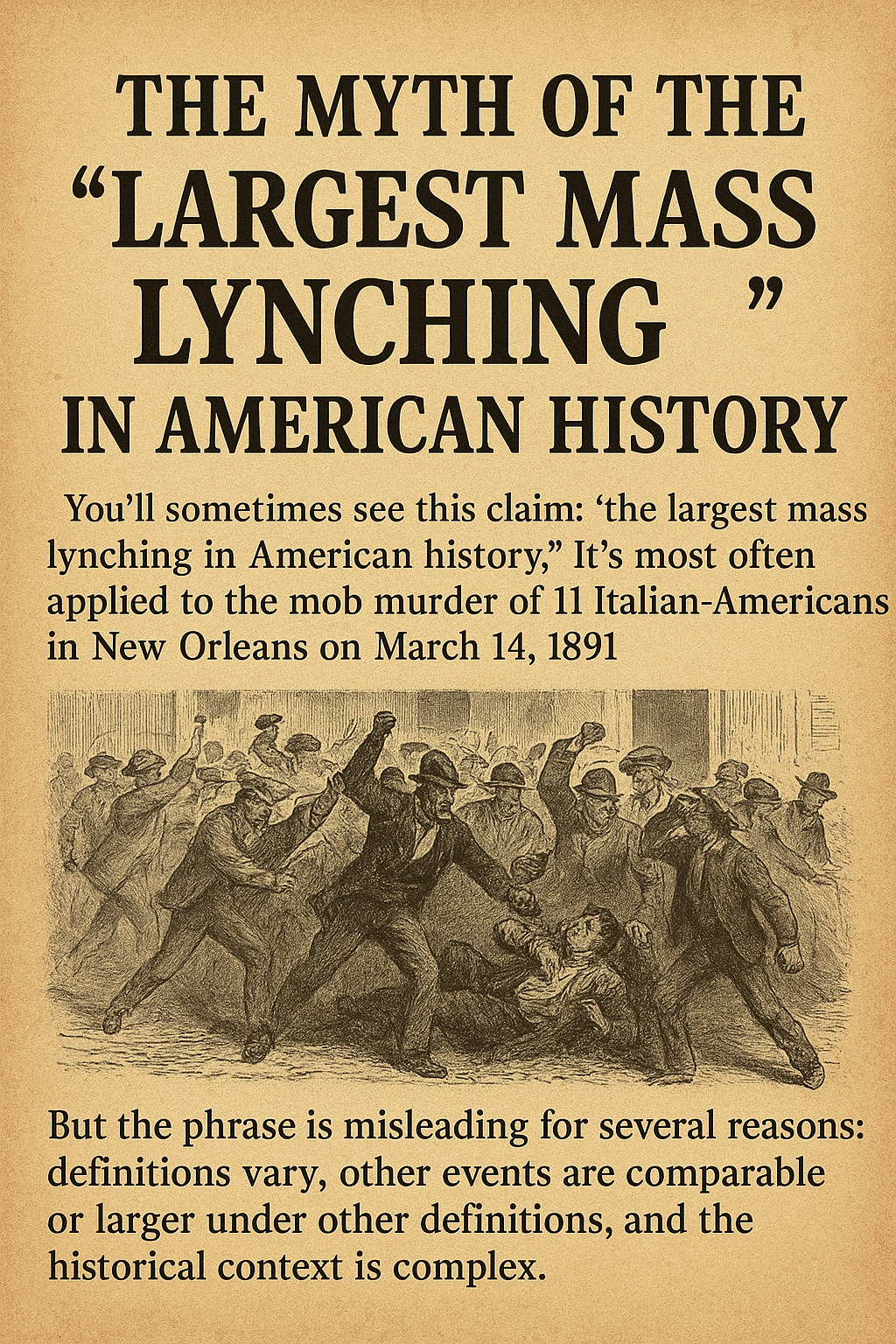
You’ll sometimes see this claim: “the largest mass lynching in American history.” It’s most often applied to the mob murder of 11 Italian-Americans in New Orleans lynchings of 1891 (March 14, 1891) in New Orleans. Encyclopedia Britannica+2HISTORY+2 But the phrase is misleading for several reasons: definitions vary, other events are comparable or larger under other definitions, and the historical context is complex.
What happened in New Orleans, 1891
- On March 14, 1891, a mob stormed the Orleans Parish Prison in New Orleans and murdered 11 Italian American men who had been accused (and in many cases acquitted) of killing Police Chief David Hennessy.
- The mob included thousands and counted among them prominent citizens.
- The victims were targeted because of xenophobia (anti-Italian sentiment), and the event sparked a diplomatic crisis between the U.S. and Italy.
- Many sources call this event “the largest single mass lynching in American history”. Wikipedia+1
So far, that framing appears straightforward: a mob, 11 victims, no legal due process. But it’s precisely the qualifiers (“single”, “mass lynching”, “in one place at one time”, etc.) that make the phrase shaky.
Here are some of the major issues:
- What is a “lynching”? The term is used for extrajudicial killing by a mob, typically targeting a (racial or ethnic) minority, often with spectacular violence, and outside the legal process. Encyclopedia Britannica+1 But the exact definition varies.
- What counts as “mass”? Is it a large number of victims compared to typical lynchings, or simply more than a “normal” lynching (which might be one or two victims)?
- Is the comparison “largest ever” meaningful when many events had tens or hundreds of victims, but may be labeled differently (massacre, pogrom, riot, etc.)?
- Some historians distinguish between “lynching” and “massacre”: for example, one definition says lynching is when victims are targeted for a specific alleged offense and the mob claims to be delivering justice; whereas “massacre” may be more indiscriminate. Reddit+1
Because of these issues, the statement “the largest mass lynching in American history” is not as clear-cut as it appears.
Other events and how they compare
Here are two examples:
- In the Los Angeles Chinese massacre of 1871, 19 Chinese immigrants were killed by a mob in Los Angeles on October 24, 1871. Wikipedia+1 Some modern sources call this “the largest mass lynching in American history” (though others call it a massacre, not a lynching).
- In the Great Hanging at Gainesville in Texas (October 1862), vigilantes hanged 41 suspected Unionists during the Civil War era — some of those hangings lacked trial or due process and are sometimes described as the largest mass lynching in Texas history. HNN+1
So depending on how you define your terms (lynching vs massacre, number of victims, targeted vs indiscriminate, etc.), the “largest” title can shift.
- Memory and identity: Events like the New Orleans lynching carry symbolic weight — they speak to immigrant oppression, xenophobia, and mob justice. The way they are framed or “titled” influences how communities remember them.
- Historical clarity: Precision in how we describe these events matters. If one claims “largest mass lynching” without clarifying definition, comparison, or context, it can obscure other atrocities or mislead.
- Victims and narratives: Who counts as a lynching victim, how they were treated, how their communities responded — all matter. Immigrants, racial minorities, native peoples have different experiences of mass violence in U.S. history.
- Avoiding trivialization: Using “largest” or “worst” requires care. Otherwise we risk diluting the significance of other events or creating a hierarchy of victims in which some atrocities seem more “important” than others.
Rather than saying “the largest mass lynching in American history”, a more accurate phrasing for the New Orleans event might be:
“One of the largest single mob lynchings in U.S. history — the March 14, 1891 lynching of 11 Italian Americans in New Orleans.”
메타데이터
- post_id
- c1c9bd9593e2
- slug
- the-myth-of-the-largest-mass-lynching-in-american-history-c1c9bd9593e2
- url
- https://medium.com/@dailyrefjournal/the-myth-of-the-largest-mass-lynching-in-american-history-c1c9bd9593e2
- canonical_url
- https://medium.com/@dailyrefjournal/the-myth-of-the-largest-mass-lynching-in-american-history-c1c9bd9593e2
- author_url
- https://medium.com/@dailyrefjournal
- status
- ok
- fetched_at
- 2026-06-09 15:37:30