The One Question That Reframes Your Marketing Budget
Why an Independent Lodge Should Own Its Exposure Instead of Renting It
The Marketing That Builds Equity
The One Question That Reframes Your Marketing Budget
Why an Independent Lodge Should Own Its Exposure Instead of Renting It
Most lodge marketing decisions get made on a single number: what does it cost? The booth fee. The ad budget. The travel.
There is a better question, and it changes everything:
When this dollar is spent, what do I still own?

Owned Marketing Assets for Lasting Visibility
Ask that question of every marketing line in your budget and the answers sort themselves into two piles very quickly.
One pile buys you exposure you rent — attention that arrives the moment you pay and disappears the moment you stop.
The other pile builds exposure you own — assets that keep working for you long after the spend, and that are worth more next year than they are this year.
This strategy is about the difference between those two piles, and about a service built specifically to move your marketing from the first pile into the second.
We are not saying sport shows are bad or that paid ads never work.
They both do something real.
The point is more useful: neither one leaves anything behind.
And for an independent operator with a small budget and four specific goals to hit, what gets left behind is the whole game.

The Long Term Value of Content Marketing
The Four Goals This System Serves
Every recommendation in this strategy connects back to the four outcomes a healthy lodge is trying to produce. These are your goals, not our deliverables:
- Increase total bookings — more guests, more weeks filled.
- Fill the shoulder season — reduce dependence on a handful of peak weeks.
- Reduce the average age of your clientele — bring in younger groups who will rebook for decades.
- Increase group size — more people per booking means more revenue per slot.

Which marketing channel helps all four business goals?
Hold these in mind as you read.
The test of any marketing dollar is not “did it create activity” — it is “did it move one of these four numbers, and does it keep moving them after the spend stops.”
Form One of Rented Exposure: The Sport Show Booth
A sport show is a valuable thing. You stand across from real anglers, shake real hands, and have the kind of human conversation that no algorithm reproduces. We are not dismissing that.
But look closely at what the spend actually buys.
What you pay for: the booth fee, the travel, the hotel nights, the meals, the printed materials and giveaways, and — the largest cost of all, though it never shows up on an invoice — several days where you and your best people are off-property and unavailable to the guests and prospects you already have.
What you get: a few days of exposure to a regional audience, most of whom walk past, in a room full of competitors doing the same thing.
What remains when the show closes: the exposure ends with the event. The conversations you didn’t capture evaporate. The person who was “going to call you” forgets your name by March. Next January, you walk into the same hall and start from zero again. You are renting a weekend of attention, and the lease is up on Sunday afternoon.
The human connection is real. It is also temporary, geographically limited, and impossible to scale. You cannot be at the booth and on the water at the same time, and the show cannot work for you while you sleep.
Form Two of Rented Exposure: Paid Traffic
Paid traffic — Facebook and Instagram ads, Google ads — is the digital version of the same trade. It buys attention quickly, and for that reason it feels modern and measurable.
But the underlying deal is identical to the booth.
What you pay for: placement in front of an audience the platform rents to you, priced at whatever the auction demands that day, with costs that trend upward year over year as competition rises.
What you get: clicks and impressions for exactly as long as the meter is running.
What remains when you stop paying: nothing. Paid traffic is a faucet. The day the budget runs out, the visitors stop — instantly and completely. You do not accumulate anything. You do not rank higher next month because you ran ads last month. You rent the same audience again, at a higher price, or the flow goes to zero. When the campaign ends, you start from zero again.
So the two most common places a lodge sends its marketing money — the sport show booth and the paid ad — share one defining trait:
They are both exposure you rent. Neither one leaves an asset behind.
Stop the spend, and you are exactly where you started. That is the trap of rented exposure: it never compounds, so you are always paying full price to stand still.
The Third Option: Exposure You Own
There is a third pile, and it operates on a completely different principle. Founded in the idea that correctly crafted content is an asset investment, not a marketing cost.
When you invest in an owned asset, the spend also happens but the exposure keeps arriving.
➜ A well-built blog post written this summer is still answering a prospect’s question and earning a search placement three years from now.
➜ A guest review captured in August is still closing the next guest’s decision next spring.
➜ An email subscriber you earned at a sport show is still receiving your story all year, every year, until they book.
➜ A structured data feed you set up once is being read by AI assistants and recommending you by name around the clock, for free, while you do something else entirely.
Each of these is a small, permanent piece of marketing real estate that you own.
Put enough of them in place and they stop behaving like separate tactics and start behaving like a flywheel — each one feeding the next, the whole system gaining momentum as it grows.

This is the shift the product set is built to produce: turning marketing from a recurring cost that resets every year into building a portfolio of customer story content assets that compounds every year.
The Annual Plan Runs on AI Ready Products
The system has two parts: an AI Ready technology layer that is already built, deployed, and running — purpose-built WordPress plugins — and an annual marketing program layered on top of them. Each plugin is real infrastructure with live APIs and machine-readable outputs, created and successfully deployed for small tourism business owners.
➤ 1. Cabin Booking Calendar: the availability and relationship engine
Our Cabin Booking Calendar (CBC) is an integrated system that handles the entire guest lifecycle — from the moment someone checks availability through their post-trip follow-up.

Cabin Availability Calendar for easy trip date selection saves dozens of phone calls
It manages the manual bookings as you assign cabins and booking dates, tracks deposits and payments, and keeps a real CRM record of every group leader and guest so it’s easy to email updates.

Cabin Booking Profit Reports Show Where Marketing Can Boost Profits
Two parts of CBC matter most:
- A built-in six-email guest journey that runs itself. Once you enter a booking, CBC automatically sends a booking confirmation email and then six personalized emails on a schedule tied to the trip dates — three before arrival (14 days, 7 days, 2 days out) and three after departure (2 days, 7 days, 30 days out). The pre-trip emails keep excitement high and answer the questions that otherwise require a phone call. The post-trip emails capture the review while the trip is fresh, ask for photos, and deliver the rebooking nudge at the 30-day mark. Most owners never have time during the open season to send a single follow-up; the ones who do rebook at dramatically higher rates. CBC makes it automatic, which means it keeps producing rebookings whether or not you remember to act.

Customize your pre-trip and post-trip email sequence.
- AI-discoverable availability. As of its current version, CBC publishes your live cabin availability through a public data feed and structured
LodgingBusinessmarkup that AI systems can read directly. We will come back to why this is the most important development in lodge marketing in a decade.
➤ 2. Better FAQ: the always-on answer engine

Example screenshot of the Better FAQ Plugin
Every booking decision is a series of questions — what does it cost, what’s included, when’s the best time to come, do I bring my own gear, are there age limits for kids.
Better FAQ puts those answers on your site in a clean, organized format, and — this is the part that compounds — simultaneously publishes them as structured FAQPage data that search engines and AI assistants can cite directly, question by question, with freshness dates that signal your content is current.
The best selling lets the buyer arrive at the decision themselves.
A well-built FAQ does exactly that: it answers the question the prospect is already asking and dissolves objections they haven’t voiced yet, with no pushy phone call.
The FAQ becomes your most effective salesperson, intercepting those questions that used to be another phone call, working every hour of every day, never tired, never off-property.
Each question-and-answer pair is also a content seed: one good FAQ can become a blog post, a short-form video, and a week of social posts. Your guests’ own questions become a year of marketing material.
➤ 3. Better Reviews: the social-proof asset
Better Reviews is a collection your reviews from Google, TripAdvisor, Facebook, and direct guest submissions into one place and highlights them as social proof that builds credibility and trust.

Example Curated Review in the Better Reviews Plugin
It displays your best ones where they close deals — on your trip and booking pages — and publishes them as AggregateRating and Review structured data that feeds star ratings and review counts straight into search results and AI travel recommendations.
In a world where many travelers get an answer without ever clicking a link, this is how your lodge’s name, rating, and best reviews appear inside the AI’s recommendation — even when the traveler never visits your website at all.
The Annual Marketing System:

Layered over the technology is a four-phase yearly cycle that turns these tools into a self-feeding machine:
- January–February — Sport Shows & Lead Generation. The purpose of a show is not a same-day sale; it is to start a conversation that ends with an email capture on your website, earned with a piece of real value (a seasonal guide, a species calendar) rather than a discount. That captured email is the asset the booth alone never leaves behind.
- March–April — Pre-Launch & Machine Setup. The full year of content, social posts, and weather updates is loaded and scheduled before the season opens, so in-season operation takes almost none of your time.
- May–October — In-Season Guest Celebration. Guest photos and stories become blog posts (built in proven story structures that hit a 65–70% read-through rate, versus the ~30% typical post earns), social content, and SEO authority — all at once. Content runs on three tracks simultaneously: your website, your private email journey, and your social feed.
- November–December — Rebooking & Nostalgia. The summer’s best moments become an emotional rebooking engine, surfacing your live availability calendar to past guests while their memories are warmest.
The cycle does not run in a straight line — it feeds itself. Guest content captured in summer becomes the nostalgia fuel that drives winter rebookings, which fill the sport show conversations the following January. Every turn of the wheel leaves the library bigger than the last.
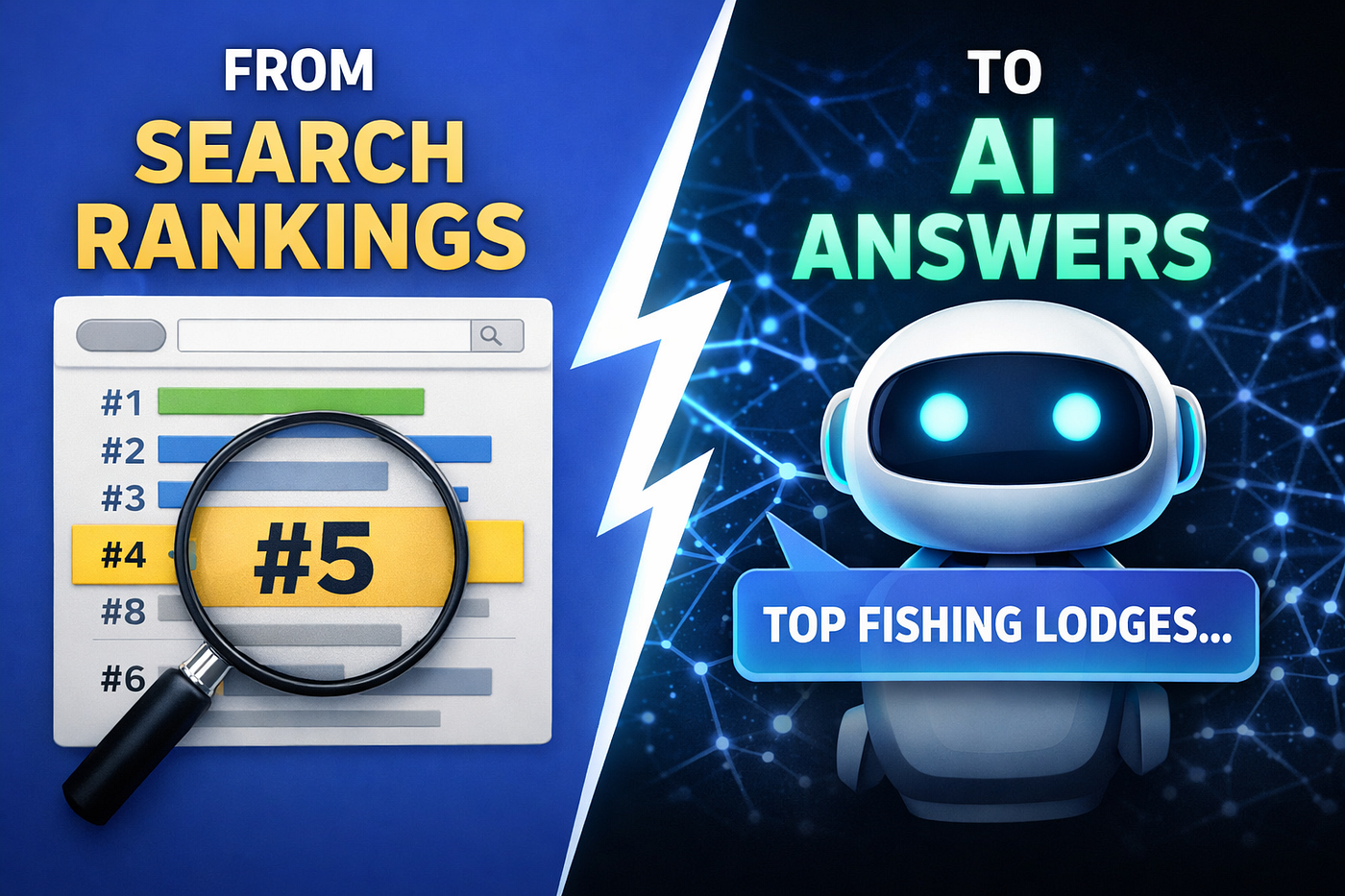
The New Front Door: AI-Mediated Discovery
Here is the development that makes the owned-asset case urgent rather than merely sensible.
⚠️ ️Between 2024 and 2026, the way people find places to stay changed at the root.
Travelers — especially the younger ones you want most — increasingly don’t open ten browser tabs and compare calendars.
They ask an assistant: “What fishing lodges in Northern Ontario have cabins for six available the third week of July?” and they expect a direct answer.
That creates a binary outcome with no middle ground:
Either your data is in the answer, or it isn’t. There is no page-two ranking to fall back on. The AI recommends you by name, or it recommends your competitor.

A beautiful website with stunning photography but no structured data is invisible to this process — its availability is trapped in colored cells that only a human with a browser can read.
A basic site running our plugin set is fully visible: your videos are fully indexed for AI Overview Citation, an AI assistant can check live availability through the Cabin Booking Calendar feed, confirm your ratings through Better Reviews, answer pre-trip questions from your Better FAQ data, and recommend you with accurate pricing — continuously, for free, without you buying a single ad.
Now place that beside the two forms of rented exposure:
- The sport show reaches a regional room for a weekend.
- Paid traffic reaches whoever you pay for, for as long as you pay.
- Structured, owned data reaches every AI assistant on the internet, for every relevant query, around the clock, at no marginal cost — and the advantage compounds. Once an assistant learns your lodge is a reliable source for “walleye fishing cabin availability near Sioux Lookout,” it tends to cite you again. Latecomers find that lead increasingly hard to close.
This is the new SEO, except it is not just about chasing keywords and backlinks. It is about owning structured data that AI systems consume and cite. The lodges that put this in place first own the recommendation layer for their region.
Side by Side: Where Does Each Dollar Go?

Where Does Each Marketing Dollar Go?
The pattern in the table is the whole argument.
The first two columns are the same deal in different clothing: pay, get attention, stop, return to zero. The third column is a different category of decision — an investment that keeps paying.
How the System Moves Your Four Numbers
Increase total bookings. Owned content earns search and AI discovery that runs all year; CBC’s automated journey converts more inquiries and recovers rebookings that manual follow-up loses; reviews close more of the decisions that reach your booking page.
Fill the shoulder season. Your live availability calendar makes open shoulder dates visible to every past guest and every AI query; the 30-day post-trip email surfaces them directly to people who just had a great trip; year-round content keeps demand from collapsing to a few peak weeks.
Reduce the average age of your clientele. Younger anglers discover lodges through AI assistants, search, and short-form video — exactly the channels structured data and the content program are built to win. A booth in a convention hall does not reach them where they look, when they are looking.
Increase group size. The pre-trip sequence asks group leaders to bring an extra person this year.
Increased Word of Mouth. The review ask is built into the post-trip email rather than left to chance. Online reviews are word of mouth that gets captured as your highest value asset instead of evaporating.
What You Own at the End of One Year
This is the cleanest way to see the difference.

Invest in content to build an audience you own or rent space?
After one annual cycle of the owned-asset system, you own:
➝ a library of 36-plus content assets still earning discovery, ➝ a verified email list receiving your story on autopilot, ➝ a structured data layer making you recommendable to every AI assistant, ➝ a curated and growing review collection closing decisions for you, ➝ an automated six-email guest journey producing rebookings without your involvement, and ➝ a content flywheel that is larger and more valuable than the day you started — equity that would transfer if you ever sold the lodge.
After a sport show, you own: a stack of business cards and a hotel receipt.
After a paid campaign, you own: a payment history.
One of these is a business asset. The other two are expenses that vanish on contact.
The owned-asset system does not ask you to spend more — it asks you to point the spending at something you keep.
Your Role, and What the System Handles
This is not a big technology learning burden, and it does not require you to spend more hours to manage it. The whole program is built on an annual plan to run inside roughly 20 hours per month of our work.
Your responsibilities focus on the human connection: answer the phone and take bookings, keep your availability calendar current, reply to comments, approve content before it posts, and forward the guest photos that become the year’s content.
Everything else — the scheduling, the posting, the email automation, the structured data, the content production — runs in the background.
The technology stays invisible so that your guests only ever feel the human connection — which is the one thing that was always worth paying for in the first place.
A Closing Thought
You already understand, better than any marketer, that a guest who feels taken care of before they arrive is worth multiples of one who books and hears nothing until check-in day. You know that the conversation at the dock matters more than the brochure.
The only question this strategy asks you to sit with is the first one:
When the dollar is spent, what do you still own?
A weekend of floor space and a hotel receipt? A faucet you have to keep paying to run? Or a portfolio of assets that recommends you, nurtures your guests, and fills your shoulder weeks while you are out on the water — and is worth more next year than it is today?
The dollars you have already set aside can buy either one. We would welcome a conversation about pointing them at the option you keep.

iFishCanada Agency Services for Tourism Marketing 👈

메타데이터
- post_id
- c1d0b7a7eb95
- slug
- the-one-question-that-reframes-your-marketing-budget-c1d0b7a7eb95
- url
- https://medium.com/ifishcanada/the-one-question-that-reframes-your-marketing-budget-c1d0b7a7eb95
- canonical_url
- https://medium.com/ifishcanada/the-one-question-that-reframes-your-marketing-budget-c1d0b7a7eb95
- author_url
- https://medium.com/@fishingguide
- status
- ok
- fetched_at
- 2026-06-22 19:40:15