India vs China Air Force Strength Comparison 2026: Which Air Force Holds the Advantage?
As military technology continues to evolve, the comparison between the Indian Air Force (IAF) and the People’s Liberation Army Air Force…
India vs China Air Force Strength Comparison 2026: Which Air Force Holds the Advantage?
As military technology continues to evolve, the comparison between the Indian Air Force (IAF) and the People’s Liberation Army Air Force (PLAAF) remains one of the most discussed defense topics in Asia. Both countries are investing heavily in modern aircraft, advanced missile systems, surveillance technology, and next-generation warfare capabilities. Understanding the India vs China Air Force Strength Comparison 2026 helps military observers, defense enthusiasts, and policymakers evaluate the balance of power in the region.
According to global military reports and defense analysts, China currently operates one of the largest air forces in the world, while India maintains one of the most experienced and combat-tested air forces. The question many people ask is simple: does a larger air force automatically mean a stronger air force?
In this detailed analysis by **Nexspire Journal**, we examine aircraft numbers, fighter jet capabilities, pilot training, air defense systems, strategic advantages, and future modernization plans to understand how these two air forces compare in 2026.
Overview of the Indian Air Force and Chinese Air Force
The Indian Air Force was established in 1932 and has participated in multiple wars and military operations. Over the decades, it has built a reputation for operational excellence and combat readiness.
China’s People’s Liberation Army Air Force was founded in 1949 and has undergone rapid modernization over the last two decades. Massive investments in indigenous aircraft development, artificial intelligence, and military technology have transformed it into a highly advanced force.
While China focuses heavily on expanding its military inventory, India emphasizes quality, strategic positioning, and operational experience.
Aircraft Fleet Comparison
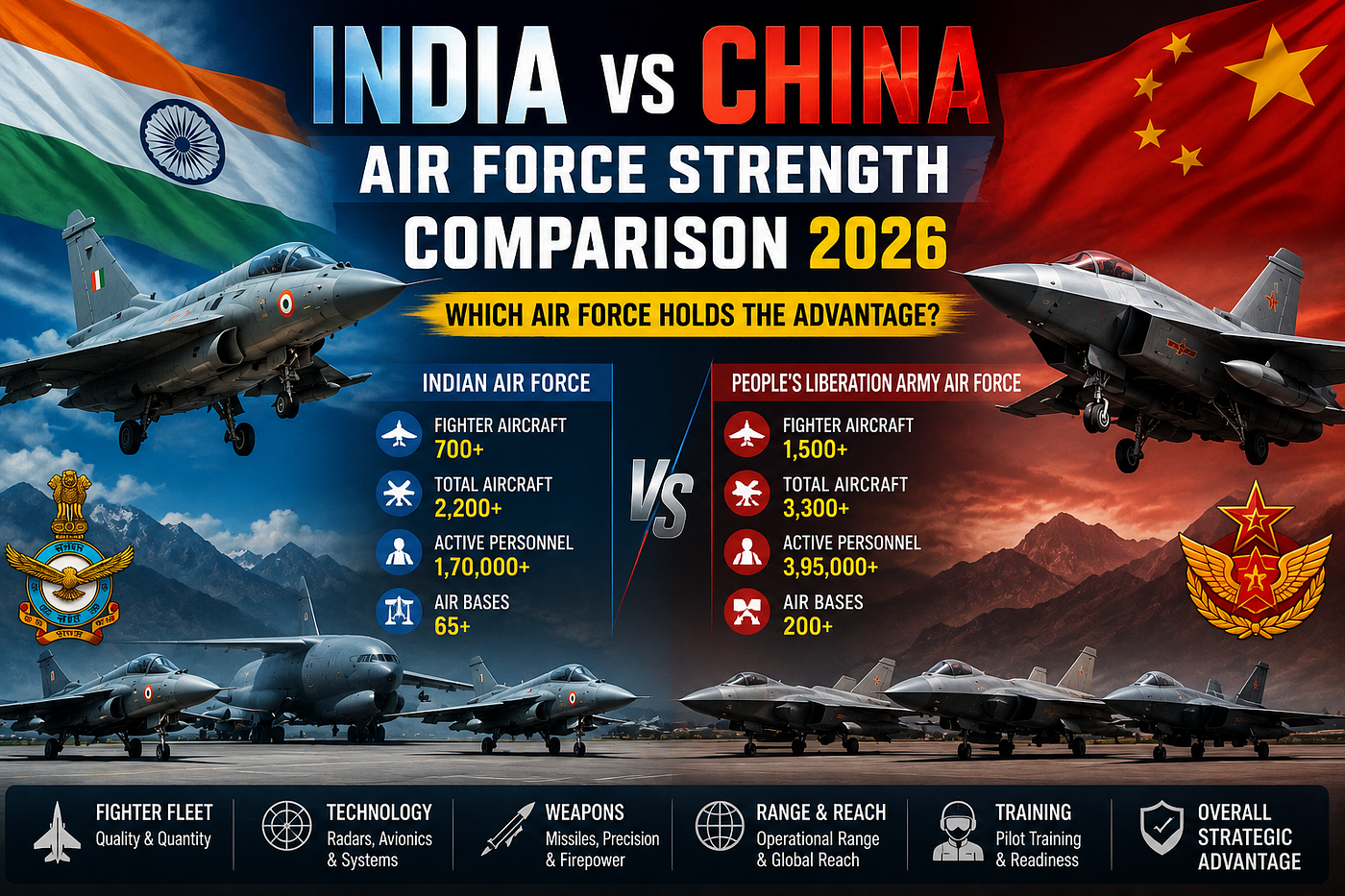
One of the most important factors in the India vs China Air Force Strength Comparison 2026 is the total number of aircraft.
China operates more than 3,000 military aircraft, making it one of the world’s largest air forces. This fleet includes fighters, bombers, transport aircraft, drones, and surveillance platforms.
India operates approximately 2,200 aircraft across different categories. Although the total number is lower, many of India’s aircraft are highly capable and supported by advanced weapons systems.
China clearly leads in terms of quantity, but military effectiveness depends on more than just numbers.
Fighter Jet Strength
Fighter aircraft form the backbone of any modern air force.
China’s major fighter fleet includes:
- J-20 Mighty Dragon stealth fighter
- J-16 multirole fighter
- J-10C fighter jet
- Su-35 fighter aircraft
The J-20 is particularly important because it is China’s fifth-generation stealth fighter designed to compete with advanced Western aircraft.
India’s frontline fighter fleet includes:
- Rafale fighter jets
- Su-30MKI aircraft
- Mirage 2000
- MiG-29
- Tejas Light Combat Aircraft
The Rafale remains one of the most advanced fighters in Asia due to its superior radar systems, electronic warfare capabilities, and long-range missile technology.
While China possesses more fighter aircraft overall, many defense experts consider India’s Rafale-equipped squadrons among the most capable combat units in the region.
Stealth Technology Comparison
Stealth aircraft play a crucial role in modern warfare because they are harder to detect by radar systems.
China currently operates the J-20 stealth fighter in significant numbers. It continues to improve the aircraft’s engine performance, sensors, and weapon systems.
India does not yet have an operational fifth-generation stealth fighter. However, the country is working on the Advanced Medium Combat Aircraft (AMCA), which is expected to become India’s first indigenous stealth fighter in the coming years.
In terms of current stealth capabilities, China holds a clear advantage.
Air Defense Systems
Modern air warfare is not only about fighter jets. Ground-based air defense systems are equally important.
India operates:
- S-400 Triumf air defense system
- Akash missile system
- Barak-8 missile defense system
The S-400 is considered one of the most advanced air defense systems in the world and can engage multiple aerial threats simultaneously.
China operates:
- HQ-9 air defense system
- HQ-22 missile system
- S-400 units acquired from Russia
Both nations possess advanced defensive networks capable of detecting and intercepting hostile aircraft and missiles.
Pilot Training and Combat Experience
A major factor often overlooked in military comparisons is pilot experience.
The Indian Air Force has extensive operational experience gained from conflicts, border tensions, counter-terror operations, and regular high-intensity exercises.
Indian pilots frequently participate in international military exercises with countries such as the United States, France, Australia, Japan, and the United Kingdom.
China has increased its training standards significantly, but it lacks the same level of recent combat experience compared to India.
Many defense analysts believe that combat-tested personnel provide India with an important advantage during real-world military situations.
Airborne Early Warning and Surveillance Systems
Airborne surveillance aircraft help detect threats long before they enter national airspace.
India operates:
- Netra AEW&C aircraft
- Phalcon AWACS systems
China operates:
- KJ-500 airborne early warning aircraft
- KJ-200 systems
China possesses a larger surveillance fleet, which improves battlefield awareness and command coordination.
However, India continues expanding its airborne warning capabilities to close the gap.
Drone and Unmanned Warfare Capabilities
The future of military aviation increasingly involves drones and autonomous systems.
China is among the world’s leading drone producers and operates a large fleet of reconnaissance and combat drones.
Chinese platforms include:
- Wing Loong drones
- CH-series drones
- Advanced AI-enabled unmanned systems
India has accelerated drone development and procurement through domestic manufacturing initiatives and international partnerships.
Although India is making progress, China currently enjoys a stronger position in unmanned aerial warfare.
Strategic Geographic Advantages
Geography plays a major role in military planning.
India’s air bases are strategically positioned across the Himalayan region and Indian Ocean areas. These locations provide flexibility in responding to regional threats.
China faces operational challenges when conducting air operations across mountainous terrain near the India-China border.
High-altitude environments often favor experienced pilots and specialized aircraft operations, areas where India has significant expertise.
Future Modernization Plans
Both countries continue investing billions of dollars into military modernization.
India’s future projects include:
- Advanced Medium Combat Aircraft (AMCA)
- Tejas Mk2 fighter jet
- Additional Rafale acquisitions
- Indigenous drone programs
- Advanced missile systems
China’s future projects include:
- Improved J-20 variants
- Sixth-generation fighter research
- Hypersonic weapon integration
- AI-powered combat systems
- Expanded drone fleets
These investments indicate that the air power competition between India and China will continue throughout the next decade.
Who Has the Stronger Air Force in 2026?
The answer depends on how strength is measured.
If the comparison focuses on aircraft numbers, stealth fighters, drone technology, and industrial production capacity, China currently holds an advantage.
If the focus shifts to pilot quality, combat experience, operational readiness, strategic positioning, and advanced multirole fighters like the Rafale, India remains highly competitive.
Most defense experts agree that China leads in quantity and technological scale, while India maintains strengths in operational expertise and strategic adaptability.
Conclusion
The India vs China Air Force Strength Comparison 2026 highlights a fascinating military rivalry between two of Asia’s most powerful nations. China possesses a larger fleet, more stealth aircraft, and stronger manufacturing capabilities. India counters with experienced pilots, advanced fighter platforms, strong air defense systems, and strategic geographic advantages.
As both nations continue investing in next-generation technologies, artificial intelligence, drones, and stealth aircraft, the balance of air power will continue to evolve. For now, neither side can be underestimated, making this one of the most closely watched military comparisons in the world.
메타데이터
- post_id
- c1d2e8bc7b99
- slug
- india-vs-china-air-force-strength-comparison-2026-which-air-force-holds-the-advantage-c1d2e8bc7b99
- url
- https://medium.com/@williammayaer123/india-vs-china-air-force-strength-comparison-2026-which-air-force-holds-the-advantage-c1d2e8bc7b99
- canonical_url
- https://medium.com/@williammayaer123/india-vs-china-air-force-strength-comparison-2026-which-air-force-holds-the-advantage-c1d2e8bc7b99
- author_url
- https://medium.com/@williammayaer123
- status
- ok
- fetched_at
- 2026-07-20 08:15:26