Ethereum’s Rollup Strategy Is Dead. Vitalik Just Said the Quiet Part Out Loud.
After years of betting everything on Layer 2s, Ethereum’s founder admits the plan failed. Here’s what actually happened.
Ethereum’s Rollup Strategy Is Dead. Vitalik Just Said the Quiet Part Out Loud.
After years of betting everything on Layer 2s, Ethereum’s founder admits the plan failed. Here’s what actually happened.
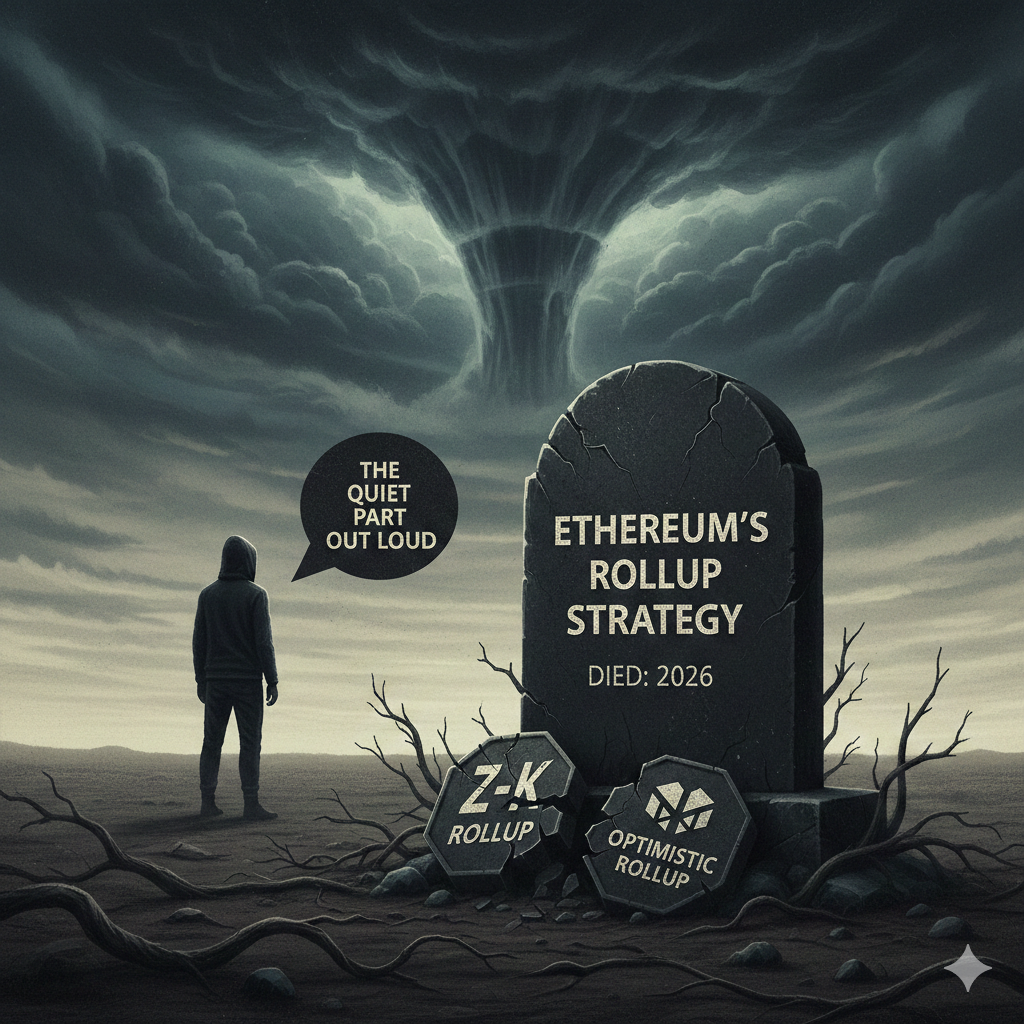
I had to read Vitalik Buterin’s post on X three times before the magnitude hit me. Ethereum’s founder just declared the network’s core scaling strategy obsolete. Not “needs refinement.” Obsolete.
“Both of these facts, for their own separate reasons, mean that the original vision of L2s and their role in Ethereum no longer makes sense, and we need a new path,” Buterin wrote Tuesday, according to The Block.
This marks a stunning reversal. Since 2020, the rollup-centric roadmap positioned Layer 2 networks as Ethereum’s salvation. The vision was elegant: Arbitrum, Optimism, Base, and others would become “branded shards,” handling millions of transactions while inheriting mainnet’s iron-clad security guarantees.
That vision collapsed on two fronts, and the data tells a brutal story.
The Decentralization Mirage
Layer 2 progress toward Stage 2 decentralization has been “far slower and more difficult than originally expected,” Buterin acknowledged. Translation: it basically didn’t happen.
Only three major rollups reached Stage 1 decentralization by 2025: Arbitrum, OP Mainnet, and Base, according to The Block’s 2026 Layer 2 Outlook. Stage 1 means “limited training wheels.” Most L2s remain stuck at Stage 0, where centralized operators can override transactions.
The market noticed. Monthly Layer 2 addresses fell from 58.4 million in mid-2025 to around 30 million by February 2026, according to TokenTerminal data cited by BeInCrypto. That’s a 50% collapse in user activity.
Buterin didn’t mince words about why. Some L2 operators explicitly told him “they may never want to go beyond stage 1, not just for technical reasons around ZK-EVM safety, but also because their customers’ regulatory needs require them to have ultimate control.”
Here’s where it gets uncomfortable. Those Layer 2s chose compliance over the trustless guarantees that made Ethereum valuable in the first place. They positioned themselves as Ethereum scaling while operating as centralized databases with Ethereum branding.
“If you create a 10000 TPS EVM where its connection to L1 is mediated by a multisig bridge, then you are not scaling Ethereum. This may be doing the right thing for your customers. But it should be obvious that if you are doing this, then you are not ‘scaling Ethereum’ in the sense meant by the rollup-centric roadmap.”, Vitalik Buterin, Ethereum Co-founder
Ethereum Layer 1 Won the Race It Wasn’t Supposed To
The second collapse point blindsided everyone. Ethereum’s base layer scaled without Layer 2s.
Following Pectra and Fusaka upgrades, fees dropped to sub-cent levels. Gas limits are projected to increase substantially in 2026, CoinDesk reported. The assumption that Layer 1 would be too expensive for most users turned out to be wrong.
PeerDAS and blob improvements expanded throughput directly on mainnet. Ethereum’s average transaction fee hovered around $0.44 as of August 2025, according to Medium analysis. Compare that to the $5 to $23 fees that drove users to Layer 2s in previous years.
The competitive pressure didn’t help. While Ethereum deliberated over rollup strategies, Solana processed transactions at $0.00025 per transaction, according to Chainspect data. The network maintained roughly 2,005 transactions per second in real-world conditions.
For the first time in Ethereum’s history, Solana attracted more new developers than Ethereum in 2025, BeInCrypto reported. That wasn’t a coincidence.
The New Framework: L2s as a Spectrum, Not Extensions
Buterin’s revised vision abandons the “branded shard” concept entirely. Instead, Layer 2s exist on a spectrum with varying degrees of Ethereum connection.
Some might prioritize privacy features. Others could focus on ultra-low latency or application-specific efficiency. The critical change: transparency about what guarantees they actually provide.
“We should stop thinking about L2s as literally being ‘branded shards’ of Ethereum, with the social status and responsibilities that this entails,” Buterin wrote.
What would he do if building an L2 today? Three priorities:
- Identify value beyond “scaling”: Privacy-focused VMs, application-specific efficiency, truly extreme throughput that even expanded Layer 1 won’t handle, non-financial use cases like social/identity/AI, ultra-low-latency sequencing, or built-in oracles and dispute resolution
- Reach Stage 1 minimum: Otherwise you’re just a separate Layer 1 with a bridge
- Support maximum interoperability with Ethereum, even for non-EVM chains
The Technical Path Forward: Native Rollup Precompiles
This is where things get interesting. Buterin has “become more convinced of the value of the native rollup precompile, particularly once we have enshrined ZK-EVM proofs that we need anyway to scale L1.”
A native rollup precompile verifies ZK-EVM proofs directly on Ethereum’s base layer. Two critical properties make it powerful:
- Auto-upgrades with Ethereum: No separate maintenance burden
- Hard-fork protection: If the precompile has a bug, Ethereum hard-forks to fix it
The design enables something called synchronous composability. Different Layer 2s could interact with each other and Layer 1 in real-time, eliminating delays and unreliable bridges, according to ForkLog.
Buterin referenced hybrid rollup designs that combine based rollups with low-latency sequencing. Sequencers handle fast blocks most of the time, then near the end of a slot, allow anyone to build a based block that gets included on Layer 1.
The result: Layer 2s keep fast execution while still allowing blocks that compose directly with Ethereum. If a Layer 1 block reverts, the Layer 2 reverts too.
The Market Already Voted
The industry response split along predictable lines. Declan Fox of Linea Build, a ConsenSys-affiliated L2, backed Buterin’s direction, CCN reported.
But markets speak louder. Top Layer 2 tokens declined 15% to 30% in January 2026, based on CoinGecko data cited by BeInCrypto. The sector’s total market capitalization stands at $7.95 billion as of February 4, 2026.
Layer 2 total value locked reached $47 billion by October 2025, up from under $4 billion in 2023, according to Yellow.com. That’s real capital at stake.
“L2s are no longer being positioned as mandatory extensions of L1, but as optional, differentiated environments with explicit tradeoffs. That’s a healthy shift. Ethereum L1 scaling buys the ecosystem breathing room and forces L2s to earn their place by building something genuinely new.”, *William M. Peaster, **Senior Writer at Bankless***
What This Actually Means
Here’s what I think happens next. Layer 2s face a binary choice: genuinely decentralize or drop the pretense.
The middle ground where teams claim Ethereum’s security while operating centralized systems is becoming untenable. Users aren’t stupid. When Ethereum Layer 1 offers comparable fees with superior security, why take counterparty risk on a multisig-controlled bridge?
Base generates significantly higher daily transaction volume than Arbitrum, processing over 50 million monthly transactions compared to Arbitrum’s 40 million, according to LeveX analysis. But Base’s sequencer is operated by Coinbase, introducing centralization that crypto purists find uncomfortable.
That tension won’t resolve itself. Either Coinbase genuinely decentralizes Base’s sequencer, or Base becomes what it functionally already is: a Coinbase-operated side-chain with Ethereum settlement.
The rollup-centric roadmap didn’t fail because rollups are bad technology. It failed because it required coordination and sacrifice that market forces didn’t incentivize. Building a truly trustless rollup is harder and less profitable than building a fast centralized chain with Ethereum branding.
The Ethereum Foundation Context Matters
This announcement didn’t happen in a vacuum. The Ethereum Foundation underwent major leadership restructuring throughout 2025. The nonprofit appointed Hsiao-Wei Wang and Tomasz Stańczak as co-executive directors in March 2025, CoinDesk reported.
The shake-up came after intense community criticism about Ethereum’s direction. In June 2025, the Foundation restructured its R&D team to focus on three priorities: scaling the base layer, expanding blobspace, and improving user experience, according to CoinDesk. The organization laid off some research staff as part of this refocus.
Buterin’s post reflects this return to first principles. Instead of asking how to scale Ethereum through external systems, the question becomes how to scale Ethereum itself while maintaining credible neutrality, censorship resistance, and trustless execution.
What I’m Watching
The native rollup precompile could change everything. If Ethereum enshrines ZK-EVM verification at the base layer, suddenly every Layer 2 can access trustless verification without maintaining separate proving infrastructure.
That enables genuine interoperability. Not the bridge-heavy, trust-minimized-in-theory-but-not-practice interoperability we have today. Actual synchronous composability where Layer 1 and Layer 2 transactions can interact in the same block.
The winners in this new framework won’t be the loudest “Ethereum alignment” cheerleaders. They’ll be the ones offering clear guarantees and compelling specializations. Privacy chains that actually deliver privacy. Application-specific chains optimized for their use case. Ultra-fast chains that genuinely need throughput beyond what even scaled Layer 1 provides.
Buterin’s acknowledgment doesn’t solve the problems. But it creates space for honest conversation about them. And in an industry that often prizes narrative over reality, that honesty matters.
The rollup-centric roadmap is dead. What emerges from its ashes will determine whether Ethereum maintains dominance or becomes a cautionary tale about letting perfect be the enemy of good.
Sources:
- *The Block: “Vitalik Buterin reevaluates Ethereum’s rollup-centric roadmap”, February 3, 2026*
- *CoinDesk: “You are not scaling Ethereum: Vitalik Buterin issues a blunt reality check”, February 3, 2026*
- *BeInCrypto: “Vitalik Buterin Urges New Approach as Ethereum Layer 2 Usage Drops by 50%”, February 4, 2026*
- *Bankless: “Vitalik Reframes Ethereum’s L2 Narrative”, February 3, 2026*
- *Ethereum Research: “Synchronous Composability Between Rollups via Realtime Proving”, February 1, 2026*
About the author: ZkMarc is a blockchain engineer with 7+ years in DeFi protocols and infrastructure. Currently exploring ZK tech, L2 vaults, and cross-chain analytics. Always building.
메타데이터
- post_id
- c1d2f4a3efd4
- slug
- ethereums-rollup-strategy-is-dead-vitalik-just-said-the-quiet-part-out-loud-c1d2f4a3efd4
- url
- https://coinsbench.com/ethereums-rollup-strategy-is-dead-vitalik-just-said-the-quiet-part-out-loud-c1d2f4a3efd4
- canonical_url
- https://coinsbench.com/ethereums-rollup-strategy-is-dead-vitalik-just-said-the-quiet-part-out-loud-c1d2f4a3efd4
- author_url
- https://medium.com/@zkMarc
- status
- ok
- fetched_at
- 2026-07-13 06:23:13