Crossing the Rubicon
Why does it matter what the land or people were like before now? Because firstly, we forget what things looked like so, so quickly, and…
Crossing the Rubicon
Photo by Szymon Michalczyk on Unsplash
Why does it matter what the land or people were like before now? Because firstly, we forget what things looked like so, so quickly, and this is like forgetting what a face looks like before it’s bloody, bruised and bleeding. It’s important to recall what health looks like. Secondly, we all know the old adage about failing to learn from history. How societies evolved is taken as a given: it’s conquest all the way. But that’s simply not the way it was, or has to be. There have been many, many societies in which people have met, and learned and lived with incomers without the old guard being annihilated. In fact, annihilation is the exception. The same is true of ideas. A new idea, like Galileo’s about the earth circling the sun, needn’t mean sun worship dies. In fact, sun salutations are my go to way to greet the day. However, Lanzarote provokes many questions on this front. Not least because the moon goddess, Tanit, is their most celebrated goddess. Note: goddess, not god. And that implies that the Phoenicians, the pioneers when it came to exploration of the seas, were here. Is it believable that the local people had no means or expertise in the art of seafaring, given their early contact with and possible colonisation by this tribe of ocean-faring expertise?
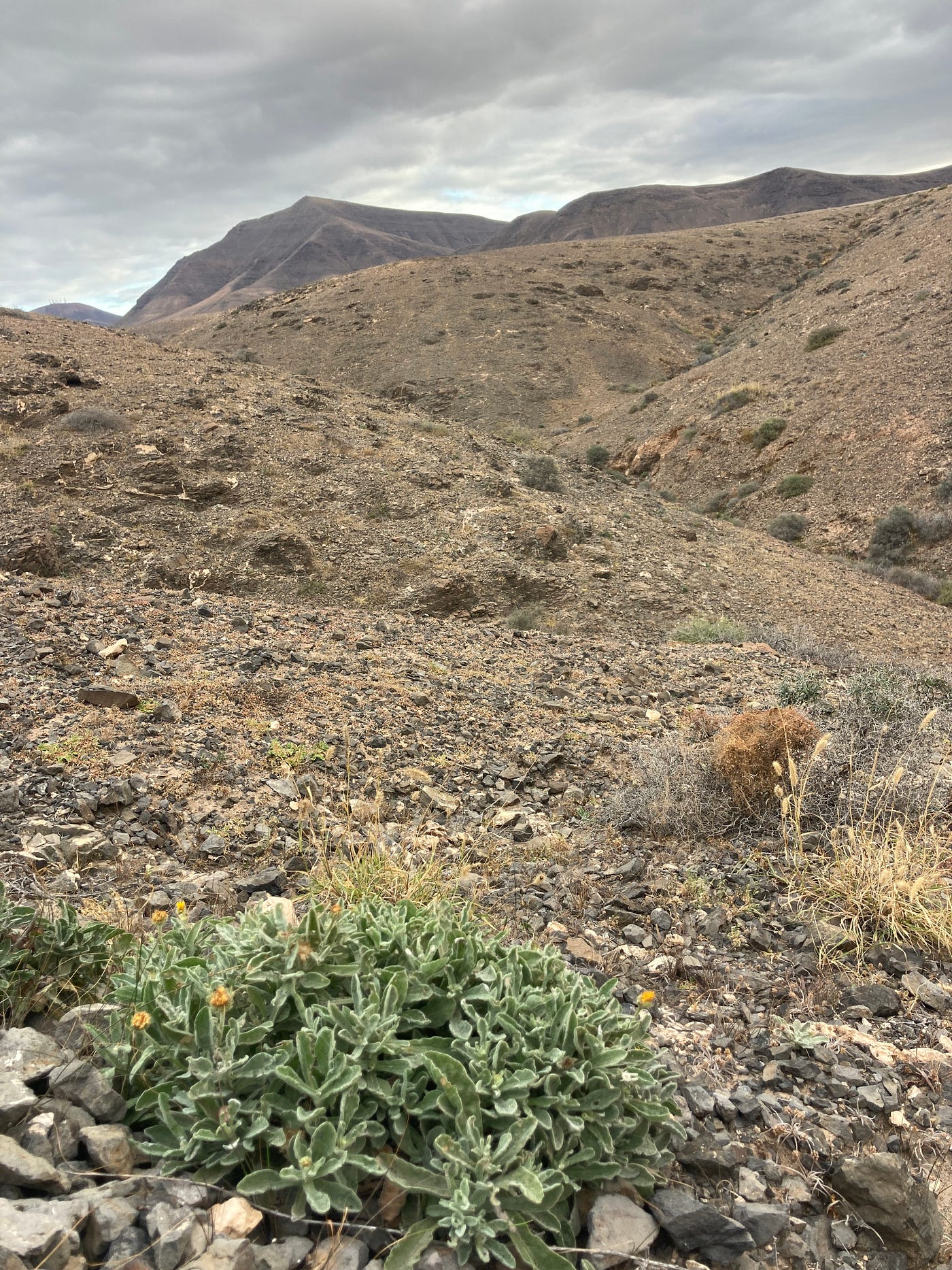
Not dead yet. Not much life though (Photo: Author)
As I walk around Playa Blanca, I am confounded by how little record there is of the early human or even pre-human history of the place. There is a castle on the walkway towards Papagayo, called Castillo de Colorado, which was built at one end of the fifteenth century city apparently founded because the aboriginal people — some say Guanches, I have heard it’s more correct to call them Mahos, or Majos, because that is the name they called themselves — told the soon-to-be conquistadors that there was a well and therefore fresh water here. I look into the well. The water is stagnant, green edged, but evident. A real rarity on this island of fire and rock.
This morning, (on the advice of my mother in Scotland, who is very keen on observing celestial objects), I was up before dawn to look for the #greencomet but the sky was a kaleidoscope of clouds and rainbows between showers. I ran along the walkway, up the steep path, and then over the lumps of igneous rock like the musculature of an ancient beast until I came to Papagayo. There are four square structures, covered in rusting iron grids, beneath which are rotting white plasterboard. It is impossible to see what is being preserved and the signs that once described the site are rotted, the remaining pieces lying on the sand. I bent to read one. 1402. A well. That is what brought the invaders here, to this place. There was fresh water. More, this was a veritable garden of Eden:
All the islands abound in apples and in birds of every kind, and in palms covered with dates, and in the pine nut. There is also plenty of honey. The papyrus grows there, and the Silurus fish is found in the rivers.
(See Pliny, Nat. Hist., lib. 6, cap. 37.)

The path to the Rubicon, a city built by Betancourt to cement the domination by the conquerors of the island. Not much remains.
Already, though, by the time Betancourt and his wily crew arrived, water was precious and perhaps the rivers described by Pliny had already begun to dry up. The laurisilva forest familiar to those who have visited La Gomera or Tenerife is only posited here but probably existed in the north, providing the “cloud forest” (the phenomenon of tree growth creating moisture, meeting moisture from the clouds, making mist, then fog, then rain) that fed said rivers. Improbable as it may seem, these cloud forests undoubtedly existed at least until the fifteen century in Fuerteventure, the island immediately to the south (and easily visible from here). There the record shows the last trees were cut down to build ships to send to other lands to plunder them.
What can we make of all this, given where we are today, at the cusp of various extinctions and the potential for our own catastrophic demise, at least in the shape and numbers we’ve grown accustomed to. I stand quiet by the place, the Rubicon, it’s called, this erstwhile city, now just four covered excavations, and even those largely neglected. Here where the last indigenous king was betrayed, first by Betancourt and then by his own clansman.
This isn’t really a history lesson (though to fill in the basics, Betancourt agreed a deal with the king which he then reneged on, and during the ensuing rucus, the king’s kinsman did a deal with Betancourt which was supposed to result in the former’s escalation to power. It gets complicated. There were betrayals and counter betrayals and the traitor got his comeuppance but by then the kingdom of the Mahos had disintegrated, and the king secured his own position at the expense of his people). It’s an enquiry into how things could be. What can we learn from history so we understand how to step back from the rubicon, or stop wading through the river of blood and ecological destruction, and recover sanity and understanding instead?

Wasteland. A common occurence in Lanzarote’s built up areas, a mix of corruption, poor planning, and the heartening determination of people to carve a path. Note the pine tree. Rare, here, but once indigenous. This one’s been chopped and deprived, and yet it lives. And yet it lives.
AI is interesting. There’s lots of advice on how to end the Ukraine-Russia conflict from ChatGPT. All of it, with some provisos, advises negotiation, and peace talks. While robust defence is accepted in the face of the unrealistic demands of an invading force, the overarching trajectory of any conflict must be towards an acceptance of some rules of negotiation that agree betrayal is the ultimate taboo.
The little and big betrayals we still endure weaken us. In spite of this, however corrupt a system, the rules keep nagging for attention. Even Putin recognises the need to appeal to people’s sense of what is right. Betancourt brought priests to legitimise his torture. But the fundamental purpose of the priesthood was to embody the message of compassion. The fundamental message of Putin’s propoganda is to chime with pride in a society that represents humanity’s highest values: stoicism, solidarity, artistic endeavour. Nowhere, sadly, is it written in the code of either the invader or the invaded that the substrate, the people and the ecosystems on which all these grand designs are implicitly written, be honoured, protected and respected in their own right. In that, we are no different from those invading forces of old. We have learnt nothing.

The struggle for life against all the odds. A feature of Lanzarote. It would take so little to nurture this.
What if we could rewild Lanzarote? There is talk of a shift in strategy among the powers that be here from a generalised exploitation of both place and people hungry for a break in the sun and for escapism in the form of rivers of drink, and clouds of marajuana, and sex, and sea, and sand and country music and dolphins and sealions kept in the plastic moulded bowls of aquariums, painted a blue to echo that of the surrounding seas, and cajoled into standing on one fin, or barking on command. To a more sophisticated form of tourism which will attract the ‘silver dollar’ of the retired and relatively wealthy. The demographic in the west is shifting and this cohort wants to have its day in the sun before the light fades entirely. Less sex, then, and more music, but with ample comfortable seating, and perhaps with waymarked, easily accessible pathways that allow older bones to explore. Bridge nights and museums, wine tasting and golf.

Human dissent will manifest itself. A good thing, too.
There is an opportunity here for a revisioning of what was, and what could be. The biggest hotel ever to be envisioned is being constructed here in Lanzarote. Like the final push of a wave before the tide ebbs, this represents (I hope) a last gasp of the old guard. It may be beautiful to some but there is no doubt that it will be monstrously big and the legality on which so many hotels here have been built lies in a legal tangle on the floor of the offices of the local political entitites. Nevertheless, it’s also possible that there’s a new guard moving in. I’ve seen more evidence this year than ever before of ecologists holding politicians to account. The Biosfera, the UN designation which attracts millions of euro in funding to the protection and research of the Timanfaya Volcanic Nature Reserve, which is around a third of the island, is under threat, but there is a strong backlash to preserve it, not only for the money, but because of the extraordinary potential it has to enhance our understanding of how, exactly, life recolonises a place that has been reduced to rock.

Here, in the caldera of Montana Roja, people have used stones to spell their names and particularly to link their names with someone they love. But in a small circular space is a persistent burst of greenery, defying all the odds, even more unlikely than love itself. Will we recognise the importance of this?
There are implications for so many places in this research but ultimately, it is a symbol of resilience, and as such, if for no other reason (and there are so many) it needs to be preserved. The birds and animals — the Egyptian Vulture (once called by the Brits ‘the shit bird’ because it was believed to live off cow dung), the Barbary Partridge (which I have seen whirling up from barrancos like ancient dervishes disturbed at their worship), the Famara Daisy, the lizards which are like ancient peoples, like the fairy folk of Ireland, reduced to tiny versions of themselves while they await the inevitable turning of the tides.

Papagayo in the distance. The line of mountains is the route from Yaiza that the Mahos took to meet Betancourt, and to be betrayed
메타데이터
- post_id
- c1e431d3cc9d
- slug
- crossing-the-rubicon-c1e431d3cc9d
- url
- https://medium.com/@lucyweirphd/crossing-the-rubicon-c1e431d3cc9d
- canonical_url
- https://medium.com/@lucyweirphd/crossing-the-rubicon-c1e431d3cc9d
- author_url
- https://medium.com/@lucyweirphd
- status
- ok
- fetched_at
- 2026-08-17 16:57:40