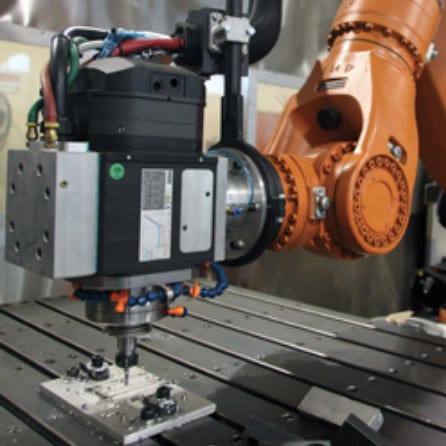
In Robotic Milling, the Problem Is Often Not the Robot — It’s the Tool Holder
Why runout and balance define machining quality.
In Robotic Milling, the Problem Is Often Not the Robot — It’s the Tool Holder
Why runout and balance define machining quality.

Robotic-HiTech Solutions
When vibration appears during robotic milling, many teams adjust feed rates or question robot rigidity.
But sometimes the issue is simpler — and closer to the cutting edge.
In high-speed applications, the spindle, tool holder, and cutter behave as a single rotating system. If that system is poorly balanced or shows excessive runout, instability increases quickly — especially in aluminum finishing or composite trimming.
HSK interfaces are often preferred for high-speed robotic setups due to improved rigidity and repeatability. But regardless of interface type, runout control is essential. Even small deviations can affect surface quality and tool life.
Balancing is equally important. At 20,000 rpm, a minor imbalance generates a significant centrifugal force. That force translates directly into vibration.
Robotic milling performance is cumulative. Stability at the spindle interface reduces the load on the robot and improves overall predictability.
Before blaming the arm, inspect the rotation.
FAQ’s
1. Why is the tool holder critical in robotic milling? Because it directly affects stability, precision, and vibration control. A poor-quality holder can compromise accuracy even if the robot itself is highly capable.
2. What are the most common issues caused by tool holders? Runout, vibration, poor clamping force, and thermal expansion are frequent problems that reduce machining quality.
3. How does tool holder selection impact productivity? The right holder minimizes downtime, improves surface finish, and extends tool life, leading to higher throughput and lower costs.
4. Are high-performance tool holders always necessary? Not always. The choice depends on the material, milling depth, and tolerance requirements. For demanding applications, premium holders are essential.
5. What maintenance practices extend tool holder life? Regular cleaning, inspection for wear, balancing checks, and proper torque application during clamping help maintain performance.
Checklist
✓ Verify tool holder compatibility with the spindle and the robot arm. ✓Check runout and balance before operation. ✓ Inspect the clamping mechanism for wear or damage. ✓ Apply correct torque when securing tools. ✓ Schedule routine maintenance and replacement cycles.
Robotic-HiTech Solutions does not simply sell technology: it drives a new way of understanding manufacturing, where industrial precision meets creativity. Its work reflects the future of automation: robots capable of producing, sculpting, building, and expanding the limits of what is possible.
메타데이터
- post_id
- c1fc2dd8f3b9
- slug
- in-robotic-milling-the-problem-is-often-not-the-robot-its-the-tool-holder-c1fc2dd8f3b9
- url
- https://medium.com/@robotichitechsolutions/in-robotic-milling-the-problem-is-often-not-the-robot-its-the-tool-holder-c1fc2dd8f3b9
- canonical_url
- https://medium.com/@robotichitechsolutions/in-robotic-milling-the-problem-is-often-not-the-robot-its-the-tool-holder-c1fc2dd8f3b9
- author_url
- https://medium.com/@robotichitechsolutions
- status
- ok
- fetched_at
- 2026-07-07 05:53:12