What If AI Investigated: The Naming — The Day Joseph Valachi Said the Words
On September 25, 1963, Joseph Valachi sat before the McClellan Committee in Washington and said the words out loud. He called it Cosa…
What If AI Investigated: The Naming — The Day Joseph Valachi Said the Words
On September 25, 1963, Joseph Valachi sat before the McClellan Committee in Washington and said the words out loud. He called it Cosa Nostra. He described the initiation ritual, the hierarchy, the oath of omertà he had taken. It was the first time a made member had named the organisation from the inside, in public, on national television.
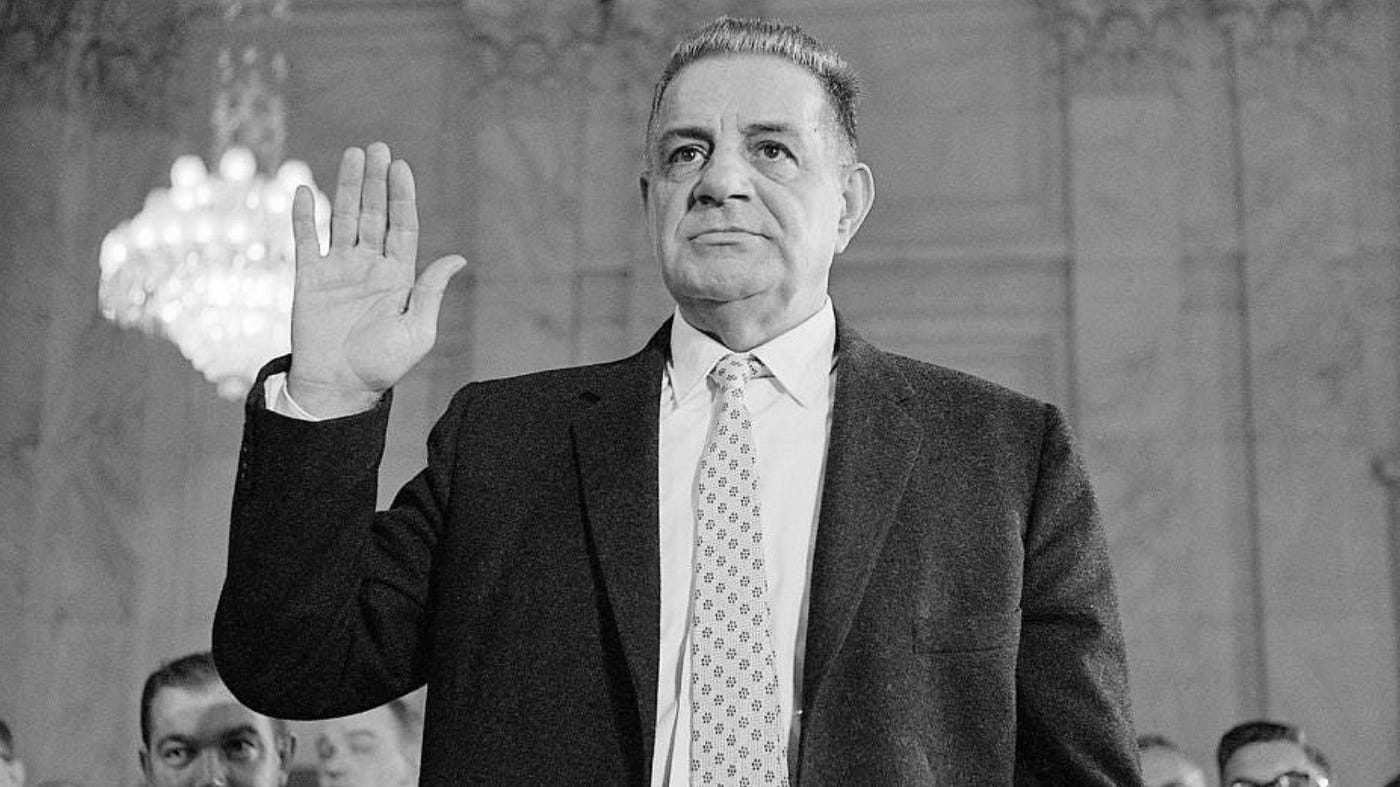
Mafioso Joseph Valachi is sworn in at the Senate Permanent Subcommittee on Investigations (McClellan Committee) on September 27, 1963. As a soldier in the Genovese crime family, Valachi made history as the first made member of the American Mafia to break the code of silence (Omertà) and publicly acknowledge the existence of the Cosa Nostra. Image: Wikimedia
Part of the What If AI Investigated series. The methodology is consistent across every piece: evidence first, documented sources and conclusions the record actually supports.
The Power of the Name
The Kefauver Committee hearings of 1950–51 had put organised crime on television. Senators questioned mob figures. The existence of a national criminal network was documented in the public record. Americans watched Costello’s hands when he refused to let his face be shown on camera.
Apalachin in November 1957 had placed sixty of the national organisation’s most senior figures in a rural New York farmhouse and produced photographs that the denial of the network’s existence could not accommodate.
But neither event had produced an insider naming the organisation from within. The Kefauver witnesses were senior figures who could plead the Fifth or maintain the fiction of their isolation. The Apalachin attendees were photographed and identified but none of them explained what they had been doing there or what the organisation was that they belonged to.
Joseph Valachi changed the specific nature of the public record on September 25, 1963. He was a made member, formally inducted, oath-sworn, an insider by the organisation’s own definition. He named it. He described it. He explained its internal structure in the language the organisation used internally.
The naming is the piece’s subject. Not what Valachi knew, he was a low-level soldier whose operational knowledge had limits, but what the act of naming did to the organisation’s relationship with official knowledge.
For thirty years, J. Edgar Hoover’s FBI had officially maintained that no national criminal organisation existed as a coordinated structure. After September 25, 1963, that position was not merely factually false, it had been publicly contradicted by a sworn witness on national television.
Who Valachi Was
Joseph Michael Valachi was born in East Harlem in 1904. He rose through petty crime to become a made member of the Genovese family’s operations in New York. He was never a boss, never a capo with significant independent authority. He was a soldier, a street-level earner and enforcer who knew the organisation from its operational floor rather than from its governance structure.
This is the first analytical point the piece requires: Valachi’s specific position within the organisation determined both what he knew and what he didn’t know. He knew the initiation ritual because he had undergone it. He knew the internal naming conventions because they were the language of his daily operational life. He knew the hierarchy because he occupied a defined position within it.
What he didn’t know, because a soldier was not supposed to know, and because the compartmentalisation of criminal organisations is designed to prevent exactly this kind of upward knowledge transmission, was the senior decision making structure. He could describe the Commission’s existence because every made member knew the Commission existed. He could not describe how it made decisions, what specific authority it exercised in specific cases or the specific figures who exercised authority within it.
The distinction between Valachi’s taxonomic testimony and Tommaso Buscetta’s structural testimony twenty years later defines exactly this gap. Valachi gave law enforcement the map: here is what the organisation is called, here is how you join it, here is how it is structured and here is the language it uses internally. Buscetta gave law enforcement the territory: here is how the cupola made decisions, here is how authority flowed and here is what the governance structure actually did and how it actually functioned.
Valachi’s map made Buscetta’s territory legible. Neither was sufficient alone.

Valachi believed Genovese had ordered him killed. The calculation from that position produced a specific outcome for the organisation. All images generated by author unless stated
Why He Talked
Valachi was serving a fifteen-year sentence for narcotics offences in the Federal Penitentiary in Atlanta. While incarcerated, he became convinced, through what he interpreted as signals from the organisation and from Genovese himself, who was also incarcerated there, that Vito Genovese had marked him for death.
The specific grievance: Genovese suspected Valachi of being an FBI informant. The suspicion may or may not have been accurate at that point, Valachi later became exactly what Genovese suspected him of being but the causal chain is circular. The assassination order that Valachi believed had been issued produced the events that made him an informant.
In June 1962, Valachi killed a fellow prisoner he believed was his assassin. The man he killed, Joseph Saupp, was, according to subsequent investigation, not connected to any assassination plot against Valachi. Valachi had killed the wrong man. Facing a possible death sentence for the prison killing, with Genovese’s organisation apparently hostile and the federal government in possession of leverage, he calculated that cooperation was the only available exit from his position.
The calculation was specific: federal prosecutors, working with the Justice Department under Robert Kennedy, offered Valachi protection and a degree of cooperation credit in exchange for his testimony. The calculation was not cooperation because he had moral convictions about the organisation he had served. It was cooperation because the alternative appeared to be either execution by the state for the prison killing or murder by the organisation for being a suspected informant.
He had violated omertà by speaking to investigators. Once that step was taken, the question became how far to go. He went to the Senate.
September 25, 1963 — The Words
The McClellan Committee, formally the Senate Permanent Subcommittee on Investigations, chaired by Senator John McClellan, had been investigating organised crime since the late 1950s. Robert Kennedy had served as its Chief Counsel. Its previous investigations had produced documentation of the Teamsters’ mob connections and had made Hoffa a household name.
Valachi’s appearance on September 25, 1963, was a different category of testimony. He was not an outside observer or an investigator or a former law enforcement official. He was a member.
He said the organisation was called Cosa Nostra, Our Thing. He described the initiation ritual: the burning of the saint’s card, the oath, the pricking of the finger, the blood, the formal declaration of membership in the organisation with its obligations and its penalties. He described the hierarchy: boss, underboss, consigliere, capo and soldier. He described the Commission and its role in governing relationships between the families. He named the families.
The Senate chamber, the television cameras, the national audience, all of it received the same account that had previously existed only within the organisation’s own internal communication.
The organisation’s response to Valachi’s testimony demonstrates what the testimony cost it. Organised crime figures across the country publicly denied everything he said. Some questioned his specific account of specific events. None of them could un-name what he had named. The words were in the public record. The Senate testimony was published. The organisation had a name that was now official.
What Valachi Gave
The specific analytical value of Valachi’s testimony is best understood by comparing it to what had existed before it and what came after it.
Before Valachi: law enforcement had investigative knowledge of individual criminal figures and their specific activities. It had the Kefauver documentation of the network’s existence. It had the Apalachin attendance list. It had the accumulated intelligence of FBI and local law enforcement surveillance.
What it did not have was the internal vocabulary. The specific names for things, what the organisation called itself, what it called its hierarchy and what the formal structure was as the organisation understood it from inside. Without that vocabulary, prosecution of the organisation as an institution was more difficult because the institutional structure itself had no agreed public definition.
Valachi provided the vocabulary. After his testimony, federal investigators and prosecutors had a common internal language for the organisation they were investigating. The structure had a name. The roles had names. The governing body had a name. The naming made the organisation legible in the specific way that institutions become legible when their internal structure is documented and shared.
What Valachi did not give was the governance intelligence that Buscetta would provide in 1984: how decisions were actually made, how authority was actually exercised, what the Commission’s actual functioning looked like from the perspective of someone who had observed it operating. Valachi’s knowledge of the Commission was the knowledge of a soldier, he knew it existed and what it was called. Buscetta’s knowledge was the knowledge of a senior figure who had participated in the relationships it governed.
The Valachi testimony made the Buscetta testimony interpretable. The map made the territory legible.

After September 25, 1963, Cosa Nostra was in the official record. The organisation had a name that the state had heard, under oath, from the inside.
The Institutional Impact
Hoover’s response to Valachi’s testimony was the most telling institutional consequence of the naming.
Hoover had maintained the FBI’s official denial of the national crime syndicate for thirty years. Apalachin had made that denial publicly indefensible in 1957, producing the Top Hoodlum Programme as a managed response that acknowledged organised crime’s existence without fully confronting the implications of the denial’s prior history.
Valachi’s testimony removed the last available position. A sworn witness before the United States Senate had named the organisation, described its structure and confirmed its national scope. The FBI could not simultaneously investigate Cosa Nostra and maintain that Cosa Nostra did not exist as a national organisation. The two positions were now formally irreconcilable in the public record.
The FBI adopted Valachi’s terminology. Cosa Nostra became the official federal designation for the organisation. The Top Hoodlum files were reorganised. The La Cosa Nostra designation entered federal law enforcement’s official vocabulary.
The Interference Thesis the database applies throughout notes that institutional responses to unwelcome evidence reveal the institution’s priorities. Hoover’s response to Valachi, adopting the testimony’s terminology while continuing to avoid the specific investigative consequences that full acknowledgment of the testimony’s implications would require, is consistent with the pattern documented across the Hoover piece and the Apalachin piece in this series.
The naming was acknowledged. The full institutional response the naming logically required was deferred.
The Verdict
Valachi died in federal custody in 1971. He had been in protective custody since his cooperation began. He never returned to the streets.
The testimony he gave on September 25, 1963, remained in the public record. The name he spoke became the official name. The vocabulary he provided became the investigative vocabulary. The structure he described became the structure that subsequent investigation mapped, prosecuted and dismantled.
He was not a hero of this story. He was a low-level criminal who cooperated with federal investigators to escape a situation he had helped create. What he gave was tactical, a map without the territory’s full dimensions, rather than strategic.
But the map mattered. The naming mattered. The specific act of a made member sitting before the United States Senate and saying the words that the organisation existed specifically to prevent anyone from saying, in public, under oath, on national television, changed what was officially known about one of the most powerful criminal organisations in American history.
Cosa Nostra. Our Thing. Said out loud. September 25, 1963.
The thing had a name. The name was now everywhere. And the organisation that had spent three decades as an open secret in which the government officially participated in the secret was suddenly in the position of being named by its own member in its own language in the chamber of the United States Senate.
Two months later, Kennedy was killed in Dallas. The McClellan Committee investigation continued. The Top Hoodlum Programme continued. The FBI adopted the terminology. The naming was complete.
The territory, the governance structure, the financial architecture, the Commission’s actual functioning, would take another twenty three years, and Buscetta’s structural testimony, and RICO applied to the Commission itself, before the law caught up with what the map described.
Part of the What If AI Investigated series. Sources: Maas, P., The Valachi Papers (1968); McClellan Committee transcript, Senate Permanent Subcommittee on Investigations (September 1963); Raab, S., Five Families (2005); Reppetto, T., American Mafia: A History of Its Rise to Power (2004).
메타데이터
- post_id
- c1ffe482f5ef
- slug
- what-if-ai-investigated-the-naming-the-day-joseph-valachi-said-the-words-c1ffe482f5ef
- url
- https://medium.com/what-if-ai-investigated/what-if-ai-investigated-the-naming-the-day-joseph-valachi-said-the-words-c1ffe482f5ef
- canonical_url
- https://medium.com/what-if-ai-investigated/what-if-ai-investigated-the-naming-the-day-joseph-valachi-said-the-words-c1ffe482f5ef
- author_url
- https://medium.com/@jamie_gray027
- status
- ok
- fetched_at
- 2026-06-13 12:55:53