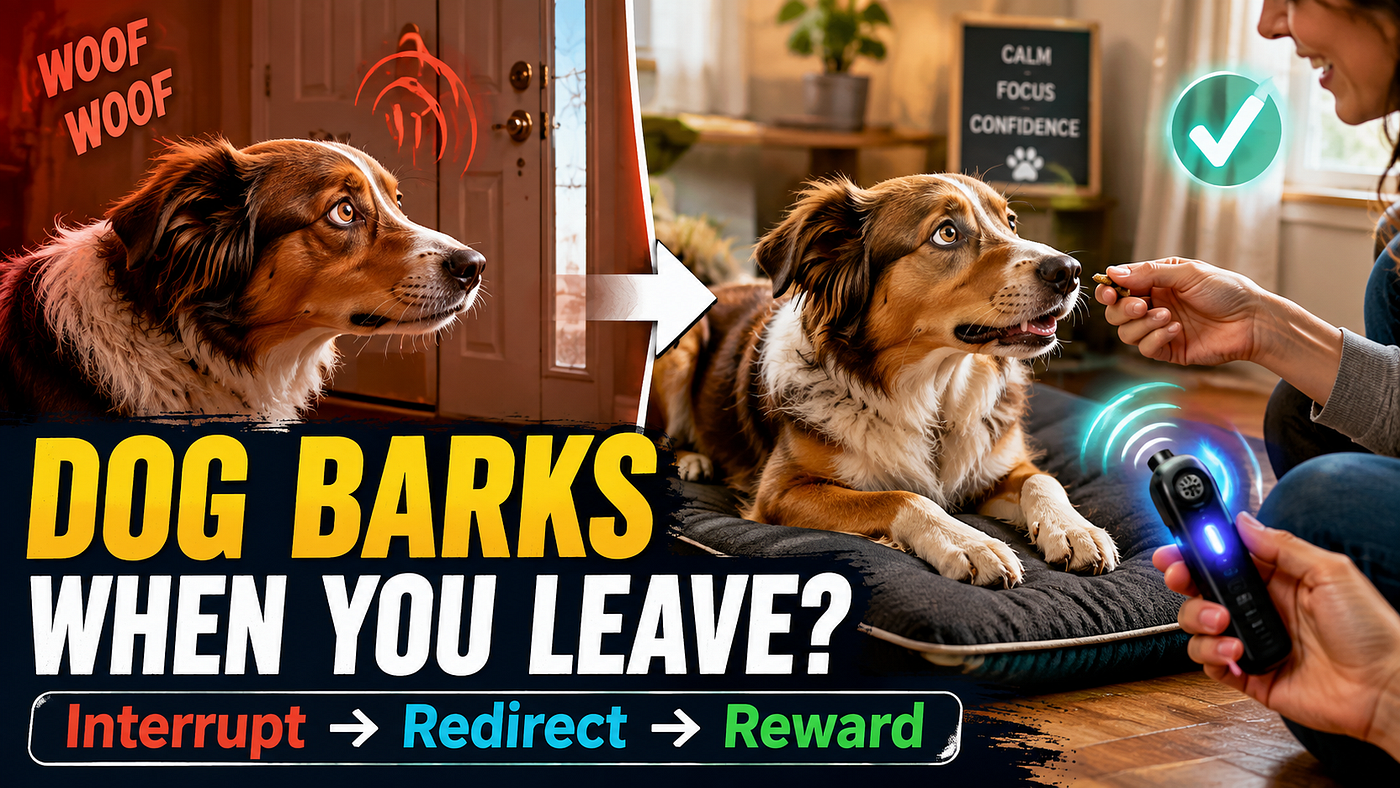
The Quiet Nights Blueprint: How to Stop Dog Barking at Night Without Waking the Neighbors
It’s 2 AM. Your dog is barking again — at the hallway, at nothing, at a sound only they can hear — and you’re lying there doing the math…
The Quiet Nights Blueprint: How to Stop Dog Barking at Night Without Waking the Neighbors
It’s 2 AM. Your dog is barking again — at the hallway, at nothing, at a sound only they can hear — and you’re lying there doing the math: how many more nights of this before someone files a noise complaint? You’ve tried ignoring it. You’ve tried shushing. You’ve tried standing outside the crate feeling like the worst dog owner alive. Nothing sticks.
Here’s the thing nobody tells you: this isn’t a “just ignore it and they’ll grow out of it” problem. Nighttime barking sits at the intersection of behavior, environment, and timing — and generic daytime training advice often fails specifically at night, in an apartment, with thin walls and a sleeping household on the other side of them.
This guide is different. It’s not a list of five random tips. It’s a complete system — four pillars, three phases, and a measurement framework — built specifically around how to stop dog barking at night without waking neighbors, whether you’re breaking in a new puppy, working with a rescue dog carrying unknown history, or managing an older dog whose nighttime confusion just started out of nowhere.
By the end, you’ll know exactly what to do tonight, what to expect over the next two weeks, and how to tell the difference between normal adjustment and a signal that something else — medical or behavioral — needs professional attention.
Why Most Nighttime Barking Fixes Fail
Most advice fails at night for one simple reason: it was written for daytime conditions.
The “just ignore it” trap. Standard training advice says to withhold attention until the barking stops. In a house with a yard between you and the nearest neighbor, that might be workable. In an apartment with shared walls, the same advice runs straight into an extinction burst — a well-documented behavioral pattern where an ignored behavior temporarily gets more intense before it fades. At 3 PM, a louder bark is annoying. At 3 AM, it’s the reason your neighbor is knocking on your door.
The yelling backfire. When you shout “quiet,” most dogs don’t process the words — they process the volume and energy. To a dog already aroused by something outside, a raised human voice often reads as joining in, not correcting. This is one of the most common patterns behind the search “why yelling quiet makes dog bark louder” — and it’s real.
Punishment creates new problems. Shock collars, spray bottles, and physical corrections don’t teach a dog what to do instead — they teach a dog to be afraid, which frequently increases anxiety-driven barking over time rather than reducing it. For a dog already barking from separation stress or unfamiliar nighttime sounds, punishment adds fear on top of the original trigger.
Treating every dog the same. A puppy crying through their first nights alone, a rescue dog with an unknown trauma history, and a senior dog experiencing sudden nighttime confusion are not the same problem wearing different fur. Applying one script to all three is why so many owners feel like “nothing works” — they were never using the right approach for their specific dog.
The 4 Pillars of Quiet Nights
Every reliable nighttime barking fix rests on four non-negotiable pillars. Skip one, and the other three won’t hold.
1. Diagnose Before You Train. You cannot fix what you haven’t identified. Barking at 2 AM at a hallway noise is a different animal than barking the second lights go off. Diagnosis comes first, always.
2. Interrupt Without Fear. The moment of barking needs a calm, non-threatening interruption — not silence (which allows the behavior to continue) and not punishment (which adds fear). This is the hinge point most owners get wrong.
3. Redirect Attention. An interrupted dog is a dog with nowhere to put their energy — unless you give them somewhere to put it. A cue, a settle command, a familiar comfort object.
4. Reinforce the Calm. The instant your dog is quiet — even for a few seconds — that’s the moment that gets rewarded. Most owners reward too late, after the dog has already moved on, which teaches nothing.
Together, these four pillars form a loop: Diagnose → Interrupt → Redirect → Reinforce. It’s the same logic professional trainers use, condensed into something you can execute at 2 AM half-asleep.
Phase 1: The Nighttime Audit
Before changing anything, spend one night simply observing. Answer these questions:

Self-diagnostic questions:
- Is this new behavior, or has it always been there? (Sudden onset — especially in older dogs — warrants a vet visit before any training plan.)
- Does the barking stop the second you appear? (Points to attention-seeking.)
- Does it happen even when nothing changes in the environment? (Points to anxiety or boredom.)
- Is your dog new to the home in the last 30 days? (Adjustment barking is normal and usually resolves within 1–2 weeks with consistency.)
This audit alone resolves a huge portion of the frustration behind searches like “why is my dog suddenly barking at nothing at 3am” — because it replaces guessing with a plan.
Phase 2: The Nightly System
This is where the four pillars become nightly action. Work through these in order.
Step 1: Set the Environment Before Bed
Instruction: Reduce triggers before they happen. Move the crate or bed away from windows and shared walls. Use a white noise machine or fan to mask hallway and street sounds. Give your dog a proper walk or play session 1–2 hours before bedtime — not right before, which can overstimulate rather than tire them out.
Pro-tip: If a white noise machine alone doesn’t help, layer it with a crate cover — the visual block combined with sound masking works better than either alone for dogs triggered by movement and shadows.
Pitfall to avoid: Don’t rely on exercise alone. A tired dog with an untreated anxiety trigger will still bark — physical fatigue doesn’t override emotional stress.
Step 2: Interrupt Calmly, the Moment Barking Starts
Instruction: The moment barking begins, you need a neutral, non-threatening interruption — something that captures attention without frightening your dog or escalating the situation. This is the step where yelling, banging on walls, or shock collars typically make things worse, because they either mimic the barking (a raised voice) or introduce fear (a shock or spray), both of which tend to increase anxiety-driven barking rather than resolve it.
Many owners find that a gentle, consistent interrupt cue — a soft “ssht” sound, a clicker, or a handheld ultrasonic trainer — works better precisely because it doesn’t add fear to the equation. This is the same logic behind the Interrupt → Redirect → Reward method some dog owners have quietly switched to: a safe ultrasonic pulse paired with an attention-grabbing LED cue interrupts the barking without touching, shocking, or scaring your dog — creating that exact window you need for the next step, from up to 50 feet away, so you’re not standing over the crate at 2 AM.
See the method in action: Show Me The Quiet Method →
Mini case example: An apartment owner with a Border Collie mix who barked at every hallway footstep found that a two-second ultrasonic interrupt, followed immediately by a “settle” cue and a treat, reduced nightly barking episodes from 8–10 down to 1–2 within ten days — without a single raised voice.
Pitfall to avoid: Don’t interrupt and then walk away. An interruption with no follow-up teaches your dog nothing except that barking sometimes randomly gets weird sounds — it doesn’t build the new habit.
Step 3: Redirect to a Settle Behavior
Instruction: Immediately after the interrupt, cue a behavior you’ve already taught during the day — “place,” “settle,” or simply returning to their bed. This can’t be taught for the first time at 2 AM; practice it during calm daytime moments so it’s automatic at night.
Pro-tip: Keep a specific “night settle” object — a particular blanket or toy used only at night — so your dog associates it directly with the wind-down routine.
Pitfall to avoid: Don’t use food alone as the redirect without a cued behavior attached. Feeding a barking dog without asking for calm first can accidentally reward the noise.
Step 4: Reinforce the Silence, Not the Struggle
Instruction: The second your dog is quiet — even briefly — mark it (a quiet “good” or a clicker) and reward. Gradually stretch the quiet duration required before the reward, starting from just 2–3 seconds.
Pitfall to avoid: Timing is everything. Rewarding even one second after your dog barks again teaches the bark, not the silence.
Phase 3: Optimization — What to Do When Progress Stalls
Behavior change isn’t linear. When the system stops improving, run this loop: Plan → Act → Measure → Analyze → Adjust.
A few common comparative decisions owners face at this stage:
- Ultrasonic interrupt vs. crate cover: Use ultrasonic interruption for barking triggered by sounds and movement; use a crate cover primarily for barking triggered by visual stimulation (shadows, passing people). Many dogs benefit from both together.
- Cry-it-out vs. gradual desensitization: For a brand-new puppy, gradual desensitization — short, increasing periods alone with calm returns — is generally more sustainable in a shared-wall building than pure extinction, which risks a loud burst before improvement.
- Moving the crate to the bedroom vs. keeping it in the living room: For dogs whose barking stems from separation anxiety, proximity to you at night (even just for a transition period) often reduces barking faster than isolation-based approaches.
If two full weeks of consistent application show zero improvement, or the barking is paired with obvious distress (drooling, destructive behavior, self-injury), that’s your signal to bring in a certified trainer or veterinary behaviorist — this system is a strong foundation, not a replacement for professional support in complex cases.
Tools & Resources That Actually Help
Environment: White noise machine, breathable crate cover, blackout curtains for street-facing windows.
Interruption: A handheld ultrasonic trainer for a calm, hands-off interrupt cue from across the room — useful specifically because it doesn’t require you to get up or raise your voice. It’s a non-invasive, chemical-free way to get that interrupt-redirect-reward window without a shock collar or a raised voice.
Try the Calm Redirect Method: See the device dog owners are switching to → (limited affiliate pricing on the official listing)
Calm support: Pheromone diffusers and calming mats can lower baseline arousal, though they work best as a supplement to training, not a replacement for it.
Tracking: A simple nightly log (barking episodes, duration, trigger) turns guesswork into a plan you can actually adjust.
Measuring Success: The KPIs That Actually Matter
Forget “did the barking stop completely” — that’s a vanity metric that sets you up to feel like a failure over normal variation. Track instead:
- Episodes per night (trending down over 7–10 day windows, not night to night)
- Time to settle after the interrupt cue
- Recovery time after a trigger (a dog who barks once and resettles in 30 seconds is succeeding, even if the bark still happened)
- Consistency of the routine — the single biggest predictor of long-term success is whether the four-step system was applied the same way, every night, for at least two weeks
Frequently Asked Questions
Will letting my puppy cry it out at night make my neighbors hate me? In a shared-wall building, pure cry-it-out often backfires because of the extinction burst — barking gets louder before it fades. Gradual desensitization with a calm interrupt-and-reward system is usually more neighbor-friendly and just as effective long-term.
Why isn’t positive reinforcement working for my dog’s nighttime barking? Usually because the reward is arriving too late, or the trigger hasn’t been correctly diagnosed (see Phase 1). Positive reinforcement fails when it’s applied inconsistently or attached to the wrong behavior.
My dog ignores the white noise machine and barks at hallway sounds anyway — what now? Layer a visual block (crate cover) with the sound masking, and add a calm interrupt cue at the moment of barking rather than relying on prevention alone.
Is it normal for a senior dog to suddenly start barking at night? Sudden-onset nighttime barking in an older dog, especially with disorientation, deserves a veterinary check before training — it can be linked to cognitive changes that need a different approach than behavioral barking.
Do anti-bark shock collars work for nighttime barking? They can suppress the sound, but they don’t address the underlying cause and often increase anxiety, which can make barking worse over time or shift it into a different unwanted behavior.
How long before I see real improvement? Most consistent owners see a meaningful drop in episodes within 7–14 nights. Full settling into a new routine, especially for anxious or rescue dogs, can take 3–4 weeks.
What if my dog barks at everything, not just nighttime sounds? Nighttime barking is often the most noticeable symptom of a broader daytime pattern. Apply the same four-pillar system during the day, since nighttime progress is hard to sustain without daytime consistency.
Your First Step Tonight
You don’t need to fix everything at once. Pick one thing: run tonight’s audit, or set up the environment before bed. That’s it. That’s the whole first move.
What’s been the hardest part of your dog’s nighttime barking — the guilt, the neighbors, or just the exhaustion? However you’re stuck, the four-pillar loop above — Diagnose, Interrupt, Redirect, Reinforce — is built to meet you exactly where you are tonight.
A quieter home could be closer than you think. You don’t have to accept endless barking, stressful walks, or frustrating training sessions as part of dog ownership — the first step begins with one simple decision.
***Start My Dog’s Quiet Streak Today →* Opens the official product listing
Affiliate Disclosure: This article contains affiliate links, including links to the product featured above. If you make a purchase through one of these links, we may earn a commission at no extra cost to you. We only recommend products we believe can genuinely help, based on the training principles outlined in this guide. This article is for informational purposes only and is not a substitute for veterinary or professional behavioral advice — if your dog’s barking is paired with signs of distress, sudden behavior change, or possible medical issues, please consult a veterinarian or certified animal behaviorist.
메타데이터
- post_id
- c2264cba1c8f
- slug
- the-quiet-nights-blueprint-how-to-stop-dog-barking-at-night-without-waking-the-neighbors-c2264cba1c8f
- url
- https://medium.com/@elsayedgamal401210/the-quiet-nights-blueprint-how-to-stop-dog-barking-at-night-without-waking-the-neighbors-c2264cba1c8f
- canonical_url
- https://medium.com/@elsayedgamal401210/the-quiet-nights-blueprint-how-to-stop-dog-barking-at-night-without-waking-the-neighbors-c2264cba1c8f
- author_url
- https://medium.com/@elsayedgamal401210
- status
- ok
- fetched_at
- 2026-08-18 08:18:08