What Nobody Tells You About Moving To Naples
A 22-year-old American drops into Piazza Garibaldi and discovers that moving to Naples isn’t an adventure — it’s a reckoning.
What Nobody Tells You About Moving To Naples
A 22-year-old American drops into Piazza Garibaldi and discovers that moving to Naples isn’t an adventure — it’s a reckoning.
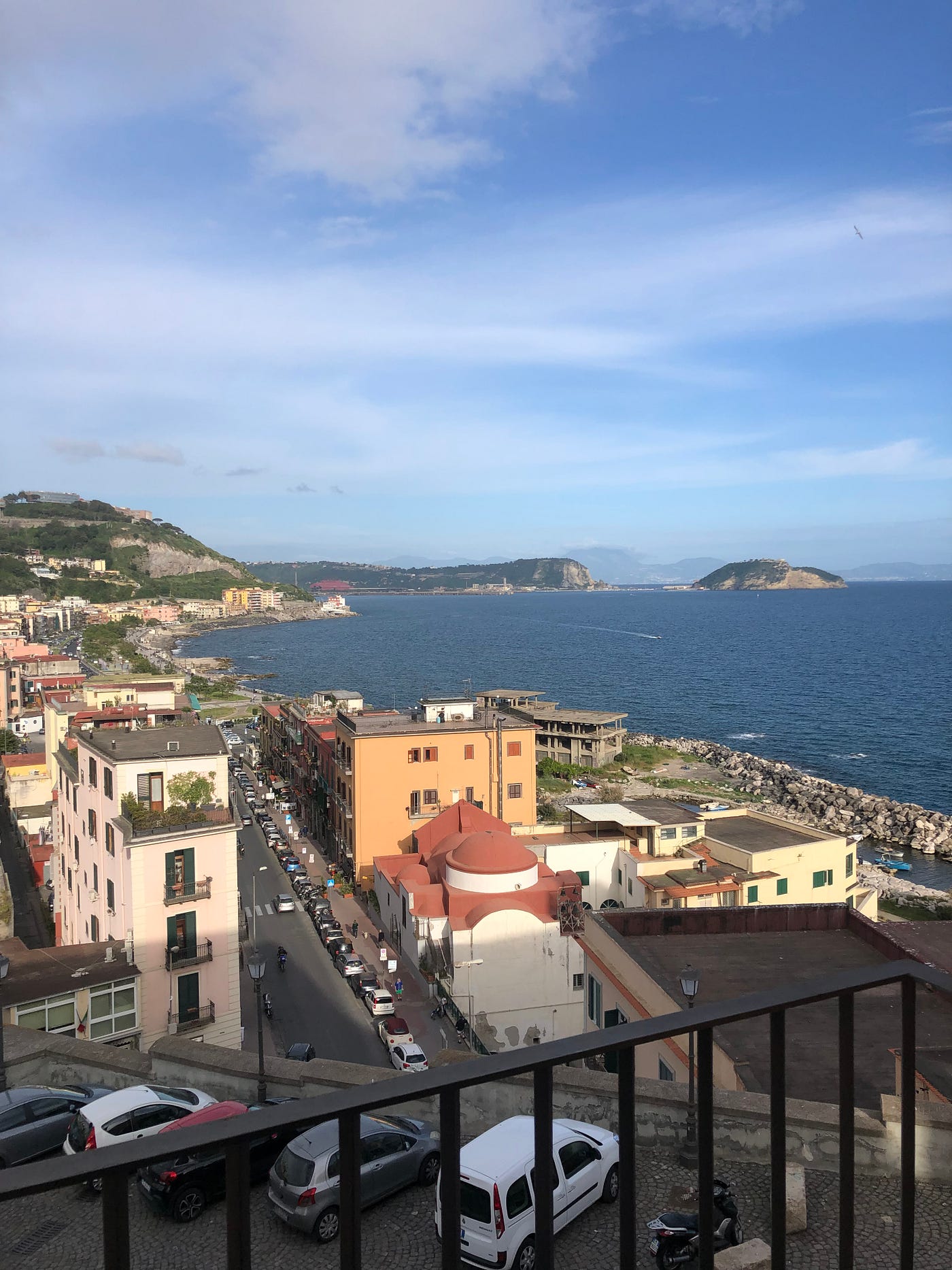
Piazza Garibaldi, June, early 90s. I was 22 years old, sitting in a car next to my father, sweating — and not just from the heat.
If you don’t know Piazza Garibaldi, it’s the beating, chaotic heart of Naples, home to the city’s main train station and what feels like every car, scooter, and human being in Southern Italy, all moving at once with no apparent rules.
I had just arrived from the States — freshly out of college, the product of my parents’ divorce, born and raised American but with Neapolitan blood flowing in my veins. I still remember stepping off that plane with a freshly printed degree in Political Science and International Relations, a minor in Italian, and the unshakeable confidence of someone who had absolutely no idea what they were getting into. I had come to Naples running from my mother, with whom my relationship had been largely built on friction. I left the life I’d built in the States, its familiarity, and most of all my sister. I’m not sure why, but I was convinced, erroneously, that Naples would be my solution to it all.
I came back looking for an Italian adventure, and my father had a very different first lesson planned.
He drove me to the middle of Piazza Garibaldi, stopped the car, and said, “The only way you can live here is to learn to drive here.”
Then he got out, walked away, and slowly disappeared into the crowd.
There I was, in the middle of what seemed like hell on earth. Sweating. My heart was pounding so hard that I thought it would explode. Fear had taken over completely, and I genuinely wasn’t sure I was getting out of there alive — but I had no other choice. Some part of me still believed my father would reappear out of the crowd, laugh at his little joke, and drive me home.
No such luck.
People yelling, cars, buses, trucks — it seemed like every form of transport in Southern Italy had gathered in one place just for me. Immigrants were trying to sell me everything and nothing. Carabinieri sirens wailing. Engines rumbling. It felt like being dropped at the starting line of a Formula One race, except nobody had given me a helmet.
I couldn’t focus. I couldn’t think. Everything was just so loud.
Then it happened. I turned the engine on, reached for the seatbelt — and immediately felt ridiculous. Nobody wore seatbelts in Naples in the early 90s. Nobody had quite figured out what they were for yet. But there I was, strapped in like I was heading to the moon, and I began to drive.
Then the city reminded me who was actually in charge.
I stalled.
Of course I did. Because every single car in Italy is a stick shift — something I had completely failed to factor in, having spent my entire driving life in the land of automatics. My greatest enemy wasn’t the traffic, or the noise, or the heat. It was the gear stick sitting there next to my legs, utterly indifferent to my panic.
I recovered, eventually. I followed a group of Vespas to keep my speed under control, watched the signs, and made my way home kilometer by kilometer — because yes, kilometers. No miles here. Minute by minute, what felt like hour by hour, I navigated my way back through Naples.
My father was waiting at the top of the road. Impatient, as always. But as I pulled up, I caught something on his face — the faintest trace of a grin. Though with my father, you could never be quite sure. He and emotions were never formally introduced.
Driving in Rhode Island was simple. Seatbelt, key in the ignition, automatic transmission, and off you went. Hard to get wrong. Naples, on the other hand, felt like someone had combined Mexico City, Bogotá, and itself into one gloriously overwhelming place and dared you to keep up.
One day at a time, right?
What saved me that summer wasn’t a map or a language class or any kind of plan. It was two people — Gesualdo and Felice. They appeared in my life and welcomed me like a brother, no questions asked, no probationary period. That summer, which still ranks among the best of my life, changed everything.
The three of us piled into an old Citroën Dyane 6 — a car so charmingly ancient it felt like it belonged in a museum — and drove all the way to the Christ of Maratea in Basilicata. Winding coastal roads where sometimes two cars barely fit, Vespas flying past like rockets, the sea glittering below. It was my real introduction to Italy. Not the chaos of Piazza Garibaldi, but the beauty underneath it.
For the first time, I thought — maybe I can actually do this.
And then there was the food. My first pizza, a portafoglio — wallet pizza — changed my life in the quiet, permanent way that only great food can. Gesualdo and Felice walked me into a pizzeria, ordered without hesitation, and right there at the counter, the pizzaiolo folded a fresh Margherita in half, then half again, wrapped it, and handed it over. Hot, simple, perfect. You eat it while walking, like a Neapolitan. If you ever visit Naples, it is a non-negotiable.
It was somewhere between that pizza and those coastal roads that Naples stopped feeling like a place I had escaped to and started feeling like home.
What came after that summer hit me like a wall I hadn’t seen coming.
The joy of a typical Italian summer dissolved quickly once September arrived, and with it my father’s patience. The honeymoon was over — his words, his rules, his timeline. I needed to find a job or go back to university and convert my American Political Science degree into something the Italian system would recognize. Real life, in other words, was calling.
But I wasn’t ready for real life. Not yet. I was still emotionally somewhere on that coastal road in Basilicata, Gesualdo and Felice laughing beside me, the sea below. I hadn’t thought that far ahead — hadn’t thought much beyond arriving.
And then came the weight of what I’d left behind. My mother. My sister. Both of them on the other side of the Atlantic, one a wound I was still carrying, the other my special person, now impossibly far away. The confidence I’d arrived with began to quietly leak out of me.
My father, meanwhile, was rewriting the rules. I was 22 years old and suddenly living under a curfew. No keys to the house. No independence. I had gone from being a free bird in the States to what felt like a trip backwards in time, piece by piece, losing everything I’d taken for granted about my own autonomy, my way of life.
So I moved out. My grandmother, Nonna Elisabetta, welcomed me into her home in a town fifteen minutes away from my father. My own space, my own keys. Better, I thought. Wrong!
Living with your elderly grandmother at 22, after years of American freedom, has its own particular kind of loneliness.
I felt trapped — both feet in a single shoe, with no idea how to get out.
Looking back, the collision was probably inevitable. I was 22, a university graduate, someone who had lived alone, made his own decisions, and kept his own hours. In the States, that’s just called being an adult. In my father’s house, it meant nothing. His house, his rules — full stop. The arguments started small and grew. My independence, the American in me, kept pushing back against him, and he kept pushing harder. It wore us both down. In the end, moving in with Nonna Elisabetta wasn’t really a choice — it was the only exit. She asked nothing, expected nothing, and loved me in that quiet, unconditional way that I didn’t fully appreciate until much later. My father and I never quite found our way back from that period. Some distances, once opened, have a way of staying open.
What got both feet out of that single shoe was, of all things, a job. A teaching job — English mother tongue teacher in Italian high schools. My father’s relentless pressure, which had felt like a wall, turned out to be a door. I walked through it, reluctantly, and found something that fit.
I still think about Rhode Island. About the life that might have been — more successful, maybe, more financially stable, more certain. But that young, somewhat foolish boy who ran toward Naples didn’t know yet that you can’t outrun yourself. The problems you leave behind have a way of waiting patiently at the destination.
What I know now, thirty-something years later, is this: my life would have been completely different had I made a different choice that summer. Whether it would have been better is a question I’ve stopped trying to answer.
Naples is still teaching me. I’m still learning.
And somewhere in this city, a pizzeria is folding wallet pizza that still tastes like the best summer of my life.
메타데이터
- post_id
- c236e2a0b5c8
- slug
- what-nobody-tells-you-about-moving-to-naples-c236e2a0b5c8
- url
- https://medium.com/@canthonyporcaro/what-nobody-tells-you-about-moving-to-naples-c236e2a0b5c8
- canonical_url
- https://medium.com/@canthonyporcaro/what-nobody-tells-you-about-moving-to-naples-c236e2a0b5c8
- author_url
- https://medium.com/@canthonyporcaro
- status
- ok
- fetched_at
- 2026-07-13 06:23:13