The Real Economy, the Financial System, and the Purpose of Finance
Why the financial system should support the real economy, not dominate it
The Real Economy, the Financial System, and the Purpose of Finance
Why the financial system should support the real economy, not dominate it

We often talk as if there is only one economy. In reality, there are the economies of real things and of financial claims. The real economy involves where people live and work. The financial system is where claims over that life are recorded, priced, transferred, and enforced. (Pirrong, 2000, pp. 437–471) Though connected, these systems serve different purposes.
The real economy is the economy of houses, food, water, energy, roads, care, education, tools, transport and work. It is the economy of materials, land, labour, machines, knowledge, time and ecological systems. It is where things are made, repaired, used, shared and maintained. It is the economy that keeps us alive and allows us to live together.
The financial system is not separate from the economy, as it employs people and uses resources. However, finance mostly functions as a network of claims on the real economy. It provides payments, savings, insurance, accounting, investment, and records ownership — but it is fundamentally distinct from the real economy itself. (Zabavnik & Verbič, 2021, pp. 55–75)
A house is a real asset; a mortgage is a financial claim. A solar panel is a real asset; the attached financial contracts are claims. A water system is a real asset; debt, equity, and revenue arrangements are financial claims. A care worker provides a real service; funding and contract structures are financial arrangements.
This distinction matters. The real economy provides what people need. The financial system tracks ownership, payments, risks, and benefits associated with those needs. A good financial system supports the real economy. A bad one extracts value from it. (Cochrane, n.d.)
What should an economy be for?
Before we ask whether the financial system is efficient, we need to ask a larger question. What is an economy for? It cannot be just about making money, because money is not the purpose of life. Money is a tool. It is a way of organising exchange, recording claims and moving purchasing power. The purpose of an economy should be to help humans live well together on a planet that remains livable.
That gives us a better set of tests. Does the economy help keep the planet livable for humans and the living systems on which human (Alola et al., 2022) life depends? Does it provide secure access to housing, food, water, energy, health care, education, transport and care? Does it reduce unnecessary suffering? Does it help people cooperate rather than destroy each other? Does it prevent extreme concentrations of power? Does it pass useful assets, knowledge and ecological capacity to future generations?
These are the questions that matter. If the economy fails these tests, it is not a good economy, even if GDP rises. If the financial system fails these tests, it is not a good financial system, even if bank profits, asset prices, and market trading speed rise. The financial system should not be judged only by how much money it makes for itself. It should be judged by what it allows the real economy to do.
Finance should support the real economy, not dominate it.
A financial system should help people pay each other, save, insure against loss, fund useful assets, share risk, record ownership and plan for the future. These are useful functions worth paying for. (Functions of Financial System, n.d.) A community needs good financial institutions, just as it needs good roads, good water systems and good public administration.
There is a difference between paying for a useful service and allowing finance to extract as much as possible from the real economy. The system should be paid for what it does, not allowed to turn every human need into a permanent income stream.
The financial system becomes dangerous when the claim becomes more powerful than the thing it claims against. (Risk and liquidity in a system context, 2008, pp. 315–329) Housing is the easiest example. A house is a place to live, but it can primarily be a leveraged financial asset. Water is a public necessity, but it can become a debt-backed revenue stream. Care is a human service, but it can become a financial product. When that happens, the financial system is no longer simply helping the real economy. It is reorganising the real economy around its own claims.
The problem of financial claims
The financial system creates claims, and some of those claims (Cochrane, 2005, pp. 1–101)s are necessary. A mortgage may help a family buy a house. A share may help fund an enterprise. A bond may help build infrastructure. Insurance may help people share risk. Superannuation may help people save for future goods and services. The problem is not that claims exist. The problem is that claims can grow faster than the real economy they are meant to serve. (Christopherson et al., 2013)
Debt can grow faster than wages. House prices can grow faster than incomes. Interest payments can outpace households’ capacity to pay. Asset values can rise even when real usefulness remains unchanged. (Glaeser et al., 2010) When this happens, more income from real work services financial claims.
People still work, houses are still houses, water is still water, electricity is still electricity, and care is still care. Yet a larger share of real income is transferred to owners of financial claims. The system becomes extractive, not necessarily creating more value, but increasing claims.
Why is finance hard to understand
The financial system is difficult to understand, partly for legitimate reasons. Modern economies are complicated. Payment systems must be reliable. Banks must manage liquidity, default risk, and regulatory requirements. Insurers must pool uncertain losses. Superannuation funds must invest across long periods. Markets must clear and settle transactions. Governments must regulate the system to prevent it from collapsing. (Liquidity Risk Management, 2024)
Some complexity is therefore necessary, but some complexity also protects the system. If people cannot see how money is created, how interest is charged, how fees are hidden, how risk is shifted, and how ownership claims are built into contracts, then they cannot easily challenge the system. (Kaiser & Lusardi, 2024) They cannot ask whether the charge is fair. They cannot ask whether the financial structure is necessary. They cannot ask whether there is a simpler way.
A person can understand a house, but not the mortgage market. Rent is simple, but securitisation is complex. Saving for retirement is clear, but decisions about superannuation funds are opaque. Paying interest is easy to understand, but bank lending and deposit creation are not. This gives the finance authority a sense of technicality, neutrality, and inevitability.
But many parts of finance are not laws of nature. They are rules, contracts, accounting systems, regulations and institutional designs. They can be explained. They can be questioned. And because they are designs, they can be redesigned.
Useful finance and unnecessary extraction
We need to be careful here. It is not enough to say finance is bad, because finance is not bad in itself. Payments, risk assessment, and fraud prevention cost money. Administration costs money. Regulation costs money. Technology costs money. Capital allocation requires judgement. Bad finance can destroy communities, so we need skilled people, strong institutions, and sound regulation.
But the legitimate cost of finance is not the same as the maximum amount finance can extract. The useful cost of finance is the cost of doing the job. The extractive cost is the extra amount taken because people have no better choice, cannot understand the system, cannot avoid the debt, or cannot access the asset without going through the financial gatekeeper.
This is the key distinction. Finance should be paid for useful service. It should not be allowed to become a toll gate between people and the things they need to live. If finance is doing real work, we should pay for that work. If finance is simply using ownership, debt or complexity to take more than is needed, then it should be redesigned.
How the financial system can be efficient and inefficient at the same time
The financial system can be very efficient in its own terms. Banks can process millions of payments. Markets can trade securities in milliseconds. Fund managers can move large amounts of capital. Payment systems can settle obligations quickly. From inside the financial system, this may look efficient.
But the real question is whether it is efficient for the real economy. If a community needs houses, does the financial system help provide secure, affordable housing? If a community needs renewable energy, does the financial system help fund its installation without unnecessary extraction? If a community needs aged care, does finance help deliver care, or does it turn care into a revenue stream? If a government needs infrastructure, does the financing structure reduce the cost to the public, or does it lock the public into decades of payments to private claim holders?
The real test is whether the system serves human well-being. Profitability, speed, legality, or sophistication are not enough if the financial system fails to help people live well together.
Money creation
One of the least understood parts of the financial system is money creation. Most people think banks lend out money that already exists. That is only partly true. In modern banking, when a bank makes a loan, it usually creates a deposit at the same time as it creates a debt. (McLeay et al., 2014) The borrower receives purchasing power. The bank records a financial claim.
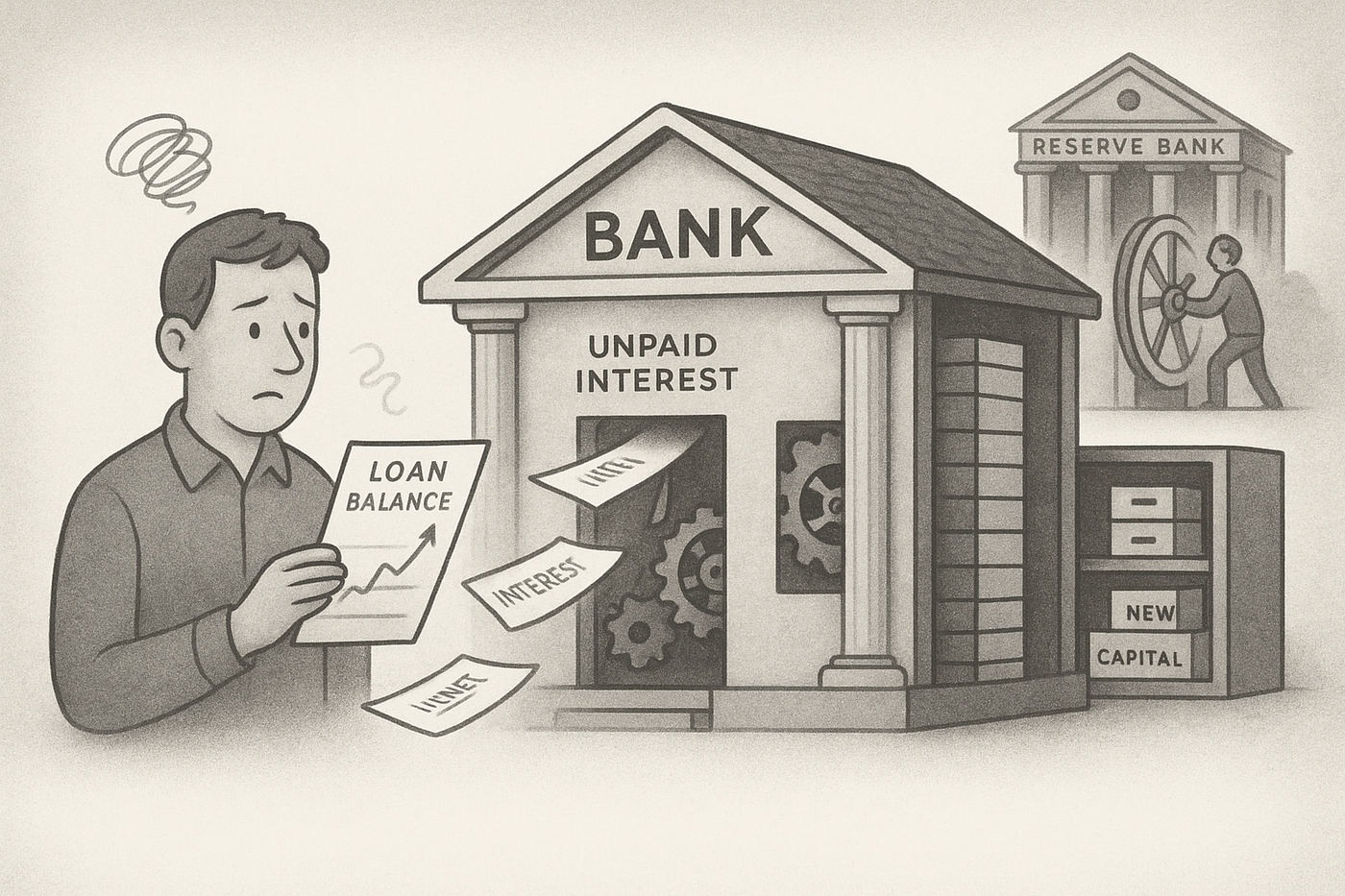
This does not mean lending is costless. Banks still have to manage risk. They need capital. They need liquidity. They need systems. They need staff. They need to comply with the regulations. They have to deal with defaults and fraud. But it does mean we should be much clearer about what is happening. New purchasing power often enters the economy as debt, and the borrower must repay principal plus interest. (Diamond et al., 2024)
The interest may include legitimate costs, but those costs are usually bundled together in a way that is hard to see. The borrower does not know how much is administration, how much is risk, how much is the bank’s profit, how much is the cost of funds, and how much is market power. (Banks’ Funding Costs and Lending Rates, n.d.) They just see an interest rate. This is one of the ways finance becomes opaque.
Cellular Economics need not say that all interest is illegitimate. The stronger argument is that the cost of money creation should be transparent, limited and tied to a real purpose. If new money is created to build or transfer a real asset, the financial claim should decrease as the asset is paid for, used, or depreciated. The money system should follow the asset’s life cycle. It should not create a permanent claim over future income.
Existing assets
Many of the things communities need already exist. Houses already exist. Water systems already exist. Energy systems already exist. Tools, buildings, vehicles and businesses already exist. The problem is often not that the asset does not exist. The problem is that ownership is concentrated.
People need access to these assets, but that access often requires paying rent, taking on debt, or paying fees that transfer income away from users. Housing is the clearest example. A person may pay rent for decades and never gain any ownership. Another person may buy a house with a large mortgage and spend most of their working life servicing the financial claim attached to that house.
The house is the real asset. The mortgage, rent stream and ownership structure are the financial arrangements around the house. Cellular Economics asks a simple question. If people are paying for an asset, maintaining it, and depending on it, why should their payments not gradually give them a recognised claim to it?
This is not saying the legal details are simple. They are not. There are questions of tax, title, governance, valuation, regulation, default, consumer protection and investor confidence. But the principle is clear. Where possible, payments should become a path to ownership. They should not remain a pure extraction.
Dynamic ownership
One problem with ordinary capital markets is that ownership can become stuck. Those who already own capital receive more claims. Those who need access to capital keep paying. (Giannetti & Meisenzahl, 2021) This may be justified at the beginning, when an investor helps make something possible. But if the investor’s claim never circulates, the users may keep paying long after the original purpose has been served.
Cellular Economics proposes dynamic ownership. Investors can still be rewarded. They can still help make assets available. They can still receive a fair return for real risk and real contribution. But their claim should not necessarily remain permanent. Over time, ownership should shift to the people who use, maintain, and pay for the asset.
This is the purpose of Fair Points Markets. They do not abolish investment. They change the direction of ownership. Instead of ownership accumulating away from users, it gradually circulates back toward them. That is a very different kind of market. It is not a market designed for speculation. It is a market designed for transfer, use and fairness.
The extraction test
Cellular Economics gives us a way to test finance. What is the real asset or service? What financial service is actually needed? What does that service actually cost? Who pays? Who benefits? Who carries the risk? Does ownership shift toward the people who use and maintain the asset, or away from them?
This is a practical test. It does not require us to say that all finance is bad. It asks finance to justify itself. If finance provides a useful service at a fair cost, it should be paid for. If finance is adding unnecessary cost, hiding claims, increasing debt, inflating asset prices or extracting income without real contribution, then it should be redesigned.
The role of government
The government has a special role because the financial system is not a natural system. The government defines property rights, licenses banks, enforces contracts, creates company law and tax law, regulates payments, banking, insurance, superannuation, and securities, and decides what counts as legal money. (Labonte, n.d.) So the government cannot pretend that the financial system just happens on its own. It is a public design.
But public money creation must also be disciplined. It is not enough to say the government can create money. The real question is whether the community has the capacity to do the work. Are there enough workers, materials, land, energy, ecological capacity and institutional competence? Will the new money create useful assets, or will it simply push up prices?
Money creation should be judged by real capacity and real purpose. If the resources exist and the purpose is useful, finance should not be the barrier. If the resources do not exist, creating more money will not solve the problem.
How Cellular Economics addresses part of the problem
Cellular Economics is not a complete replacement for the financial system. It does not remove the need for banks, payments, insurance, regulation, law, accounting or investment. It addresses a particular problem: the unnecessary cost that arises when money creation, ownership claims and investment returns become detached from real assets and real users.
It addresses money creation by tying new money more directly to real assets, real productive capacity and community purpose. Instead of creating money mainly as interest-bearing debt, it could be sold, issued, or directed to approved social enterprises that create or transfer real assets. The financial claim would then be reduced over time as the asset is paid for, used, or depreciated.
It addresses the transfer of existing assets by allowing beneficial ownership to move gradually from passive owners to users. This matters because communities need more than new assets. They also need fair access to existing assets. If people are already paying for the use and maintenance of an asset, Cellular Economics asks whether part of that payment should also transfer ownership.
It addresses unnecessary extraction by separating the useful services of finance from the extraneous layered claims. Finance should be allocated to administration, risk, governance, technology, and genuine investment. It should not be able to hide excessive returns inside complexity.
It addresses the problem of immobile ownership by requiring claims to circulate. Investors may receive fair rewards, but users should gain ownership as they contribute. It also addresses the invisibility of financial cost by making the flows explicit. Every payment can be divided into its real purposes: maintaining the asset, paying for administration, rewarding genuine risk, transferring ownership, retiring the financial claim, or exposing unnecessary extraction.
Once we ask those questions, the financial system becomes visible. And once it becomes visible, it can be changed.
The central argument
The real economy is where value is created, used and experienced. The financial system should help that value circulate. It should not dominate it. It should not hide its costs. It should not turn every human need into a permanent claim on future income. It should not reward passive ownership more than real contribution.
A good financial system helps people build and maintain what they need. It lowers unnecessary cost, shares risk fairly, records contribution accurately, moves ownership toward those who use and care for assets, supports ecological repair, helps keep the planet livable, and helps people cooperate rather than destroy each other.
A bad financial system does the opposite. It hides costs, inflates asset prices, concentrates ownership, expands debt, rewards passive extraction and makes communities dependent on claims they do not understand.
The purpose of Cellular Economics is to make finance visible, accountable and circulating. It does not ask us to abolish finance. It asks us to redesign finance so that it serves life.
That is the real issue. The financial system should not be an economy feeding on the real economy. It should be the accounting, payment and ownership-transfer system that helps communities build what they need, pay for it fairly, and pass a livable world to the people who come after us.
References
Grammarly was asked to find references to support the assertions made in this document. These are the references it found.
Pirrong, C. (2000). A Theory of Financial Exchange Organization. Journal of Law and Economics 43, pp. 437–471. https://doi.org/10.1086/467462
Zabavnik, D. & Verbič, M. (2021). Relationship between the financial and the real economy: A bibliometric analysis. International Review of Economics & Finance 75, pp. 55–75. https://doi.org/10.1016/j.iref.2021.04.014
Cochrane, J. (n.d.). Financial Markets and the Real Economy. https://www.nber.org/papers/w11193
Alola, A. A., Alola, U. V., Akdag, S. & Yildirim, H. (2022). The role of economic freedom and clean energy in environmental sustainability: implication for the G-20 economies. Environmental Science and Pollution Research 29. https://doi.org/10.1007/s11356-022-18666-5
(n.d.). Functions of Financial System. Finance Train. https://financetrain.com/functions-financial-system
(2008). Risk and liquidity in a system context. Journal of Financial Intermediation 17(3), pp. 315–329. https://doi.org/10.1016/j.jfi.2008.02.003
Cochrane, J. (2005). Financial Markets and the Real Economy. Foundations and Trends® in Finance 1(1), pp. 1–101. https://doi.org/10.3386/w11193
Christopherson, S., Martin, R. & Pollard, J. (2013). Financialisation: roots and repercussions. Cambridge Journal of Regions 6(3). https://doi.org/10.1093/cjres/rst023
Glaeser, E. L., Gottlieb, J. D. & Gyourko, J. (2010). Can Cheap Credit Explain the Housing Boom?. NBER Working Paper №16230. https://doi.org/10.3386/w16230
(2024). Liquidity Risk Management. FINRA.org. https://www.finra.org/rules-guidance/guidance/reports/2024-finra-annual-regulatory-oversight-report/liquidity-risk-management
Kaiser, T. & Lusardi, A. (2024). Financial Literacy and Financial Education: An Overview. NBER Working Paper 32355. https://doi.org/10.3386/w32355
McLeay, M., Radia, A. & Thomas, R. (2014). Money Creation in the Modern Economy. Bank of England Quarterly Bulletin 2014 Q1. https://doi.org/10.21314/boe/2014.03
Diamond, W. F., Landvoigt, T. & Sánchez, G. S. (2024). Printing Away the Mortgages: Fiscal Inflation and the Post-Covid Boom. NBER Working Paper №32573. https://doi.org/10.3386/w32573
(n.d.). Banks’ Funding Costs and Lending Rates. Reserve Bank of Australia. https://www.rba.gov.au/education/resources/explainers/banks-funding-costs-and-lending-rates.html
Giannetti, M. & Meisenzahl, R. (2021). Ownership Concentration and Performance of Deteriorating Syndicated Loans. CEPR Discussion Paper №16452. https://doi.org/10.2139/ssrn.3907060
Labonte, M. (n.d.). Who Regulates Whom? An Overview of the U.S. Financial Regulatory Framework. https://www.congress.gov/crs-product/R44918
메타데이터
- post_id
- c242d7b74e87
- slug
- the-real-economy-the-financial-system-and-the-purpose-of-finance-c242d7b74e87
- url
- https://medium.com/@kevin-34708/the-real-economy-the-financial-system-and-the-purpose-of-finance-c242d7b74e87
- canonical_url
- https://medium.com/@kevin-34708/the-real-economy-the-financial-system-and-the-purpose-of-finance-c242d7b74e87
- author_url
- https://medium.com/@kevin-34708
- status
- ok
- fetched_at
- 2026-08-09 00:55:21