Physical AI: The Next Frontier Of Investment As Smart Money Shifts From Screens To Robots
For decades, the technology revolution has largely existed inside screens. From personal computers and smartphones to cloud computing and…
Physical AI: The Next Frontier Of Investment As Smart Money Shifts From Screens To Robots
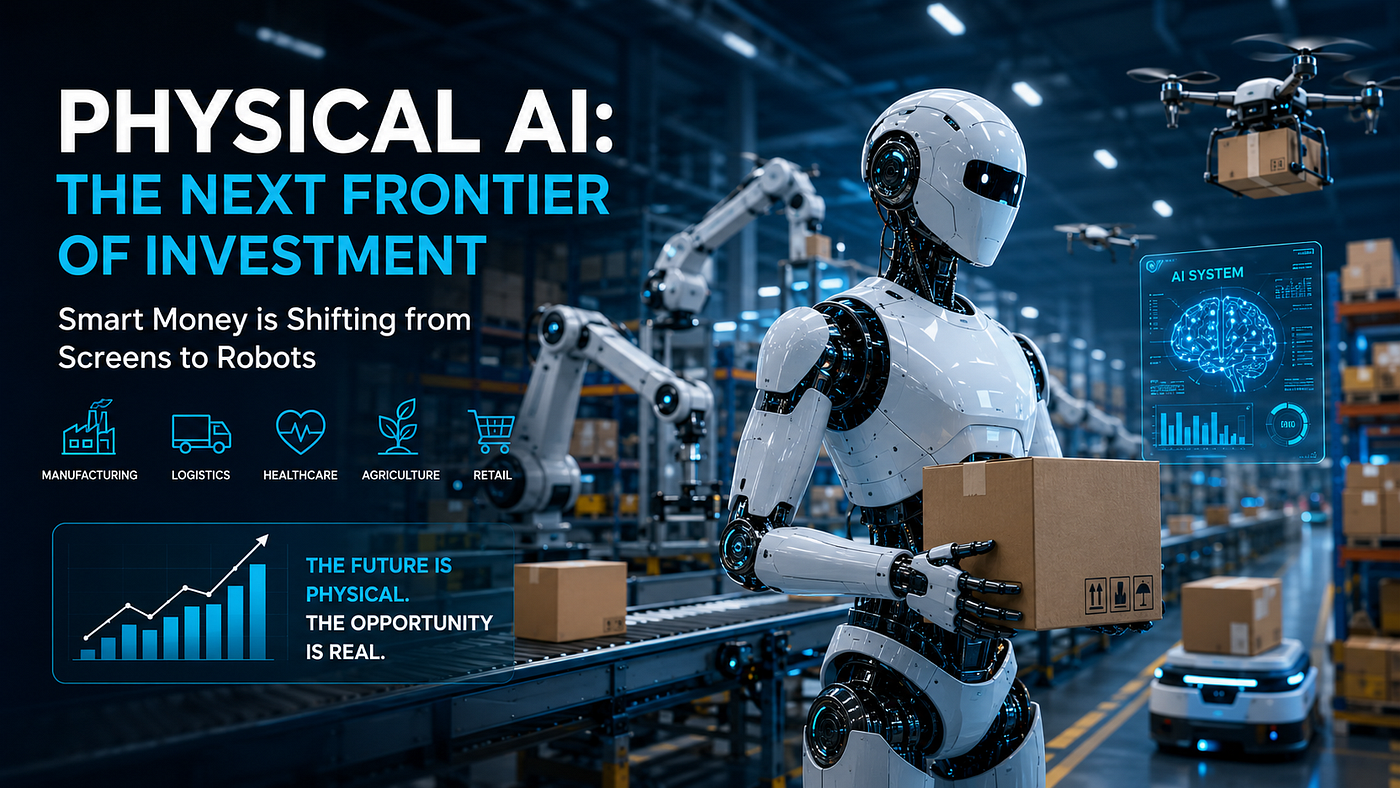
The Next Frontier Of Investment As Smart Money Shifts From Screens To Robots
For decades, the technology revolution has largely existed inside screens. From personal computers and smartphones to cloud computing and generative artificial intelligence, investors have consistently rewarded companies that built digital ecosystems. Today, however, a new investment wave is emerging — Physical AI.
Unlike traditional AI that generates text, images, or software, Physical AI gives machines the ability to perceive, reason, learn, and physically interact with the real world. It combines artificial intelligence with robotics, autonomous systems, sensors, computer vision, and edge computing.
From Tesla’s humanoid robots to Amazon’s warehouse automation and AI-powered surgical robots, the world’s biggest technology companies are investing billions into machines that don’t just think — they act.
Many analysts believe Physical AI could become one of the largest investment opportunities of the next two decades.
What is Physical AI?
Physical AI refers to intelligent systems embedded inside physical machines capable of sensing, understanding, making decisions, and performing real-world tasks with minimal human intervention.
Unlike ChatGPT or traditional software AI, Physical AI operates in environments such as:
- Manufacturing plants
- Hospitals
- Warehouses
- Farms
- Construction sites
- Homes
- Retail stores
- Logistics networks
- Autonomous vehicles
In simple terms:
Digital AI thinks. Physical AI thinks and acts.
Examples include:
- Self-driving cars
- Delivery robots
- Humanoid robots
- AI-powered drones
- Automated warehouse robots
- Smart manufacturing equipment
- Robotic surgery systems
Why Investors Are Shifting Toward Physical AI
The first wave of AI focused on software productivity.
The second wave focuses on solving physical labor shortages.
Several global trends are accelerating investment.
1. Labor Shortages
Many developed countries face aging populations and shrinking workforces.
Industries like manufacturing, healthcare, logistics, and agriculture struggle to hire enough workers.
Physical AI provides scalable automation.
2. Falling Hardware Costs
Sensors, cameras, processors, and batteries have become significantly cheaper.
As hardware prices decline, deploying intelligent robots becomes increasingly economical.
3. Better AI Models
Recent advances in:
- Computer vision
- Reinforcement learning
- Large language models
- Edge AI
allow robots to understand complex environments and adapt in real time.
4. Rising Productivity Demand
Businesses seek higher productivity without proportionally increasing labor costs.
Physical AI enables 24/7 operations with consistent performance.
5. Government Investment
Countries including the United States, China, Japan, South Korea, and Germany are investing heavily in robotics and AI infrastructure to strengthen industrial competitiveness.
How Physical AI Works
Physical AI combines several advanced technologies into one intelligent system.
Step 1: Perception
Cameras, LiDAR, radar, microphones, and sensors collect environmental data.
Step 2: Understanding
AI algorithms analyze objects, people, distances, obstacles, and context.
Step 3: Decision-Making
The system evaluates multiple actions and selects the safest or most efficient option.
Step 4: Action
Robotic arms, motors, wheels, or actuators execute the chosen task.
Step 5: Learning
The AI improves over time using feedback and new data.
This continuous learning cycle enables smarter and more reliable performance.
Practical Example
Imagine a modern warehouse.
Instead of hundreds of workers manually moving packages:
- AI cameras identify products.
- Robots retrieve items.
- Autonomous vehicles transport goods.
- AI optimizes delivery routes.
- Inventory updates automatically.
The result:
- Faster shipping
- Lower labor costs
- Fewer errors
- Improved customer satisfaction
This is already happening in leading logistics companies worldwide.
Investment Calculation Example
Suppose a factory employs 100 workers.
Average annual salary:
₹5,00,000
Total annual labor expense:
100 × ₹5,00,000 = ₹5 crore
The company invests ₹10 crore in Physical AI robots.
The robots reduce workforce requirements by 40%.
Annual labor savings:
40 × ₹5,00,000 = ₹2 crore
Additional gains:
- Reduced product defects: ₹50 lakh
- Increased production: ₹75 lakh
- Lower downtime: ₹25 lakh
Total annual benefit:
₹2 crore + ₹50 lakh + ₹75 lakh + ₹25 lakh = ₹3.5 crore
Payback Period
₹10 crore ÷ ₹3.5 crore ≈ 2.9 years
After the payback period, the savings directly enhance profitability, illustrating why many businesses view Physical AI as a compelling long-term investment.
Success Story
One of the most notable examples is Tesla.
Tesla is developing Optimus, a humanoid robot designed to perform repetitive, dangerous, and labor-intensive tasks.
CEO Elon Musk believes humanoid robots could eventually become more valuable than Tesla’s electric vehicle business.
The company is leveraging:
- AI chips
- Computer vision
- Autonomous driving technology
- Advanced robotics
to create robots capable of working in factories, warehouses, and potentially homes.
Beyond Tesla, companies such as Amazon, Nvidia, ABB, and Intuitive Surgical are investing heavily in robotics and Physical AI, reflecting growing confidence in this emerging sector.
Industries That Will Benefit Most
Manufacturing
- Assembly automation
- Quality inspection
- Predictive maintenance
Healthcare
- Robotic surgery
- Patient monitoring
- Elder care assistance
Agriculture
- Precision farming
- Autonomous tractors
- Smart harvesting
Logistics
- Warehouse automation
- Delivery robots
- Autonomous forklifts
Retail
- Inventory management
- Shelf scanning
- Smart checkout systems
Construction
- Autonomous machinery
- Site inspection drones
- AI-powered safety monitoring
Advantages of Physical AI
Increased Productivity
Robots can work continuously with minimal downtime.
Lower Operating Costs
Reduced dependence on manual labor lowers long-term expenses.
Improved Accuracy
AI systems minimize human errors in repetitive tasks.
Enhanced Workplace Safety
Dangerous jobs can be assigned to machines, reducing accident risks.
Faster Decision-Making
Real-time data enables quicker and more informed operational decisions.
Better Scalability
Businesses can expand operations without proportionally increasing headcount.
Disadvantages of Physical AI
High Initial Investment
Robotic systems require significant upfront capital.
Job Displacement
Automation may replace certain routine roles, requiring workforce reskilling.
Cybersecurity Risks
Connected robots can become targets for cyberattacks if not properly secured.
Maintenance Costs
Advanced robotic systems require specialized servicing and software updates.
Regulatory Challenges
Governments continue to develop standards for autonomous machines and AI safety.
Ethical Concerns
Questions around accountability, privacy, and the societal impact of automation remain important considerations.
Why Smart Money Is Investing Early
Historically, investors who identified transformative technologies early often captured outsized returns.
Examples include:
- Internet infrastructure in the 1990s
- Smartphones in the 2000s
- Cloud computing in the 2010s
- Artificial intelligence in the 2020s
Many analysts believe Physical AI represents the next major technological platform.
Rather than replacing software AI, it extends AI into the physical world, unlocking opportunities across manufacturing, healthcare, transportation, and everyday life.
“The biggest breakthroughs in AI won’t remain trapped behind computer screens. They will move into factories, hospitals, warehouses, farms, and homes through intelligent machines that can perceive, decide, and act.” — Jacky Kapadia
Conclusion
Physical AI represents the convergence of artificial intelligence and robotics, transforming how work is performed in the real world. As labor shortages, technological advances, and productivity demands reshape industries, intelligent machines are becoming essential rather than optional.
For investors, the opportunity extends beyond robot manufacturers. Companies producing AI chips, sensors, industrial automation systems, machine vision, cloud infrastructure, and autonomous software are also positioned to benefit from this long-term trend.
While challenges such as high capital costs, cybersecurity, and workforce transition remain, the long-term potential is significant. Just as digital AI reshaped software, Physical AI is poised to redefine manufacturing, logistics, healthcare, agriculture, and countless other sectors. Those who understand this shift early may be better positioned to participate in one of the defining investment themes of the coming decades.
Frequently Asked Questions (FAQs)
1. What is Physical AI?
Physical AI combines artificial intelligence with robotics and intelligent machines that can perceive, make decisions, and perform tasks in the physical world.
2. How is Physical AI different from Generative AI?
Generative AI creates digital content such as text, images, or code. Physical AI applies intelligence to robots and autonomous systems that interact with real environments.
3. Why are investors interested in Physical AI?
Investors see strong growth potential driven by labor shortages, automation demand, declining hardware costs, and rapid advances in AI technologies.
4. Which industries are expected to benefit the most?
Manufacturing, healthcare, logistics, agriculture, retail, construction, and transportation are among the sectors likely to experience the greatest impact.
5. Is Physical AI a long-term investment theme?
Yes. While adoption will take time, many experts view Physical AI as a multi-decade growth opportunity with the potential to reshape global industries, much like the internet, cloud computing, and digital AI did in earlier technology cycles.
Thank you for reading! If you enjoyed this, don’t forget to follow and subscribe to see more of my writing.
Be a part of our growing community! Show your support by clapping and following the writer 👏️️.
Stay updated by following us on TALKFEVER ( Indian Facebook ), X, LinkedIn, YouTube, Discord, and subscribing to our newsletter.
메타데이터
- post_id
- c247d61e070a
- slug
- physical-ai-the-next-frontier-of-investment-as-smart-money-shifts-from-screens-to-robots-c247d61e070a
- url
- https://medium.com/no-time/physical-ai-the-next-frontier-of-investment-as-smart-money-shifts-from-screens-to-robots-c247d61e070a
- canonical_url
- https://medium.com/no-time/physical-ai-the-next-frontier-of-investment-as-smart-money-shifts-from-screens-to-robots-c247d61e070a
- author_url
- https://medium.com/@jckapadia003
- status
- ok
- fetched_at
- 2026-07-13 06:23:13