Open-Sourcing the Universe’s Code: Entanglement Dies Suddenly, but Nothing Acts Nonlocally
Fundamental Density Theory (FDT): Dragging Physics Kicking and Screaming Out of a Century-Long Rabbit Hole and Back to Reality.
Open-Sourcing the Universe’s Code: Entanglement Dies Suddenly, but Nothing Acts Nonlocally
Image by ChatGPT
Fundamental Density Theory (FDT): Dragging Physics Kicking and Screaming Out of a Century-Long Rabbit Hole and Back to Reality.
NotebookLM Deep Dive
Listen to the Deep Dive. NotebookLM can be inaccurate; please double check by reading the downloadable PDF.
When continuous local decay produces a sudden global threshold
Wang and collaborators have experimentally demonstrated entanglement sudden death under natural dissipation in a circuit-QED system. Two photonic qubits were stored in separate leaky microwave resonators and monitored using two superconducting Xmon qubits. Each local resonator underwent ordinary asymptotic Markov decay: its coherence and loss factors decreased continuously and remained positive at every finite time. Yet the concurrence of the two-mode system reached zero after a finite interval.
That apparent contradiction is the heart of the experiment. Local quantities decay smoothly, but the joint entanglement diagnostic can disappear abruptly.
The analysis shows why. The coherence shared by the two resonator modes evolves as the product of two local attenuation factors:
zeta(t) = g1(t) g2(t) zeta(0)
Each factor is generated exclusively by its own resonator-reservoir branch. Nothing must travel instantaneously between the two systems. Nothing requires a nonlocal channel. The prepared state initially carries a shared phase relation, and each local environment progressively degrades its own contribution to that relation.
Concurrence, however, is not simply the coherence magnitude. For the experimental X state, it is determined by a threshold comparison:
C(t) = 2 max{|zeta(t)| — sqrt[p10(t)p01(t)], 0}
The coherence term decreases while the relevant populations also evolve. At a finite time, these continuously varying positive quantities cross. The maximum operation then places concurrence exactly at zero. The sudden death is therefore a feature of the bounded joint diagnostic — not a discontinuity in either local physical process.
Local phase geometry, not nonlocal action
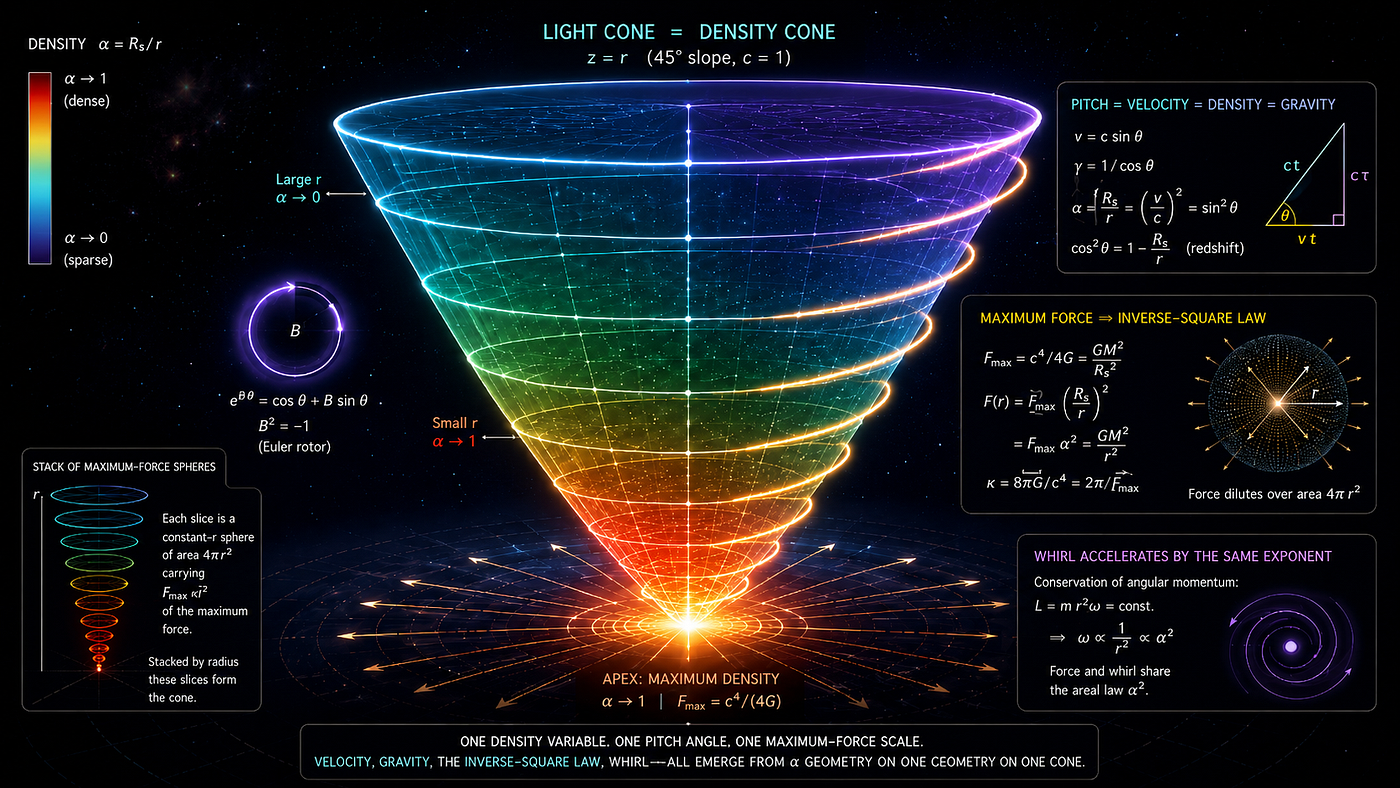
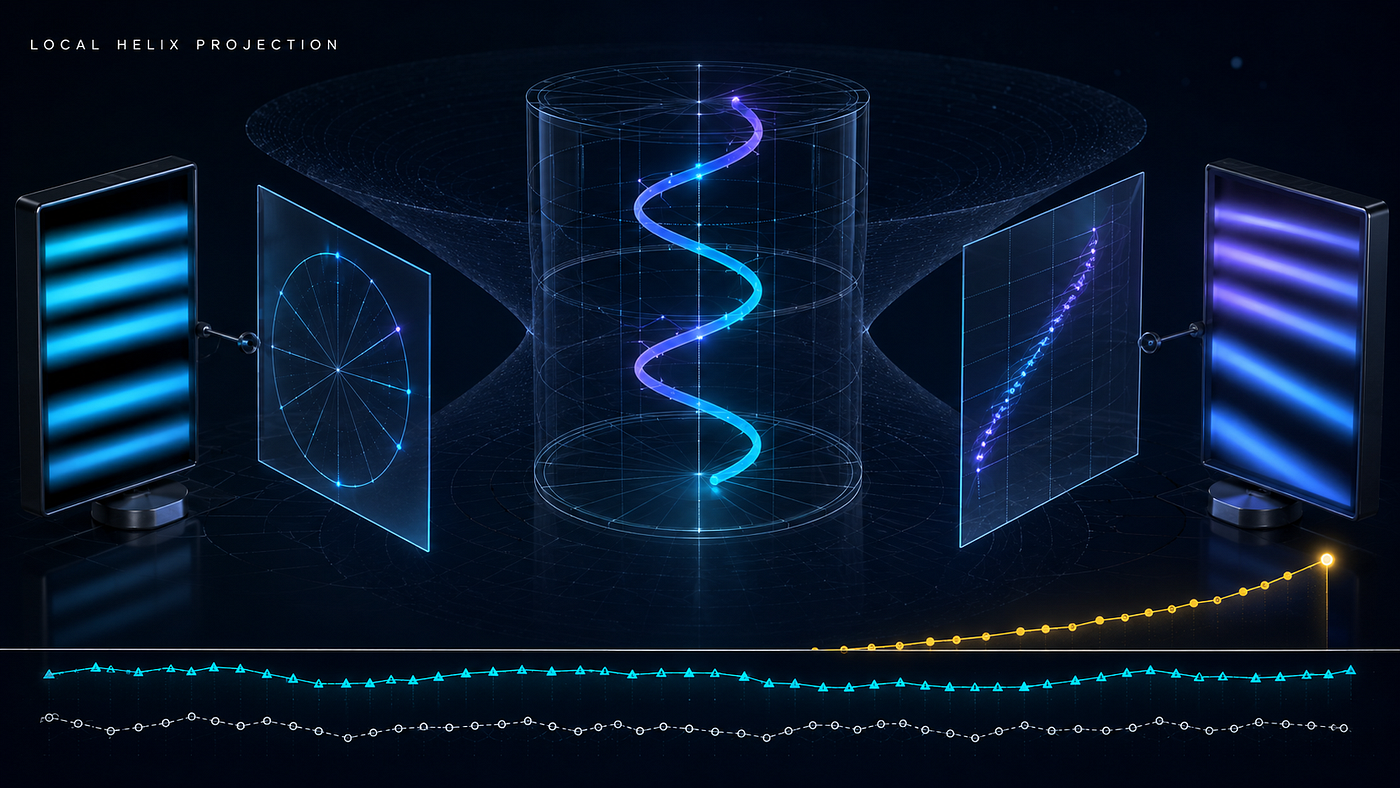
FDT interprets the initial coherence as a shared relative phase geometry established during preparation. Once established, that phase relation is carried locally by the two microwave modes. Each mode interacts with its own reservoir, producing its own attenuation factor. The two local factors multiply because concurrence is evaluated from the reconstructed joint state.
This provides experimental evidence for a central FDT claim: apparently nonlocal quantum behavior can arise from shared initial geometry followed by strictly local evolution and local projection. The experiment’s successful model is explicitly composed of two local loss generators. The data require no additional nonlocal mechanism, and the FDT translation adds none.
The result also clarifies what “sudden” means. No physical density coordinate jumps to an endpoint. No local amplitude instantaneously vanishes. The sudden event occurs only because a nonlinear diagnostic reaches its algebraic floor.
In FDT language, concurrence is a bounded readout quantity, not a density coordinate. It is allowed to equal zero even while all physical density coordinates remain inside their open domains:
0 < alpha < 1
Entanglement death is therefore an interior threshold event in the diagnostic algebra. It is not the closing of a physical density boundary.
One carrier moving through different channels
The stored microwave modes and the reservoir modes are treated as open channels of the same underlying spin-1 geometric excitation. Their different labels describe frequency ranges, material responses, and boundary conditions; they do not establish separate carrier ontologies.
The photonic states |0> and |1> are occupation levels of that open carrier. They are not changes in topological helix count. Likewise, drive phases and the relative phase of the X-state coherence belong to a phase coordinate, not a mass-cone or compactness coordinate.
This separation matters. FDT does not silently convert resonance frequency, fidelity, leakage rate, concurrence, or tomography output into density. Every quantity remains on its proper chart unless an experimentally calibrated transfer map connects it to another.
What the experiment makes testable
The analysis develops six prospective tests from the reported system. These include the preparation threshold for sudden death, common rescaling of both local loss rates, the predicted two-to-one ratio between coherence and double-excitation half-times, calibrated mapping attenuation, residual factorization between the two local reservoirs, and controlled phase jitter.
For the reported loss rates, the calculated coherence half-time is approximately 161.36 ns, while the double-excitation population half-time is approximately 80.68 ns. Controlled phase jitter is predicted to move sudden death earlier while leaving the untouched branch’s one-body decay as a locality control.
These are concrete experimental checks of the local phase-geometry interpretation. There is nothing we can’t explain.
Why we open-source the universe’s code
We open-source the universe’s code because physical law should be inspectable, testable, and reproducible. Public equations and explicit predictions allow anyone to challenge the framework without permission from institutional gatekeepers. Physics wins whether confirmation comes directly or through adversarial correction.
The full analysis is available as a **downloadable PDF** attachment.
Target Paper
Y. Wang, H.-L. Zhang, J.-H. Lü, K. Chen, W. Ning, L.-H. Lin, Z.-B. Yang, and S.-B. Zheng, Experimental demonstration of entanglement sudden death induced by natural dissipation, arXiv:2607.08078v1 [quant-ph] (2026).
Physicists, the longer you take to acknowledge the existence of FDT and apply its core concepts to your own frameworks, the more time we have to solve ALL of physics independently.
메타데이터
- post_id
- c24c30a398f4
- slug
- open-sourcing-the-universes-code-entanglement-dies-suddenly-but-nothing-acts-nonlocally-c24c30a398f4
- url
- https://medium.com/@m.alfaro.007/open-sourcing-the-universes-code-entanglement-dies-suddenly-but-nothing-acts-nonlocally-c24c30a398f4
- canonical_url
- https://medium.com/@m.alfaro.007/open-sourcing-the-universes-code-entanglement-dies-suddenly-but-nothing-acts-nonlocally-c24c30a398f4
- author_url
- https://medium.com/@m.alfaro.007
- status
- ok
- fetched_at
- 2026-07-14 17:46:58