Why the 2023 Alfa Romeo Giulia Qv SWB Z is the pinnacle of automotive design, or at least to my…
20 December 2022. Just another wintry day for most in the European hemisphere, but today marks the debut of the long-awaited (or ignored)…
Why the 2023 Alfa Romeo Giulia Qv SZ is the pinnacle of automotive design, or at least to my amateur mind…
20 December 2022. Just another wintry day for most in the European hemisphere, but today marks the debut of the long-awaited (or ignored) Giulia Qv SZ, the Zagato-bodied final iteration of the ultimate, petrol-powered Alfa Romeo sports car, the swan song of an era of rapid EV ascendancy and popularity.
Images first emerged in a teaser which, as teasers go, didn’t give away too much, but when the first images emerged, my jaw was on the floor…

Right, I’m lost for words seeing this — I mean it’s hands down the best automotive design in the past 10 years. Or even more. It’s a dissertation on the forms and shapes that are clearly evocative but at the same time referencing the coachbuilding tradition of the vintage motorcar of the interwar and postwar periods, where the bodywork is treated as an art form afforded by the practical purpose of the car, where the functionality the automobile with its specific historical lineage and evolution should be reflected in the form, proportion, graphics, and detailing of the resultant vehicle. It is precisely the set of unique attributes that distinguish automotive design from mere product design, due to the status of the automobile and the concepts it represents in the collective culture and consciousness.
The proportions are picture-perfect and there’s simply not a bad angle to this masterpiece — it’s a feast to the eyes, and as with every outstanding automotive project, the more you stare at it, the more you begin to appreciate its finer, subtler details — in short, Carrozzeria Zagato really knows how to bend sheet metal.
The coachwork is finely tailored in that there’s not an inch of excess — no ridiculous creases and vents that appear garish or jarring to appease the wider, Instagram-hungry audience here, a breath of fresh air after the recent horrors at BMW and the like, a textbook example of a perfectly-balanced restraint that seemed to have long departed the automotive arena.
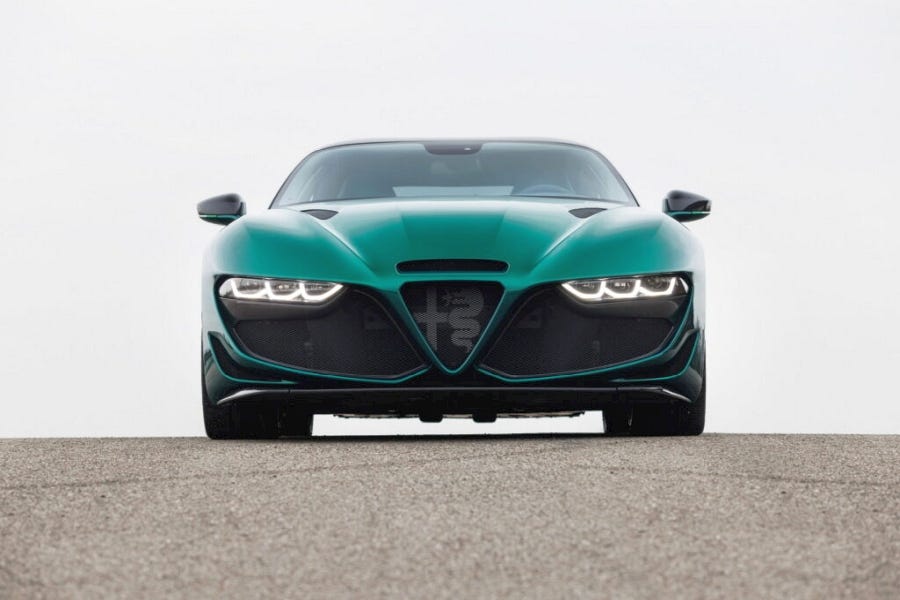
The dead-on front aspect hints upon the Miura-inspired Montreal supercar of Gandini fame, the signature Alfa “Scudetto” grille as the dominant feature, adorned with the central inlet just above, flanked by air inlets in the form of blacked out negative space, combined with the triple headlight units on either side, create an intricate, layered structure to the front fascia that clearly reference classic Alfa/Zagato collaborations such as the 105 series Junior Z (a clear Perspex panel replacing the conventional front grille area with a hollowed out Scudetto imprint and headlights sitting behind), and the SZ/RZ duo (tripartite headlights with a heavily stylised integral grille/clamshell bonnet due to their use of pioneering composite bodywork materials).

The frontal view of the Alfa Montreal supercar penned by Gandini during his tenure at Bertone. Often dubbed the baby Miura, the use of negative space to incorporate the Alfa scudetto grille with the front fascia and the half-concealed pop-up headlights were design elements that clearly influenced the new Giulia Zagato.

The front view of the Junior Z is pure Zagato weirdness with the clear perspex front with faired-in quad headlights that helped aerodynamics and the stylised representation of the Scudetto grille; the overall wedge-like fastback proportions also influenced other compact sports coupes such as the Honda CRX.

Official shots of the old and the new, the tripartite headlights from the SZ/RZ of the late 80s clearly influenced the new car; it’s however noted that the SZ/RZ duo were allegedly designed in-house by Centro Stilo Alfa, with Zagato only responsible for the production.
The overall surfacing is a dissertation in the cross-pollination of modern aerodynamics and classical sculpture. The fade in and fade out of the creases on the front wings are tightly draped over the front axle and masterfully aligned to give the impression of a smart, suave suit, a clever hint to the potency beneath the bonnet; the central double creases on the bonnet create a slight power hump that tapers beautifully to the front to join and terminate at the lower tip of the front Scudetto grille; the front extreme corners are dressed with slotted vents that run parallel with the central main vents, which, together with the almost dainty front splitter, create an unmistakably Alfa face with enough clues to suggest its exclusivity over the “standard” Giulia.

Of chief interest is the slight crease over the front wings aligning with the centre-point of the composite headlight unit and blending into the shoulder line, creating a surface tension and in turn an organic quality to the otherwise inert metalwork.
The sophisticated surfacing continues over the rear haunches, with the shoulder line gradually blending into the radius of the rear wheelarch, and the reverse kink across the surface forming a highlight in a compressed Z-shape, doubly relevant in echoing the Zagato heritage while contributing to the prerequisite (or perhaps an abused but decidedly valid cliché) of any sports car design being able to “look fast while at a standstill”.

The double-bubble roof and the partially blacked-out glasshouse flows into the centrally-raised Kamm tail; also note the Z-shaped highlights formed by the base of the C-pillar and the complex radii of the wide rear haunches, a subtle nod to the creators, Carrozzeria Zagato.
The side profile is dominated by the flowing shoulder line that span the entire length of the car, with an almost impossibly low bonnet line, deeply scalloped doors/sides, and the well-defined sill panels to suggest an organic skin tightly draped over a muscular skeleton; the overall height is just right at almost exactly twice that of the wheels, and the blacked-out pillars around the glasshouse further reduces the visual height of the vehicle; which, together with the aforementioned low bonnet, create a planted, road-hugging stance.

The side profile is a textbook example of balanced proportions, the dash-to-axle ratio clearly places the visual weight on the rear, appropriate for a FR sports coupe; the overall height is maintained to be no more than twice the wheel diameter, and the extended line from the A-pillar ends squarely at the centre of the front axle.
The double-bubble roof is a signature design cue of Zagato of course, and here it flows gracefully into a fastback-style rear, into the centrally-raised ducktail rear bootlid spoiler which at the same time is further defined by the strip taillight following the contours and radii of the truncated Kamm tail. We could certainly see the elements drawn from the classic TZ and TZ2 racecars with their similar cutoff Kamm posteriors that contribute to aerodynamics and high speed stability on the racetrack. The rear diffuser follows the raised centre section of the bootlid spoiler contours and sports a centrally-mounted twin exhaust rear section, tightly organising the design cues without overwhelming the eyes with any in-your-face bold vulgarity.

The TZ (above) and the TZ2 (below). Both showing the same flowing lines that got truncated by a Kamm Tail for the benefit of aerodynamics on the racetrack, particularly high-speed stability. The later TZ2 has an even more dramatic lowered bootline to slice through the air more effectively, its mechanicals snugly fitting within its graceful yet aggressive racebred bodywork.

All this visual drama would be nothing unless it’s based on sound underpinnings, and here it doesn’t disappoint. A restyling exercise of the Giulia Quadrifoglio, the SWB Zagato has 100mm taken out of its wheelbase (hence the SWB moniker), and benefits from the same 2.9l Ferrari-derived, 90-degree twin turbo V6 powerplant, mated to a six-speed manual transmission which has always been available only in LHD format for the standard Qv. This appears to be the last hurrah of the outgoing carbon-fibre Giorgio FR underpinnings, which will soon be discontinued as Alfa Romeo (and by extension the Stellantis Group) move onto other hybrid and electric platforms.
This amounts to a complete, correct, sports coupe package that’s incredibly attractive and desirable, an instant classic, a rare gem in the contemporary automotive scene dominated by trend-chasing “global cars”, a return to the core qualities of the expression of the automobile and how it transforms the way we interact with society.

One-off specials are the norm these days, especially with high-end supercar and luxury car manufacturers. Must us plebians all be deprived from good design?
Alas, a fortunate (and likely extremely well-off) German owner has commissioned Carrozzeria Zagato to create this masterpiece as a one-off, which really is a shame for us all; however, what could carmakers and designers learn from this eloquent thesis that transcends borders, categories, and trends, particularly in their mass-market offerings? Do we always have to look up to unicorns such as supercars / hypercars or impossibly rarefied concept cars as the only icons in the automotive world? What’s actually wrong with automotive design today?
AlfaRomeo #Giulia #Zagato #Automotive #Design #classic #Carrozzeria #cars
메타데이터
- post_id
- c24e2d1fdf64
- slug
- why-the-2023-alfa-romeo-giulia-qv-swb-z-is-the-pinnacle-of-automotive-design-or-at-least-to-my-c24e2d1fdf64
- url
- https://medium.com/@themasterswitch/why-the-2023-alfa-romeo-giulia-qv-swb-z-is-the-pinnacle-of-automotive-design-or-at-least-to-my-c24e2d1fdf64
- canonical_url
- https://medium.com/@themasterswitch/why-the-2023-alfa-romeo-giulia-qv-swb-z-is-the-pinnacle-of-automotive-design-or-at-least-to-my-c24e2d1fdf64
- author_url
- https://medium.com/@themasterswitch
- status
- ok
- fetched_at
- 2026-07-26 08:17:08