Funding Secured, Future Uncertain: Concerns of CTA Commuters and Experts
By Vanessa Medina-Araiza and Leslie Rodriguez-Michel
Funding Secured, Future Uncertain: Concerns of CTA Commuters and Experts
By Vanessa Medina-Araiza and Leslie Rodriguez-Michel
For years, CTA users have learned to navigate slow zones, delays, packed cars, and hazardous stations. Now, with $1.5 billion in new state funding from regional sales and redirected fuel taxes aimed at stabilizing the transit system, many commuters say uncertainty still lingers with them each day.
DePaul student Leonard Losoya, 19, is one of thousands of commuters who rely on the CTA buses and trains to get across the city for school and daily activities.
“Since starting college, I use the CTA constantly,” Losoya said. “But the delays and safety issues haven’t gone away just because of this new funding.”
Losoya’s concern highlights a larger conversation across Chicago: Although the secured funding has helped avert immediate service cuts, transit experts warn that deeper issues remain — issues that can shape how the city operates in the years to come.
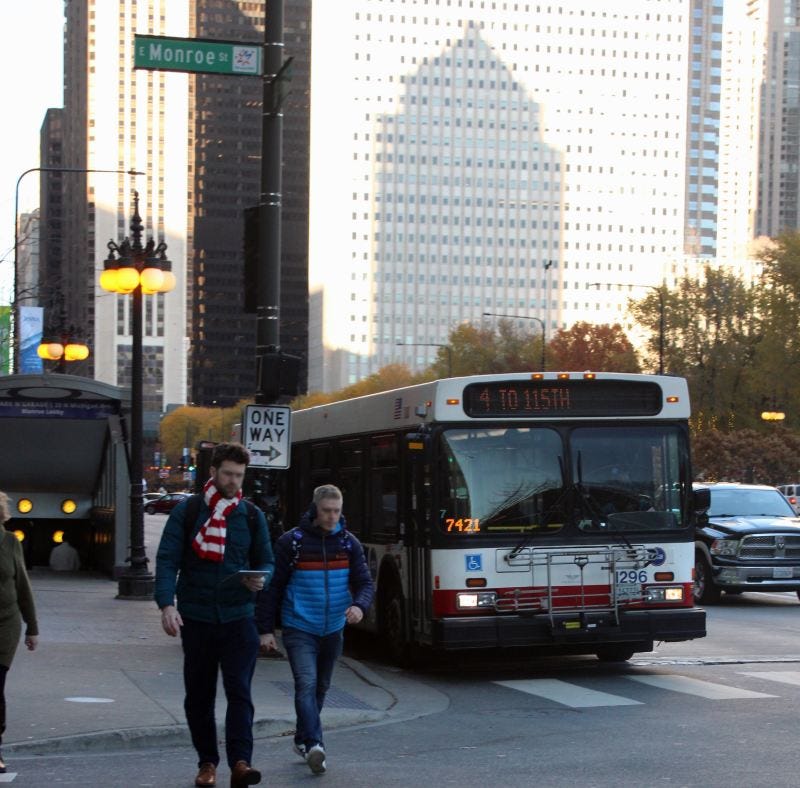
Pedestrians crossing Monroe Street near a CTA Route in downtown Chicago, Nov. 27, 2025. Photo by Leslie Rodriguez-Michel
The funding arrived after months of uncertainty from local agencies about emerging budget gaps of $771 million for the region, which was originally, but later revised to approximately $200 million for 2026, a figure that threatened the reduction of services from trains to buses across multiple lines. Though the financial crisis has been temporarily stabilized, questions surrounding safety, reliability, and long-term investments still remain for transit officials and especially riders alike.
The Chicago Transit Board unanimously approved a balanced $2.23 billion operating budget for the CTA on Nov. 12, after months of uncertainty about the future of public transit in Chicago. The agency was facing a projected $202 million funding gap for 2026 that would have included potential service cuts and fare increases.
[embed]
The approved budget for 2026 includes no fare increases, no service cuts, and no layoffs. With the operating budget 3.2% higher than the 2025 budget, there will be service enhancements, strengthened security, enhanced cleaning measures, and an expansion of their accessibility initiatives. Along with the approved 2026 CTA budget, the board also approved the agency’s $6.75 billion, five-year Capital Improvement Program that prioritizes projects like Red Line extensions and new vehicle purchases.
Dr. Joe Schwieterman, a professor at DePaul University’s School of Public Service and the Director of the Chaddick Institute for Metropolitan Development, suggested that even with the new improvements that are coming with the approved budget, the proposed projects for the CTA are insufficient.
“We lack a flagship project that makes the whole system work better — like better downtown connections or unifying Metra and CTA operations,” Schwieterman said.
Schwieterman’s comment makes a clear point about the broader concern shared by many transit users: even with the funding introduced, the system still fails to deliver the level of reliability and comfort that many riders expect. This new budget may have prevented immediate service cuts, but it doesn’t resolve the longstanding issues that have made it harder for commuters to fully rely on the CTA.
For everyday CTA users, such as Losoya, the result of these unresolved issues manifests in small but significant ways. Something as simple as a single mistimed bus can ruin an entire morning.
“If I miss the Pershing bus, I usually wait 20 minutes or more for another one,” he said.
“Adams and Wabash look like it’s about to fall apart. The rust is everywhere.”

Source: Google Trends, accessed December 2025
Recently, safety issues in the CTA have become transit users’ main concern, with several violent crimes taking place in various heavily transited routes. This concern intensified following a Nov. 17, 2025 incident in which a 26-year-old woman was set on fire on the CTA Blue Line by a 50-year-old man. Although Mayor Brandon Johnson has called this fire attack an “isolated incident,” it highlights the urgent need to address these safety concerns.
Another incident that has made headlines is one of multiple men named the “Loop punchers” who have committed several random attacks on women in Chicago’s Loop and train stations. Although one of the perpetrators has been recently sentenced to seven years in prison, many residents have expressed frustration with the authorities, who have allowed these serial punchers to terrorize riders for months.
Safety issues have become so prevalent that many riders are choosing alternative modes of transportation. Dr. P. S. Sriraj, the Director of the Urban Transportation Center and a Research Professor at the University of Illinois Chicago, said that the recurring safety issues for transit users and improving ridership should become one of the main priorities for the CTA with their new approved funding.
“Safety and ridership: post-pandemic, low ridership allowed unsavory elements to occupy the system,” Sriraj said. “Now the CTA struggles to reverse it, causing a vicious cycle — low safety leads to lower ridership.”
A decline in ridership would lead to budget cuts throughout the CTA, leaving many without a mode of transportation that is both economical and avoids traffic congestion. In Chicago, fares cover approximately half of the operating costs; the remaining costs are covered by the state through the Regional Transportation Authority (RTA).

Downtown Chicago Transit Authority on a Sunday evening, Nov.29, 2025. Photo By Leslie Rodriguez-Michel
This funding mechanism has created gaps in the CTA’s funding, as seen in previous years, including 2005, 2008, 2012, and 2024. For Illinois to have a more stable funding mechanism for public transportation, it needs to utilize better taxation tools, such as those used by NYC, which employs the mortgage transfer tax.
[embed]Vanessa Medina- Araiza — Interview with Professor Dr. P.S. Sriraj, University of Illinois Chicago
In order for the CTA to stay afloat, it needs to improve various aspects of the service it provides to riders. Sriraj said that with apps like Uber and Lyft, which offer short wait times and safer commutes, the CTA will have a hard time competing with the services these companies provide to riders.
“CTA must compete with automobiles and rideshare,” he said. “With short average CTA trip lengths, Uber is a real competitor. CTA must improve comfort, reliability, quality, and highlight environmental benefits.”
Your Thoughts
— — — — — — — — — — — — — — — — — — — — -
What do you think the CTA should prioritize with this new funding to improve itself?
Leave a comment below and let us know your thoughts
메타데이터
- post_id
- c25d25f3ce53
- slug
- funding-secured-future-uncertain-concerns-of-cta-commuters-and-experts-c25d25f3ce53
- url
- https://medium.com/@lr134340/funding-secured-future-uncertain-concerns-of-cta-commuters-and-experts-c25d25f3ce53
- canonical_url
- https://medium.com/@lr134340/funding-secured-future-uncertain-concerns-of-cta-commuters-and-experts-c25d25f3ce53
- author_url
- https://medium.com/@lr134340
- status
- ok
- fetched_at
- 2026-06-14 11:28:49