Latour’s “What is Iconoclash?”
…But reimagined as Iconic Iconoclasm
Latour’s “What is Iconoclash?”
…But reimagined as Iconic Iconoclasm
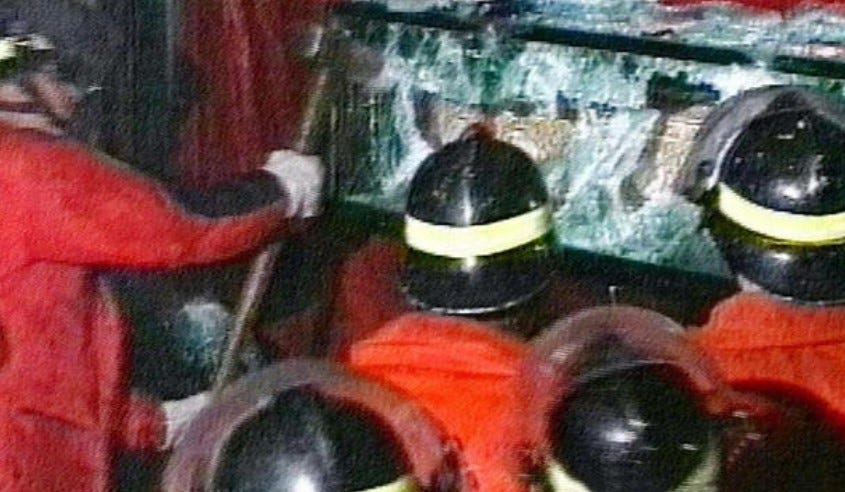
Firefighters Saving the Shroud of Turin by Raidue/Getty Images
Last year I fell in love with Semiotics…Not necessarily semiotic analysis or specific semiotic theories, although I enjoy that too, but Semiotic philosophy — W.T.J. Mitchell, Roland Barthes, and Bruno Latour.
In Bruno Latour’s What is Iconoclash? Or Is There a World Beyond the Image Wars? (you can find the piece here)
He shows that image destruction has always coexisted with a cascade of image production, visible in traditional Christian images as well as in scientific laboratories and the various experiments of contemporary art, music, cinema, and architecture.¹
Iconophilia is the phenomenon of making or clinging to images and representations. In contrast, iconoclasm is the destruction of images and representations, iconoclash is the exchange and seeming battle between the two. Iconophiles form attachments to images and representations while iconoclasts, with various motivations, seek to erase or counter those representations. According to Latour, there is a dialectal relationship between the two sides that has a long history, and he argues, no end in sight. The dialectic has a definitive trajectory though, a forward movement through history, but the story will never end because humans will always seek to make images and representations.
This is Latour’s iconoclash.
In his words,
“No matter how adamant one is about breaking fetishes and forbidding oneself image-worship, temples will be built, sacrifices will be made, instruments will be deployed, scriptures will be carefully written down, manuscripts will be copied, incense will be burned, and thousands of gestures will have to be invented for recollecting truth, objectivity, and sanctity.”²
So iconoclash is imagined as a ceaseless, temporal process that happens over the course of history.
But what if we are to reimagine iconoclash not as a dialectic but as a paradox that occurs as in a ‘happening’? I’m definitely drawing on French philosophy for this term, but in a different sense. Sometimes, an event, although unfolding in a temporal way, is iconically a single ‘event’. In some cases, these events are simultaneously iconoclastic and iconic when understood as a single ‘happening’, creating a paradox of iconography and iconoclasm, and a different concept of iconoclash. Though the paradox of iconoclash does not apply to all iconoclastic acts, there is, arguably, a subset of these where the iconoclasm itself is iconic, so that an image perishes through the creation of another representation in a single event. In certain cases, the iconoclasm is so bold and public, and so clearly points to what is signified that it is at once iconic in the event and the resulting images.
A clear example of paradoxical iconoclash is the fall of the Berlin Wall. The event was the destruction of an icon of communism, which itself became an icon for the fall of the iron curtain. For those alive at the time, or students of history, there are copies and copies of images that differ only slightly in its visual imagery so that the image of the iconoclasm is emblazoned in our minds. In this event, the iconoclasm was iconic. Though the wall was always an icon, it reached a new status of iconography only when it was destroyed.
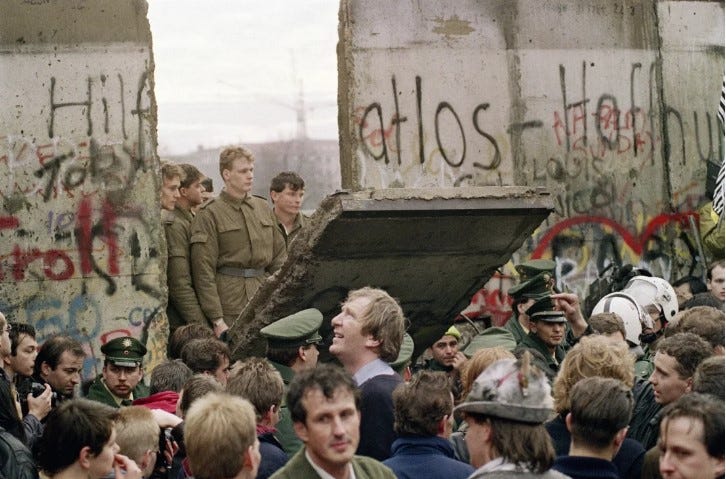
Fall of the Berlin Wall by Gerard Malie/Getty Images
Similarly, when Sinead O’Connor tore a picture of Pope John Paul II during a Saturday Night Live musical performance in 1992, the iconoclasm was captured on film, and a quick google search reveals a litany of copies of the footage of her performance. Here too, iconoclasm was iconic, begetting a species of iconophilia. In one sense, O’Connor meets the criteria for Latour’s typology for Iconoclast C, who are not against images, except of their opponents. But wait — O’Connor herself is an iconic iconoclast. I use the present tense here because in spite of her death, her iconic status as iconoclast persists. By tearing up that photograph, not only was the iconoclastic act iconic, but she herself became an icon for iconoclasm in the event. Upon her death, social media posts most frequently remembered and idolized her for iconoclastic acts — tearing up the photograph of the pope, and shaving her head to destroy the beauty standard she had represented.

Sinead O’Connor on Saturday Night Live by NBC/New York Times
Amid the wave of discoveries of mass graves from Canadian residential schools in recent years, iconoclasm was rampant. Churches were burned and statues were toppled or doused with paint.
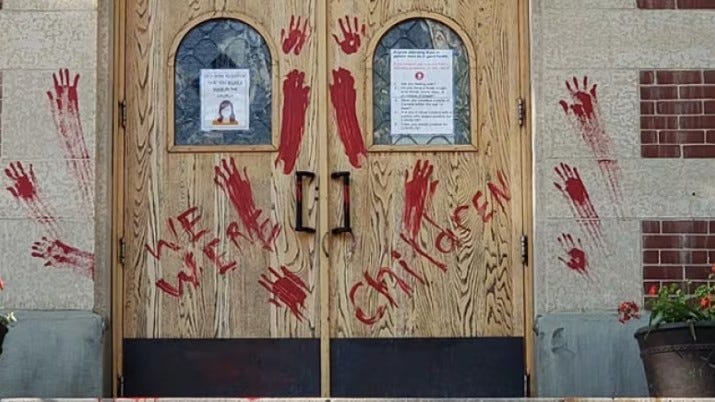
St. Paul’s Cathedral in Saskatoon by Donna Heimbecker/CBC
The visual impact of the vandalism of a Saskatoon Cathedral was more like a piece of art than typical vandalism. Carefully framed on the doorway, the words and handprints presented a clear visual representation of the ghosts of residential school children; unlike much of the other iconoclasms at the time, it was left untouched while much of the painting of churches and statues had layers of words and images. This resulted in photographs of the painted doorway circulating widely and rapidly through news and social media. While the vandalism was iconoclastic, when we look at the photos, we don’t see iconoclasm, we see an icon. We don’t see the desecration of a church, we see the image created by the paint, and the rapid recirculation of an image.
Latour alludes to 9/11 as a peak iconoclasm that forever disrupted our moral evaluation of iconoclasm. But this fails to tell the whole story of 9/11 — no single book, image or description ever will. 9/11 was a cataclysmic destruction of a daunting symbol of the capitalist Western empire. But the immediately recognizable clips of the event are inscribed in our minds as a moment in time when the world changed.

Twin Towers Attack by Specer Platt/Getty Images
When the event happened, when the world watched on September 11, 2001, the images were so profoundly shocking, that regardless of the historic events that followed, the images we saw were permanently imprinted in our minds. The event and the footage captured of it are icons, images, representations of a new world order where disorientation and fear dominate. It was not only two minutes of the absolute destruction of iconic edifices, but in the same time frame the creation of new images and representations of equally epic proportions. The images represent the real birth of islamophobia, 100mL carry on limits, and a new Western epoch.
This is to say nothing of the 911 Memorial Museum. How do we make sense of this in the world of iconoclash?
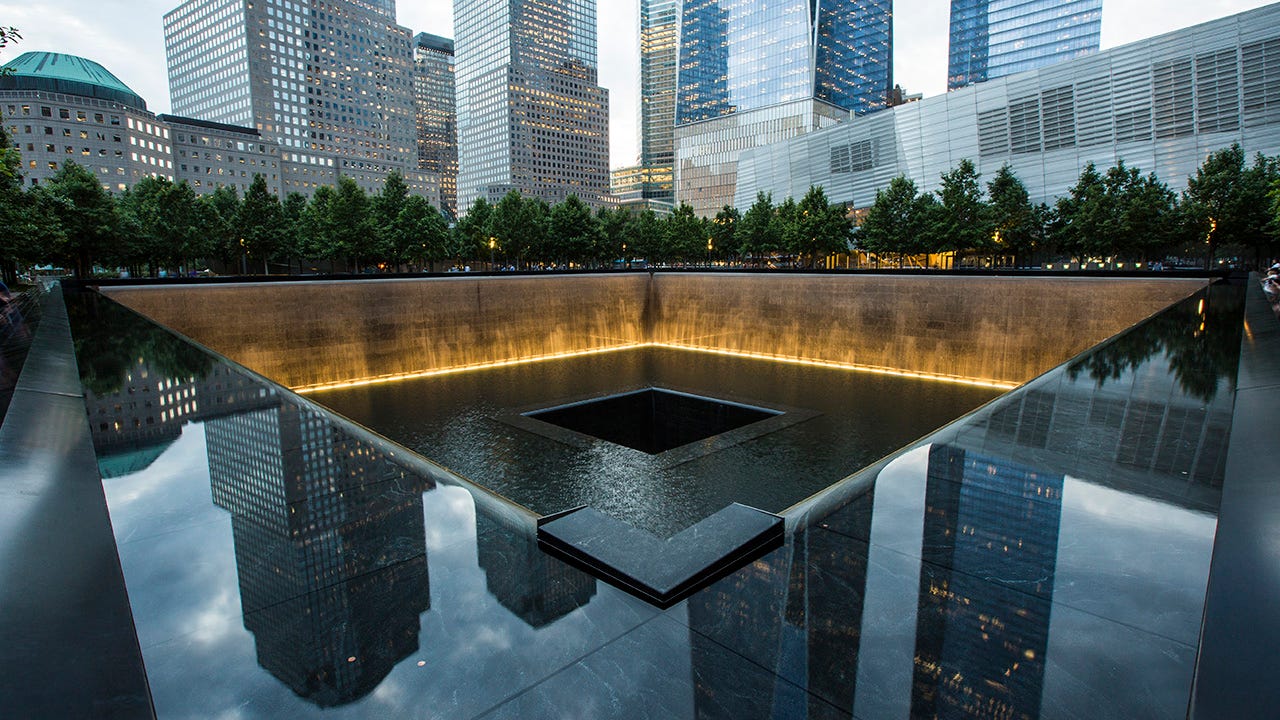
Reflecting Absence photo by Jin S. Lee
Titled Reflecting Absence, the memorial pools are set in the footprints of the World Trade Centre towers. They are a juxtaposition of a depression in the landscape where skyscrapers once stood. The waterfall flows into a seeming void in the center. The memorial depicts in a negative way by depicting absence or nullity rather than a positive way by presenting an image. In its absence of images, what results is an image of absence. While not an iconic iconoclasm, perhaps the memorial can be understood in its depiction of the absence of what was, as an iconoclastic icon. Maybe this is a stretch, but it is at the very least an icon of iconoclasm. When we play with the various ways in which images can be related to image destruction, the network of ways they interact forms a complex and irregular web.
Perhaps Latour envisioned iconic iconoclasm inclusively in writing iconoclash. The introduction describes the scene of firefighters breaking glass to save the shroud of Turin in an iconoclash that is contained in a ‘happening’, similarly though not identical to what I have suggested here. In Latour’s example, it is not the smashing of the glass, the iconoclasm itself that is iconic, it is the shroud behind it. In this sense, although iconoclasm and icon are both present in a single event, the representation being broken or created is not the same. The breaking of the glass is not iconic in itself. In this way, the overall impact of the piece leaves the impression of perpetual and temporal dialectic. I’m not trying to invalidate or challenge Latour, but more to twist or contort the notion of iconoclash into something slightly different. Iconoclash can be more than one thing. Even though the notion of a paradoxical iconoclash is based on Latour’s dialectic iconoclash, the inspiration shares more in common with T.J. Mitchell. Representations are different ways of representing another representation. Similarly to Mitchell, the aim is to show that representations are more like Yayoi Kusama’s Infinity Mirrors.

Yayoi Kusama’s Infinity Mirrors by artist/ David Zwirner/Ota Fine Arts/Victoria Miro
Even here, the representation of an art installation (which is itself representative) is used to convey notions of semiotics. In a sense we cannot really separate iconophilia from iconoclasm, even though they are contradictory — this is the nature of a paradox. Although they can be binary opposites, they can also coinstantiate. The nature of images is not so simple, not just two polarities in a progressive dialectic but an elaborate series of mirrors, which indeterminately represent likeness, but also change form and angle with each reflection, sometimes reflecting back on itself in the process.
So who cares? — Why is this relevant? What are its implications? Why does this happen?
A reimagined iconoclash is a humble attempt to articulate an idea. Iconoclash is not just a representation of an idea, but a representation of fractured and kaleidescopic concepts, from different angles, creating permutations of images and ideas. Its purpose is to add something, rather than to critique, or subtract. The paradox of iconoclash is a spark, it does not have much momentum on its own, but the potential flame is not fueled by responding to the questions that academic discourse asks of it, it is fueled by igniting another wick. Your wick. The idea and its relevance can certainly be made into matters of fact, to be sacrificed on the alter of critique, but I would far rather make a humble attempt to articulate them as grist for someone else’s mill. Academic thought is not simply advanced by critique, but through reading a new perspective.
I hope it helps you think critically, I hope it gives you an idea — just as Latour did for me.
¹Summary from Bruno Latour’s website, available here ²Bruno Latour, “What is Iconoclash? Or is There a World Beyond Images” in Iconoclash ed. Bruno Latour and Peter Weibel (Karlsruhe, Germany: ZKM, 2002), 24.
*Bruno Latour is an interdisciplinary scholar, first trained as a philosopher, then as an anthropologist. His books and articles range from the philosophy, history, sociology and anthropology of science, climate change, to work in science policy and research management.*
메타데이터
- post_id
- c2698f01a18c
- slug
- latours-what-is-iconoclash-c2698f01a18c
- url
- https://medium.com/counterarts/latours-what-is-iconoclash-c2698f01a18c
- canonical_url
- https://medium.com/counterarts/latours-what-is-iconoclash-c2698f01a18c
- author_url
- https://medium.com/@alisonforster17
- status
- ok
- fetched_at
- 2026-07-22 18:24:31