Kicking Off a New Study on Metabolic Health with Cook Island Communities in Aotearoa New Zealand
Variant Bio recently launched a study with Novo Nordisk, this time in partnership with the University of Otago and Pukapuka Community Group
Kicking Off a New Study on Metabolic Health with Cook Island Communities in Aotearoa New Zealand

Dr. Jaye Moors (third from left, standing) and members of the Cook Island study team trying out medical devices used in the study. Photo credit: Olivia Gray
A few months ago, I wrote about a project that Variant Bio recently launched together with Novo Nordisk and Oceania University of Medicine in Samoa. This followed shortly after we announced the launching of a new project with Novo Nordisk and the Catholic Hospital Group of Lille focused on inflammatory and metabolic conditions in Tahiti. Now, I am thrilled to announce that we have kicked off recruitment for a third new project with Novo Nordisk, this time working with Cook Island communities living in Aotearoa New Zealand, in partnership with the University of Otago and Pukapuka Community Group in Auckland.

Map of the Cook Islands, an island country in Polynesia, which includes the main island of Rarotonga to the south and the island of Pukapuka to the north. Image credit: Matt Blacka et al.
As detailed in an article highlighting our collaboration with Novo Nordisk in *The New York Times *last year, Aotearoa New Zealand is the first place that Variant Bio co-founders visited in order to propose partnering with Indigenous and underrepresented communities on a genomic research project. Over the past seven years, Variant Bio has steadily built a relationship of trust and reciprocity with Pacific partner communities in Aotearoa, as well as research collaborators at both the University of Otago and the Pukapuka Community Group. For this reason, our newest project in Auckland feels like a natural evolution of the work we did with the Pukapuka community there in 2023, which was also led by Professor Tony Merriman, a world-renowned gout researcher, Mr. Nuku Rapana, President of the Pukapuka Community Group, and Dr. Colin Beumelburg-Poyila, a Pacific medical doctor.
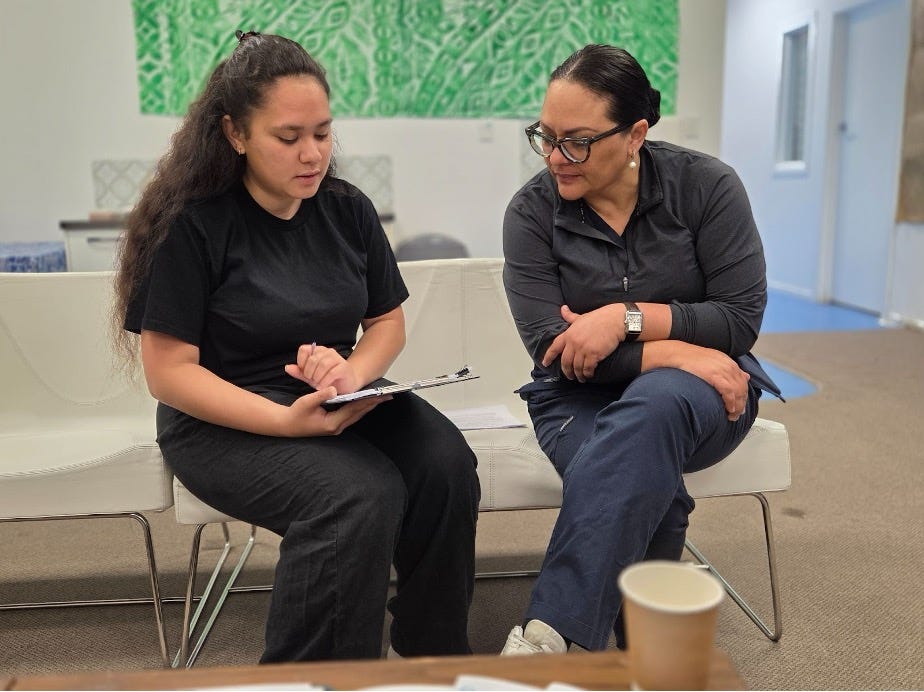
Variant Bio Standley Fellow Temoe Neuffer (left), practicing the informed consent process for the study together with Dr. Tapaeru-Ariki French. Photo credit: Olivia Gray
This time, for the larger project with Cook Island communities in Auckland, the study team also includes Temoe Neuffer, a Variant Bio Standley Fellow. Temoe is a recent graduate of Ōtākou Whakaihu Waka, the University of Otago. Originally from Tahiti and Raiatea in Mā’ohi Nui, French Polynesia, she is passionate about the genetic diversity of Pacific populations and the ethically grounded application of genomics in health and population research. Since beginning her Fellowship with us, Temoe has gained hands-on experience training on the use of medical devices needed for the study, administering informed consent, health questionnaires, and phenotypic measurements, and many other aspects of study implementation.

Left to right: Project manager Ratu Rapana from the Pukapuka Community Group in Auckland together with study team nurses Rebecca Nielsen and Frosey Tearoa-Vekene. Photo credit:Olivia Gray
As is the case for the study we are currently carrying out in Samoa, this project also includes a governance committee (Kaitiaki Group) made up of Cook Island community leaders. The Kaitiaki Group will share updates on the study locally and receive feedback on and advise on matters such as sample and data processing throughout the lifespan of the project. Working with the Kaitiaki Group aims to ensure that community voices are included throughout the research process, and the group’s role is clearly outlined in the study’s ethics protocol, participant information sheet, and research collaboration agreement between Variant Bio and the University of Otago.

Rebecca Nielsen practicing a blood draw ahead of the study launch. Photo credit: Jaye Moors
Before launching the project in November of last year, my colleague Dr. Olivia Gray and I trained the study team together in Auckland. While she was there, Olivia also presented overall results from the 2023 study with the Pukapuka community. This presentation was an extension of the results we already returned in 2024, and focused on the recent analysis of genetic data collected during the study. Specifically, she shared with the community how the measurements and traits collected during the study could be analyzed along with genetic data to deepen our understanding of the links between genes and health. She highlighted unique features of genetic variation in the study cohort including a protective genetic variant in a gene known as Apolipoprotein-E (APOE). This genetic variant was found at unusually high frequency in the community compared to other groups — both within Polynesia and globally — potentially helping to explain historically low cholesterol in Pukapukan people first documented in the 1960s.
The presentation was followed by enthusiastic discussion, questions, and suggestions from community members on how to interpret the data and what else to examine as analysis continues. In addition to sharing new findings, this discussion highlighted the success of our first collaborative study, the value of community insight and input on analysis, and the great potential of our new research project with Cook Island communities in partnership with Novo Nordisk, the University of Otago, and the Pukapuka Community Group.

Dr. Olivia Gray from Variant Bio presenting study results from a 2023 study with the Pukapuka community in Auckland. Photo credit: Jaye Moors
메타데이터
- post_id
- c26e5ae6cfb4
- slug
- kicking-off-a-new-study-on-metabolic-health-with-cook-island-communities-in-aotearoa-new-zealand-c26e5ae6cfb4
- url
- https://medium.com/variantbio/kicking-off-a-new-study-on-metabolic-health-with-cook-island-communities-in-aotearoa-new-zealand-c26e5ae6cfb4
- canonical_url
- https://medium.com/variantbio/kicking-off-a-new-study-on-metabolic-health-with-cook-island-communities-in-aotearoa-new-zealand-c26e5ae6cfb4
- author_url
- https://medium.com/@jaye_90985
- status
- ok
- fetched_at
- 2026-06-11 05:11:55