The Book of Disquiet
The Art of Being No One: On The Book of Disquiet
The Book of Disquiet
A Companion in Silence
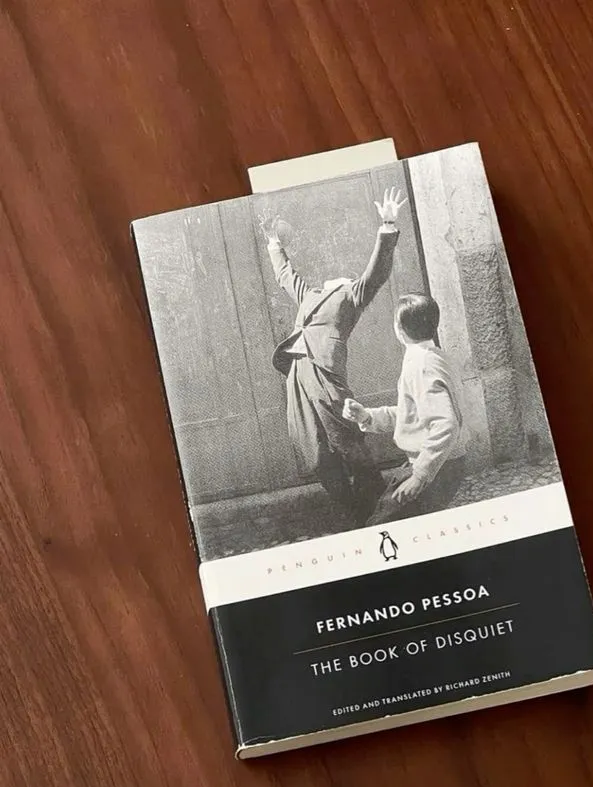
Photo by author
I first read The Book of Disquiet during the early days of the pandemic. It was a time when the world felt still yet heavy with uncertainty, and days blurred into each other.
Somehow, it was the perfect moment to encounter this book. From the very first word, I fell in love with it.
Some books find you when the time is right, slipping into your life like a whispered confession.
Now, when I’m in the right mood, those quiet, reflective nights when the world feels slightly out of reach, I find myself grabbing it again. And every time, it speaks to me differently.
This isn’t a book you read once and move on from. It lingers, like a dream half-remembered, pulling you back when you least expect it.
Fernando Pessoa’s The Book of Disquiet isn’t a novel. It’s not even a book in the traditional sense.
It’s a collection of fragmented thoughts — a lifelong project Pessoa never completed, left behind in a trunk, unpublished in his lifetime.
The words belong to Bernardo Soares, one of Pessoa’s many literary personas (or heteronyms, as he called them), one of the most enigmatic writers of the 20th century.
Pessoa was a poet, philosopher, and literary chameleon, known for creating dozens of heteronyms — fictional identities with distinct personalities, writing styles, and perspectives. Soares is one of them: a quiet Lisbon office worker who watches life from a distance, always observing, rarely engaging, and existing in a state of restless sadness.
The lack of structure makes the book feel even more intimate, like reading someone’s private journal. There is no plot, no resolution — just thoughts, emotions, and moments of clarity followed by deep uncertainty.
Reading The Book of Disquiet feels like having a conversation with yourself — the version of you that only comes out when the world is silent. Soares reflects on loneliness, ambition, dreams, and the Familiar rhythms of daily life.
Some passages are breathtakingly poetic; others are brutally honest. One moment, he admires the world; the next, he questions the meaning of existence itself.
It’s a book for those who have ever felt out of place, who have questioned their purpose, who have stood at the window watching the world move forward while feeling strangely detached from it.
Pessoa doesn’t offer answers, only reflections — and somehow, that makes the book feel even more personal.
I don’t read this book from start to finish. I open it at random, letting fate decide what thought I need to come across at that moment. Sometimes it’s a passage that makes me pause and re-evaluate everything; other times, it’s a sentence that simply makes me feel understood.
It’s not a book for everyone, and it’s certainly not one you rush through. But if you find yourself drawn to quiet solitude, to the beauty and weight of passing thoughts — then maybe, like me, you’ll keep returning to The Book of Disquiet, whenever the mood is right.
There are books that guide you, books that challenge you, and books that provide an escape.
The Book of Disquiet does none of these. Instead, it sits beside you, mirroring your own restlessness, your own quiet longing. It’s not for everyone, and it’s certainly not a book to rush through.
“There are metaphors more real than the people who walk in the street. There are images tucked away in books that live more vividly than many men and women. There are phrases from literary works that have a positively human personality. There are passages from my own writing that chill me with fright, so distinctly do I feel them as people, so sharply outlined do they appear against the walls of my room, at night, in shadows… I’ve written sentences whose sound, read out loud or silently (impossible to hide their sound), can only be of something that acquired absolute exteriority and a full-fledged soul.” -Pessoa, The Book of Disquiet.”
메타데이터
- post_id
- c287fc3b40ff
- slug
- the-book-of-disquiet-c287fc3b40ff
- url
- https://medium.com/thinking-block/the-book-of-disquiet-c287fc3b40ff
- canonical_url
- https://medium.com/thinking-block/the-book-of-disquiet-c287fc3b40ff
- author_url
- https://medium.com/@su3aadka
- status
- ok
- fetched_at
- 2026-07-19 20:53:55