PPM vs Sigma: Understanding Quality Metrics in Six Sigma
In every quality-driven business, success is measured by how few defects occur and how stable the process remains. That’s where PPM…
PPM vs Sigma: Understanding Quality Metrics in Six Sigma
In every quality-driven business, success is measured by how few defects occur and how stable the process remains. That’s where PPM (Parts Per Million) and Sigma Level come in — two core metrics that translate process performance into numbers everyone can understand.
This guide explains what they mean, how they relate, and how to use both to make smarter decisions in Six Sigma projects.
🔹 What Is PPM (Parts Per Million)?
PPM expresses the number of defective units per one million produced. It’s an easy way to measure process quality in manufacturing, labs, or even software testing.
Formula
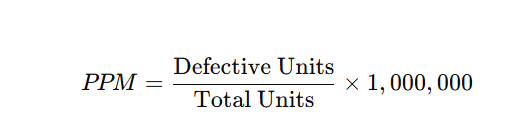
Example: If a plant produces 1,000,000 parts and 25 are faulty → PPM = 25.
A lower PPM means better quality. It’s the simplest metric to track daily performance or compare suppliers.
💡 Need fast results? Try the PPM Calculation Formula Tool or PPM Defect Calculator.
🔹 What Is Sigma Level?
Sigma (σ) measures process capability — how well a process stays within its specification limits. It’s based on the number of standard deviations between the mean and the nearest limit.
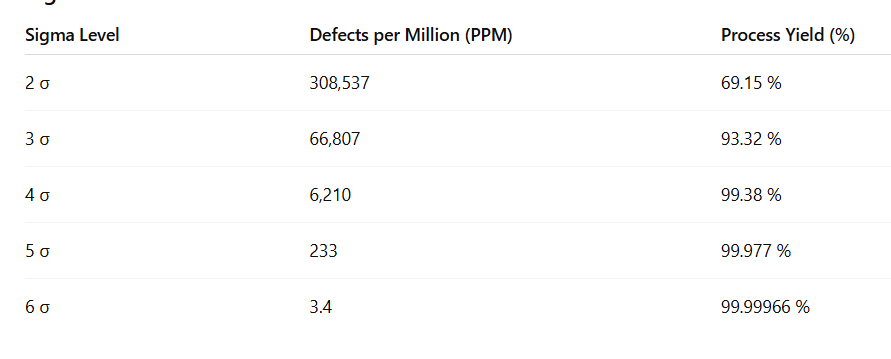
The higher the Sigma Level, the fewer the defects. A Six Sigma process has only 3.4 defects per million opportunities (DPMO).
Sigma Conversion Table
Why the 1.5 Sigma Shift Matters
Real processes drift. Six Sigma assumes a 1.5 σ shift to represent long-term variation — explaining why “perfect” 6 σ still yields 3.4 PPM defects.
🔹 PPM vs Sigma — Key Differences

In short:
- PPM tells you what happened.
- Sigma tells you why it happened.
Both metrics are essential — PPM helps visualize progress; Sigma shows how sustainable that progress is.
🔹 How to Convert PPM to Sigma
You can estimate the Sigma Level using the normal-distribution inverse:

Example:
- PPM = 6,210 → σ ≈ 4
- PPM = 233 → σ ≈ 5
- PPM = 3.4 → σ ≈ 6
For quick results, use the PPM to Sigma Calculator or Six Sigma PPM Conversion Tool.
🔹 Real-World Example: Automotive Quality
An auto-parts supplier manufactures 1 million brake pads per month. Last month, 150 were defective.
- PPM = 150
- Approx. Sigma Level = 4.9 σ
That’s strong quality performance — but reaching Six Sigma (3.4 PPM) could save millions in warranty costs and reputation risk.
🔹 When to Use Each Metric
Scenario Use PPM Use Sigma Daily production tracking

Most organizations report PPM monthly and analyze Sigma quarterly to balance simplicity and depth.
🔹 Practical Tips for Quality Metrics
- Collect enough data. Small samples distort PPM and Sigma.
- Visualize trends. Control charts and yield graphs show shifts early.
- Track short-term vs long-term Sigma. Drift reveals process fatigue.
- Combine with Cp and Cpk. They complete the capability picture.
- Communicate clearly. Executives prefer PPM; engineers prefer Sigma.
🔹 Common Questions (FAQs)
1. What is the difference between PPM and DPMO? PPM counts defective units; DPMO counts defects per opportunity.
2. Why is Six Sigma defined as 3.4 PPM? Because of the 1.5 sigma mean shift used in real-world process modeling.
3. Can Sigma be negative? Yes — if your defect rate is extremely high (> 500,000 PPM).
4. What is a good PPM benchmark? Under 1,000 PPM is strong; under 100 PPM is world-class for most industries.
5. How can I improve my Sigma level? Apply DMAIC principles — Define, Measure, Analyze, Improve, Control — to reduce process variation.
메타데이터
- post_id
- c288f7d0911e
- slug
- ppm-vs-sigma-understanding-quality-metrics-in-six-sigma-c288f7d0911e
- url
- https://medium.com/@cloudrankpro/ppm-vs-sigma-understanding-quality-metrics-in-six-sigma-c288f7d0911e
- canonical_url
- https://medium.com/@cloudrankpro/ppm-vs-sigma-understanding-quality-metrics-in-six-sigma-c288f7d0911e
- author_url
- https://medium.com/@cloudrankpro
- status
- ok
- fetched_at
- 2026-06-13 00:08:42