Why Bad Things Sometimes Heal You Faster Than Mildly Annoying Ones
A strange fact about being human: you will recover from a catastrophe faster than you’ll recover from a mild inconvenience.
Why Bad Things Sometimes Heal You Faster Than Mildly Annoying Ones
A strange fact about being human: you will recover from a catastrophe faster than you’ll recover from a mild inconvenience.

Photo by Coline Haslé on Unsplash
Not a Medium member? Read this story here.
The heartbreak that levels you gets processed and healed in months. The lukewarm, “eh, it’s fine” relationship can drag on for years, quietly draining you, precisely because it never got bad enough to force your hand.
This is the region-beta paradox, and once you understand it, you’ll spot yourself living inside it constantly.
The name comes from a 2004 study by psychologist Daniel Gilbert and colleagues, and the origin story is delightfully mundane.
Imagine you have a rule: if a destination is under a mile away, you walk; if it’s over a mile, you bike. Because biking is so much faster than walking, you’ll actually arrive sooner at some far-away places than at some nearby ones. A spot 1.1 miles away (which you bike to) gets reached quicker than a spot 0.9 miles away (which you trudge to on foot). The far thing beats the near thing. Plot it on a graph and there’s a region, “region beta”, where greater distance produces faster arrival. Distance, counterintuitively, helps you.
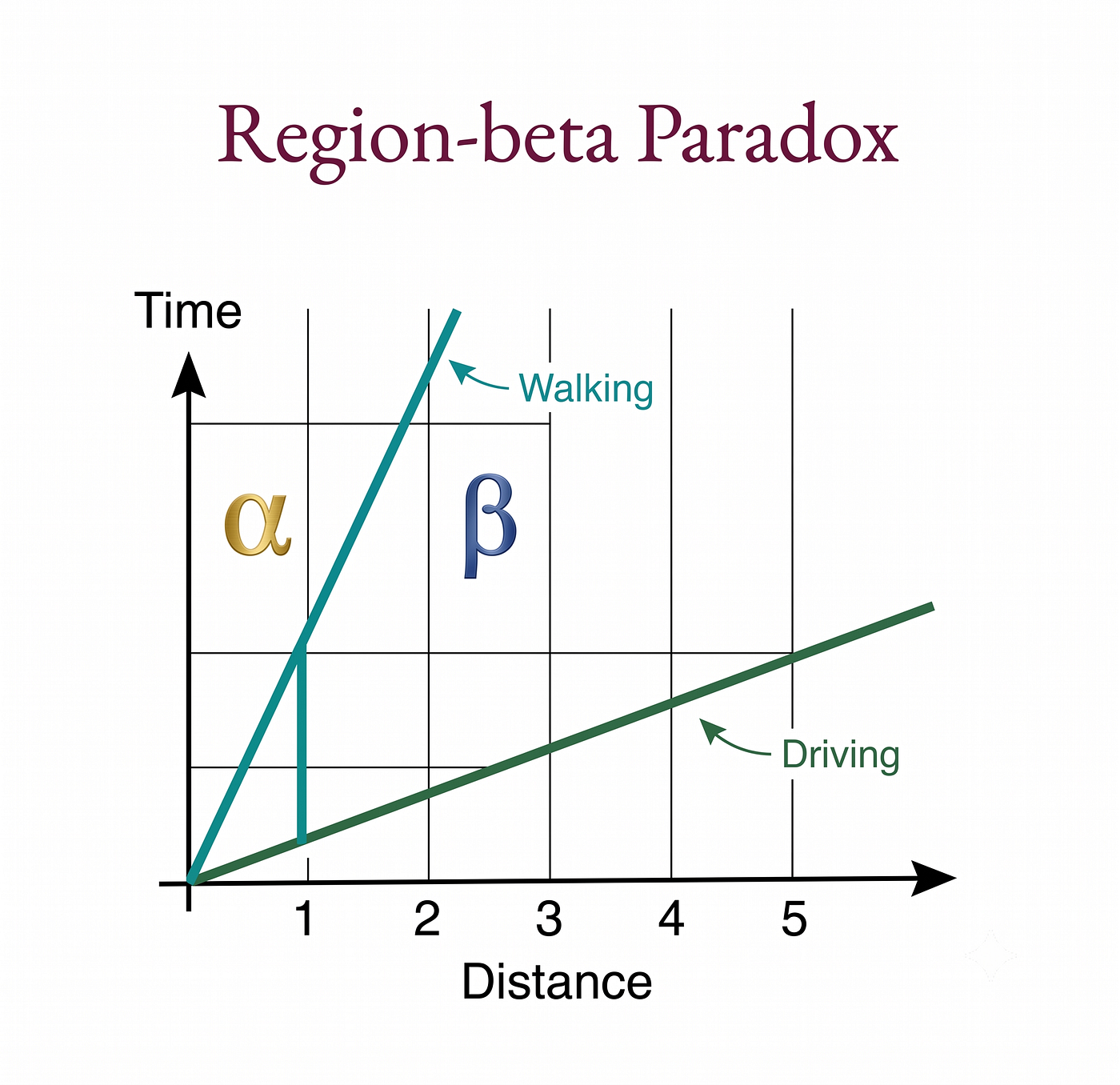
Image by author
Gilbert’s insight was that human emotions work exactly the same way. We have psychological defense systems, our whole apparatus of rationalizing, reframing, coping, and moving on. But, and this is the crucial bit, these systems only switch on above a certain threshold of intensity. A major blow trips the alarm and mobilizes the full healing response. A minor irritation stays below the alarm, so the defenses never activate, and you just… endure it. Indefinitely. The intense pain gets treated. The mild pain gets tolerated forever. So severe suffering can end faster than gentle suffering, because only the severe kind is bad enough to trigger the machinery that ends it.
Let me give you some examples, because this shows up in the strangest corners of life.
Consider the person with a shoe that’s just slightly uncomfortable. Not painful enough to throw out, not comfortable enough to enjoy. They’ll wear those shoes for three years, wincing mildly a thousand times, when a shoe that actively hurt would have been in the bin by yesterday. The blister that ends the shoe’s life quickly is, in a sense, more merciful than the low hum of “eh, they’re okay.”
Or the classic office chair with the wobble. If a chair collapses, the company buy a new one that afternoon. If a chair merely creaks and lists three degrees to the left, you’ll sit in that slowly-degrading throne of mild discomfort until you retire. The disaster gets fixed instantly. The nuisance becomes a decade-long companion.
Now: mild illness versus severe illness recovery. Studies on this have found that people who experience a more serious health event sometimes report better long-term psychological adjustment than those with a moderate one, because the serious event forces a genuine reckoning, lifestyle changes, support-seeking, meaning-making, while the moderate one lets you shrug and carry on unchanged, quietly unwell.
Or think about the friend who ghosts you dramatically versus the friend who slowly, blandly fades. A brutal falling-out hurts sharply and then heals, you grieve it, you process it, you move on. But the friendship that just gently curdles into obligatory birthday texts and “we should catch up sometime!” can hang around your neck for a decade, because it never got bad enough to formally end. The clean break is kinder than the slow rot.
And the biggest arena of all: work. People trapped in actively terrible jobs tend to quit. People trapped in mediocre jobs, the ones that are 60% fine, decent enough pay, not-quite-awful boss, mildly soul-eroding tasks, can stay for fifteen years. The mediocrity is the trap. If the job were unbearable, you’d have fled and found something better. Because it’s merely meh, your defense system never fires, and you slowly boil like the proverbial frog who’d have leapt out of genuinely hot water.
That frog metaphor is scientifically bogus, by the way, real frogs jump out. But as a description of the region-beta paradox, it’s perfect. The dramatic threat gets a response. The gradual, low-grade one doesn’t.
There’s an even sneakier version involving pleasure. Consider low-grade, always-available comforts, the mindless scroll, the mediocre snack, the show you don’t even like but keep watching. None of these is bad enough to trigger a “this is a problem” response, so they quietly consume enormous amounts of your life. A genuinely destructive habit might eventually force an intervention. A mildly numbing one just sits there, sub-threshold, forever. The small pleasures that never quite satisfy are stickier than the big ones that eventually alarm you.
So what do we actually do with this, beyond marveling at how strangely we’re built?
Your mind is a fire department that only responds to big fires. The five-alarm blaze gets put out. The smoldering ember in the wall gets ignored, and smolders for years. Most people’s lives aren’t wrecked by dramatic infernos. They’re slowly hollowed out by things that were never quite bad enough to fix.
So go find the smoldering ember, the shoe, the chair, the friendship, the job, the habit that’s just tolerable enough to survive your neglect. Name it. Add up what it’s really costing you across time. And then, since your defenses won’t do it for you, pull the alarm yourself.
The paradox only owns the people who don’t know it’s there. You know now.
메타데이터
- post_id
- c28a7d511d75
- slug
- why-bad-things-sometimes-heal-you-faster-than-mildly-annoying-ones-c28a7d511d75
- url
- https://medium.com/the-writing-table/why-bad-things-sometimes-heal-you-faster-than-mildly-annoying-ones-c28a7d511d75
- canonical_url
- https://medium.com/the-writing-table/why-bad-things-sometimes-heal-you-faster-than-mildly-annoying-ones-c28a7d511d75
- author_url
- https://medium.com/@sadhvipharasi
- status
- ok
- fetched_at
- 2026-07-14 06:41:41