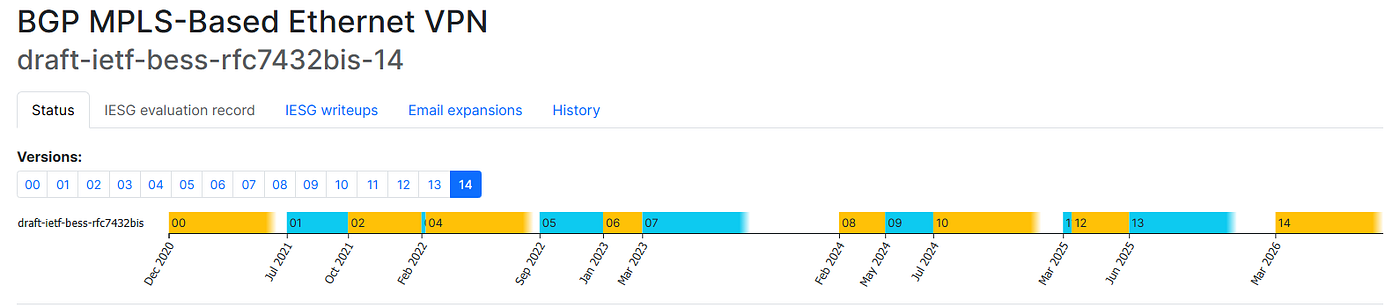
BGP MPLS-Based Ethernet VPN [ draft-ietf-bess-rfc7432bis-14 ]
EVPN (Ethernet VPN) is a networking technology designed to deliver Layer 2 services across large-scale networks such as data centers or…
BGP MPLS-Based Ethernet VPN
[ draft-ietf-bess-rfc7432bis-14 ]
EVPN (Ethernet VPN) is a networking technology designed to deliver Layer 2 services across large-scale networks such as data centers or service provider infrastructures in an efficient and scalable manner. Its core concept is the use of BGP as the control plane to exchange MAC and IP information between devices, replacing traditional flooding-based mechanisms. This allows all nodes in the network to learn endpoint locations in advance and forward traffic directly to the destination, significantly reducing broadcast traffic and improving scalability.
Conceptually, EVPN (RFC 7432) can be compared to a city that evolved from a model where everyone had to “shout across the city” to locate each other, into a system with a centralized “registry,” enabling efficient communication. However, when deployed at scale in real-world data center and service provider environments, several limitations became apparent. These include unstable Designated Forwarder (DF) election causing widespread changes when adding nodes, MAC flapping leading to excessive BGP churn and control-plane overload, ambiguity in the specification resulting in inconsistent multi-vendor implementations, and the limitation of supporting primarily multipoint services.
To address these issues, rfc7432bis-14 was introduced as an evolution of the original standard. Rather than changing the core protocol, it focuses on “hardening” EVPN to make it more stable and predictable in production environments. Enhancements include improved DF election mechanisms to reduce disruption during topology changes, MAC mobility control to mitigate excessive BGP updates, clearer definitions of fields and behaviors to ensure true multi-vendor interoperability, and the integration of point-to-point services (EVPN-VPWS) into the same framework. As a result, EVPN has evolved from a strong architectural concept into a production-ready solution capable of delivering scalability, stability, and deterministic behavior in modern networks.
Differences: RFC 7432 (Original) vs rfc7432bis (Enhanced)
Overall, rfc7432bis represents the accumulation of approximately a decade of real-world operational experience, refining EVPN to improve clarity, stability, and production readiness. Importantly, it does not introduce a new protocol — EVPN still relies on BGP — but instead addresses practical limitations and ambiguities observed in deployments.
1. Integration with VPWS (Point-to-Point Services)
In RFC 7432, EVPN was primarily designed for multipoint (LAN) services. Supporting point-to-point connectivity required separate mechanisms or additional design considerations, increasing operational complexity. In rfc7432bis, EVPN-VPWS (as defined in RFC 8214) is incorporated into the same framework, enabling both multipoint and point-to-point services under a unified control plane. In this model, VPWS establishes a direct logical circuit between two PEs without requiring MAC learning, reducing CPU overhead and providing more deterministic forwarding behavior.
2. Designated Forwarder (DF) Election Mechanism
In RFC 7432, DF election is based on a modulo algorithm derived from the service identifier and the number of participating PEs. This approach has a major limitation: any topology change, such as adding a new PE, alters the modulo calculation for all services, triggering a full re-election. This can lead to widespread traffic disruption and packet loss, even for minor changes.
In rfc7432bis, the election process is improved with more stable and flexible algorithms such as Highest Random Weight (HRW) or preference-based selection. These approaches localize the impact of topology changes, avoiding mass re-election and significantly reducing convergence time — from seconds to milliseconds — resulting in a more stable and predictable network.
3. Clarifications and Interoperability Improvements
One of the key challenges in RFC 7432 was ambiguity in certain parts of the specification, leading vendors to interpret and implement features differently. This caused interoperability issues in multi-vendor environments, particularly in areas such as ESI label handling, sticky MAC behavior, and BGP extended communities, where inconsistent interpretation could lead to route rejection or unexpected behavior.
rfc7432bis addresses these issues by explicitly defining field-level behavior within BGP, including the use of Control Word (CW), precise ESI comparison rules, and detailed handling of extended communities and flags. This results in consistent behavior across vendors, enabling true plug-and-play interoperability and reducing the need for vendor-specific workarounds.
4. MAC Mobility and Flapping Control
In RFC 7432, MAC flapping — often caused by loops or misconfigurations — can lead to rapid MAC movement between PEs, triggering excessive BGP updates (BGP churn). In extreme cases, this can overload the control plane and significantly impact device CPU performance.
rfc7432bis introduces enhanced MAC mobility handling mechanisms, including sequence numbers, threshold limits, and time windows to detect abnormal behavior. When a MAC address moves excessively within a defined period, it is identified as a duplicate or anomaly, and its advertisement is temporarily suppressed (frozen), with alerts generated for operators. This prevents uncontrolled BGP update storms and significantly improves control-plane stability.
Overall Summary
rfc7432bis is not a protocol redesign but a critical evolution that transforms EVPN into a fully production-ready solution. By improving stability, eliminating ambiguity, and enforcing deterministic behavior across control-plane operations, multi-vendor interoperability, and failure handling, it enables EVPN to meet the demands of modern cloud and data center environments that require scalability, resilience, and predictable performance at scale.
Reference: https://datatracker.ietf.org/doc/draft-ietf-bess-rfc7432bis/
메타데이터
- post_id
- c2a52bc0bee1
- slug
- bgp-mpls-based-ethernet-vpn-draft-ietf-bess-rfc7432bis-14-c2a52bc0bee1
- url
- https://medium.com/@tee.pornthep/bgp-mpls-based-ethernet-vpn-draft-ietf-bess-rfc7432bis-14-c2a52bc0bee1
- canonical_url
- https://medium.com/@tee.pornthep/bgp-mpls-based-ethernet-vpn-draft-ietf-bess-rfc7432bis-14-c2a52bc0bee1
- author_url
- https://medium.com/@tee.pornthep
- status
- ok
- fetched_at
- 2026-06-17 16:37:43