Christ in Palestine — Binding the Wounds
One afternoon, Bishara reached a breaking point. It had been a rough day for him. He had to discipline one of his worst troublemakers, a…
Christ in Palestine — Binding the Wounds
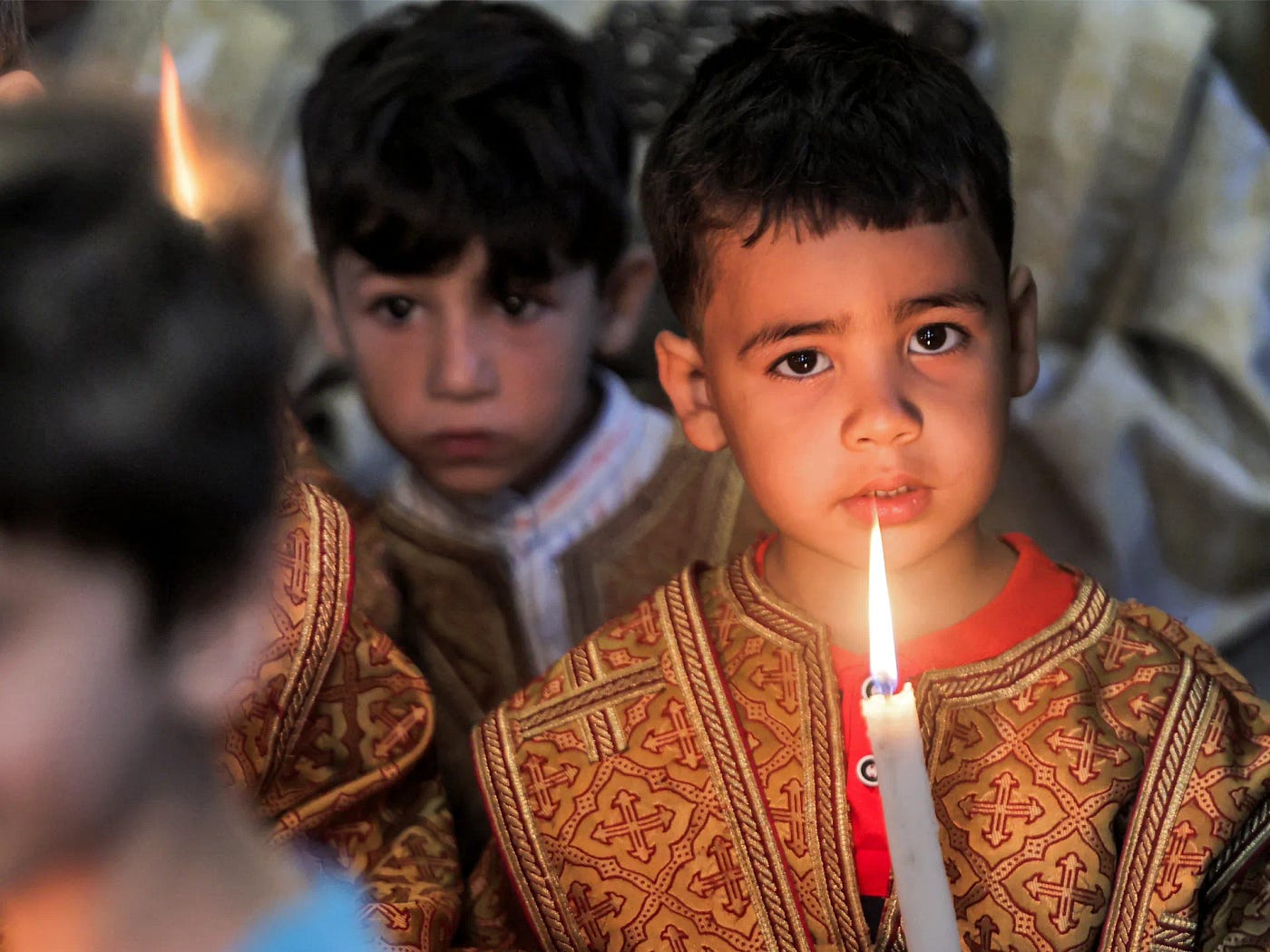
Omar Al-Qattaa/AFP
One afternoon, Bishara reached a breaking point. It had been a rough day for him. He had to discipline one of his worst troublemakers, a student in his school, and the combination of defiance and brokenness in the student’s eyes devastated him. “I could not go on like this,” he said. “None of us could.”
He closed the door to his office and knelt beside his desk, choking out a desperate prayer. “Lord, why I am so ineffective? I want this school to be a place of healing, where your Spirit dwells. Why can’t I reach them?”
Huda’s son Bishara went to the United States to study. After his education, he returned to Bethlehem and married Salwa. She was a resident of Gaza. They both went back to the US and started working at a school in Kansas City.
During that time, Mennonite Central Committee approached him to see if he would be interested in taking the position of principal at their boy’s school in Beit Jala, Bethlehem. It was a boarding and vocational school for disadvantaged Palestinian boys. He was thrilled to take this opportunity to go back to his homeland and serve his people.
Some of the boarding schoolboys were orphans, while others came from homes too poor to properly care for them. The school operated as a humanitarian outreach, providing services to prepare students for a trade through which they could earn a living.
It was only after they settled into the campus for several months that the gravity of their situation became clear to them. Many of the boys were angry and disobedient. As the principal, he was tired of dealing with rebellious students being sent to his office for discipline. In the angry eyes of the boys, he saw a reflection of himself, and memories he had not recalled in years began to surface.
The tectonic plate was shifting again for him; the buried anger that had simmered inside him for so long was about to surface.”
Abdallah was one of his newer students who lived near Aida refugee camp on the outskirts of Beit Jala. Ever since his father was arrested by the Israelis a few years earlier, he had been getting in trouble. His mother begged Bishara to give him a new start at their school.
Bishara sat next to him once at lunch and shared some of his own story of growing up without a father. “God is a father to the fatherless, Abdallah”, He told him, putting my arm over his shoulder. “My office is always open if you want to talk.”
Not many days from then, one night when everyone was sleeping, Israeli soldiers came, as they often do, and asked for Abdallah and took him.
Bishara’s heart sank. The soldiers didn’t look much older than the boy they came to arrest. They were European Jewish kids with guns.
All knew well that every boy arrested was pressured to give names of other boys, and that some of the students returned to as “informers,” which increased their sense of shame and inner isolation. After enduring harsh verbal interrogations, most of them signed confessions for stone-throwing.
Bishara said, “None of us talked too deeply about these experiences, however. Most of the boys were too ashamed to speak of what they had been through, and I did not have the skill to draw the stories out of them. How could I, when I could not even give ear to my own stories, which remained buried inside me?”
During those nights, Bishara sometimes recalled his own brother Mubarak’s two-month experience in a Jerusalem jail. Mubarak suffered regular beatings in the middle of the night and was tortured with electric shocks. They hanged him upside down by his feet. He was also refused access to a toilet.
Mubarak once told Bishara. “When Israeli jailers torture and degrade you how can you maintain respect for their dreams, for their nation, or for them?”
Jewish political scientist Norman Finkelstein, speaking of Gaza and why he would not condemn Hamas for their crimes, said, “they are born into a concentration camp, they lived for two decades in a concentration camp. They have no past, they have no present, and they have no future. If I was in their situation, I do not know how I would react.”
At that time, there were few ministers and even fewer trained counsellors among Palestinians to help them deal with what they were experiencing. Like most among Bishara’s generation, they expended a lot of mental energy trying not to relive their trauma, and that is what he taught the boys to do as well. It was the only coping mechanism he knew.
Nevertheless, emotions that are merely suppressed have a way of resurfacing. It had been much easier to forget when Bishara was in America. But now, resurrected memories slipped like ghosts through the locked doors of his mind. He discovered that time alone does not heal all wounds.
More stones thrown led to more midnight arrests, which led to more stones thrown. “We seemed to be caught in a vicious cycle of petty violence with the Israelis,” said Bishara, and he felt powerless to stop it.
When Bishara locked himself in his office and knelt at his desk and prayed. He questioned God, I want this school to be a place of healing, where your Spirit dwells. But why can’t I reach them?”
The answer came softly: “It is because you are so bitter. If you don’t deal with your anger, you will never be a blessing to your students.”
The pain, the trauma that he unconsciously laboured to keep in place for so many years, was apparently surfacing. Then again he felt God saying, “It is more than anger, Bishara. You are filled with hatred.” Bishara spat bitterly. “That’s right, God, I’m furious. And it’s true — I do hate the Israelis!”
He had never admitted this to anyone, not even to himself. Saying it out loud was like the last heaving of the tectonic plate within him. “Now my rage erupted with a force so great that I could physically feel it in my body,” he said.
He heard God say, “Do you think I judge you for an unhealed wound in your heart, my son?”
He began to sob. “Yes, I did think that, but I had not known it until this moment. Can I speak to you from my wound, then, Lord? I believe you love me. But I don’t understand what is happening to us. Don’t you care about what is happening to my people? It was bad enough that my generation had to suffer. Shall the next generation also bear the same heavy burden? When will this end, Lord?
“Why is it that so many of my fellow Christians across the world are so indifferent to our oppression? Where is the compassion for Palestinians? What crime did we commit?”
A fresh wave of grief washed through him as he continued to choke out his sorrow. “I wasn’t just angry, way down at the bottom of my hatred and anger was a broken heart. My broken heart.”
In his mind, he saw an image of the Holy Land as a beautiful silver chalice filled with wine, over which nations had fought. As he was reflecting on this, he saw a hand tilting the cup and pouring the wine to the ground, like blood. It was the blood of generations.
Then another image came: Jesus, lifted high on the cross, the chalice itself, his blood rolling down his naked body to the Jerusalem soil as a drink offering. He was drinking all the violence and domination and victimisation that his people and all the peoples of the land had experienced.
Then he heard the words, “Father, forgive them, for they don’t know what they are doing.” “Were those his words or mine?” Bishara wondered. He thought to himself. All he knew for certain was that they echoed within his depths. “I knew that he meant them with his entire being, and that somehow, I did too. I forgive, Lord. I forgive. Cleanse me of this hatred. Wash my wounds and heal me. Have mercy on me. Have mercy on us all.”
The waters of the Jordan River when Bishara was baptised had been external, whereas this baptism came from within, washing him from the inside out.
He didn’t know how long he remained on the floor, washed by Christ’s tears mingled with his own, but when he stood up, he was a new man.
“The cold weight I had carried within me for so long seemed to have entirely melted, and the feeling in my heart was the glorious lightness of love that seemed to lift me up and suspend me between heaven and earth. It was a love that transcended any human ability to earn it or deserve it,” he said.
“It was compassion for the oppressed and the oppressor, the love of Christ himself for all people, including my people, the Palestinians. And yes, a deep compassion for the Jews too — unspeakable love for everybody.”
By the grace of God, Bishara uncovered the deep wounds that he has been concealing from himself to be cleaned and healed by God.
We all carry our wounds; but if we are unwilling to be healed, it distorts our perception of threat, driving us to pre-emptively hurt others to maintain power and prevent ourselves from being victimised again. Then we pass these wounds to our next generation.
Sadly, Zionist Jewish settlers are unwilling to seek healing from their past generational trauma. They continue to reject Christ and his love that heals, therefore inflicting their past trauma upon others, especially the Palestinians.
After reading Bishara’s story, I wonder if I can truly love my oppressor who stole my house, land, food, fields and killed my loved ones. As you read this, many Palestinians’ homes were occupied or destroyed in the West Bank, and some are even killed.
Palestinians are living through immense trauma. It is hard to imagine whether their wounds ever get healed. I pray it does; I pray Palestinian Christians continue to hope in Christ, who has the power to heal the broken-hearted and bind their wounds. And also take this healing to the rest of the Palestinians and also their oppressive Jewish settlers.
If we truly understand the Gospel, we see that Christ did not promise to free us from our oppressors; instead, he wants to bind our wounds and heal our broken hearts so that we can be liberated to love our enemies.
This story is an excerpt from the book, Yet in the Dark Streets Shining: A Palestinian Story of Hope and Resilience in Bethlehem — Mercy Aiken, Bishara Awad.
[embed]
Recommended books
Blood Brothers: The Dramatic Story of a Palestinian Christian Working for Peace in Israel — Elias Chacour, David Hazard
Daughters of Palestine: A Memoir in Five Generations — Leyla K. King
Crossing over — Deena Ragless
메타데이터
- post_id
- c2a76996b51b
- slug
- christ-in-palestine-binding-the-wounds-c2a76996b51b
- url
- https://medium.com/@markraja/christ-in-palestine-binding-the-wounds-c2a76996b51b
- canonical_url
- https://medium.com/@markraja/christ-in-palestine-binding-the-wounds-c2a76996b51b
- author_url
- https://medium.com/@markraja
- status
- ok
- fetched_at
- 2026-08-09 02:20:51