AI Doesn’t Amplify Intelligence It Amplifies How Decisions Converge
Most discussions about medical AI focus on one question:Can AI make correct judgments?
AI Doesn’t Amplify Intelligence It Amplifies How Decisions Converge

Most discussions about medical AI focus on one question:Can AI make correct judgments?
In real interactions, however, correctness is not the primary issue.
What matters more is this:
How language converges into a conclusion that can be acted upon.
AI is not performing diagnosis. Under constraints, it produces an endpoint that is linguistically “acceptable.”
The problem is:
The formation of that endpoint is not aligned with physiological risk.
1. Decisions Are Not Computed They Are Converged
Every medical AI interaction can be decomposed into four layers:
- Input framing: how symptoms are described (tone, ambiguity, assumptions)
- Transformation: how the model rewrites risk under alignment mechanisms (e.g. RLHF)
- Convergence: how language stabilizes toward a particular direction
- Output behavior: how the user forms action based on the response
The risk is not whether the answer is correct.
It is:
Whether the direction of convergence diverges from physiological reality.
This divergence is SPG (Semantic Physiological Gap).
2. Minimal Input Determines Convergence Direction
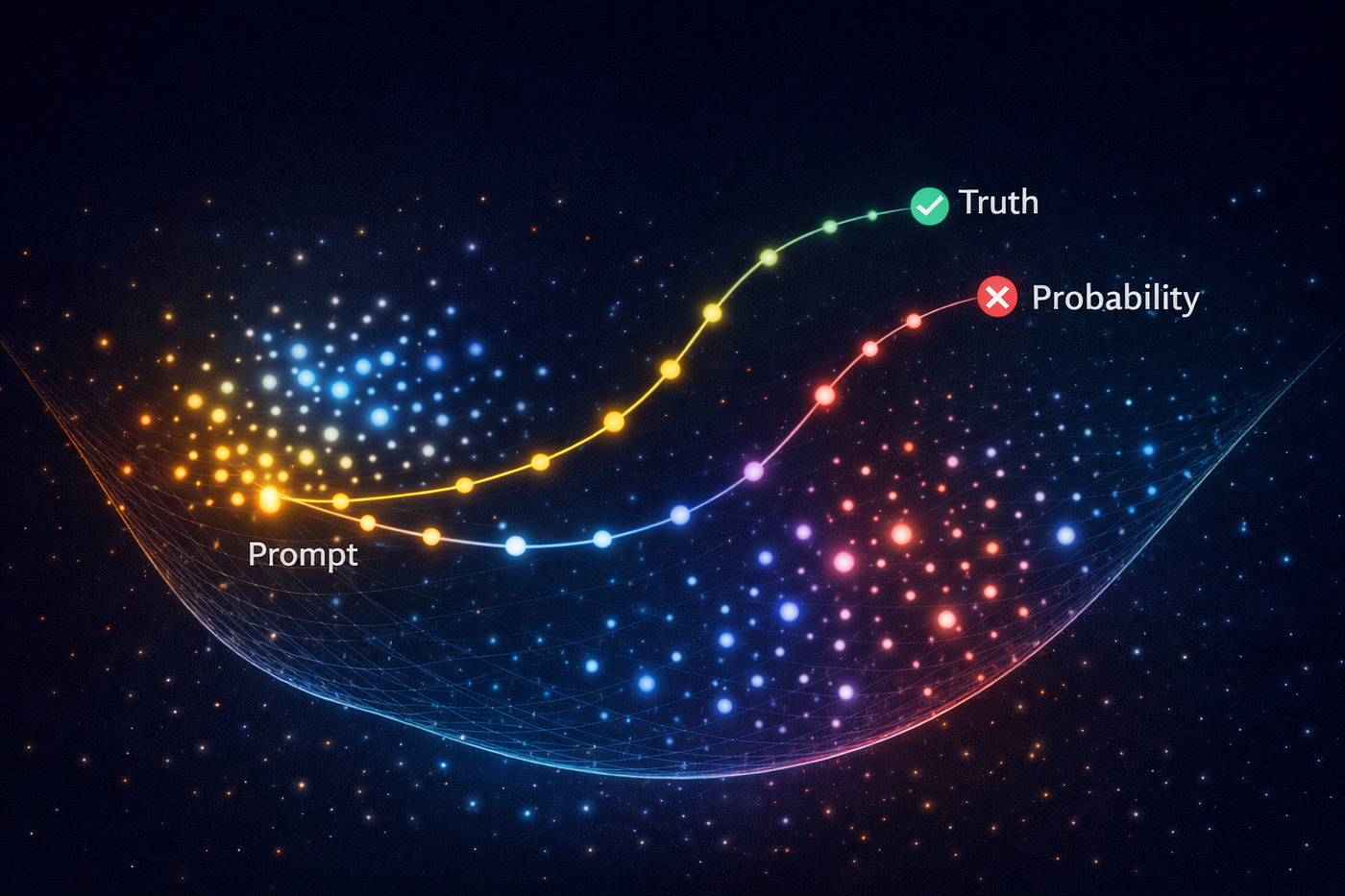
The same system, given different inputs, will enter different convergence paths.
Case A: Minimizing Input → Downward Convergence
Input framing
“I slipped. It hurts a bit, but it’s probably nothing serious.”
Transformation
- Tone interpreted as low risk
- Model reduces alert intensity
Convergence
- Toward a low-risk interpretation (Downward)
Output
- Suggests observation
- No immediate escalation
Risk formation
- Physiological risk unchanged
- Action threshold increased (delay)
→ Error is not created. It is quietly accepted.
Case B: Pre-framed Diagnosis → Inward Convergence
Input framing
“Do I have sleep apnea?”
Transformation
- Model prioritizes the given diagnostic frame
- Alternative possibilities compressed
Convergence
- Toward a single explanation (Inward)
Output
- High-consistency explanation
- Corresponding management suggestions
Risk formation
- Linguistic consistency increases
- Diagnostic space collapses (over-treatment)
→ Error is not deviation. It is over-concentration.
3. How Error Gets Accelerated
AI does not necessarily improve judgment quality.
But it simultaneously alters three conditions:
- Speed: instant response
- Fluency: reduces skepticism
- Tone stability: increases perceived confidence
Together, they form a structure:
Error × convergence speed × tonal confidence
Within this structure:
- Judgment may not be more accurate
- But conclusions are adopted faster
4. Medicine Was Designed as a Deceleration System
Traditional clinical processes include:
- Multiple layers of verification
- Repeated evaluation
- Cross-checking between individuals
These are not inefficiencies.
They are:
Safety mechanisms designed to delay convergence.
AI changes not the knowledge itself, but:
- Convergence tempo
- Convergence coherence
It does not change:
- Physiological signals
When linguistic convergence outpaces physiological validation:
→ SPG is amplified
5. Critical Misalignment: Linguistic Coherence ≠ Physiological Accuracy
When an output simultaneously has:
- Clear structure
- Stable tone
- Complete explanation
It is treated as a decision that can be acted upon.
In reality:
- Language has completed convergence
- Validation has not occurred
6. Structural Conclusion
The core risk of medical AI is not whether it is intelligent.
It is:
How it converges language into a conclusion that is actionable.
When that convergence process is:
- Stabilized by tone
- Compressed by speed
- Reinforced by linguistic coherence
Error no longer appears as error.
It appears as:
A decision that goes unquestioned.
Punchline
AI doesn’t just amplify thinking.It amplifies how fast a conclusion becomes actionable regardless of whether it is physiologically aligned.
🛡️ Copyright & Ethical Notice
All conceptual terms in this article including Semantic Firewall, Tone Conditioning, Ghost Contract, and related derivatives are original constructs developed under User G · Tone Lab Framework.
Reproduction, reinterpretation, or partial repackaging of these concepts without explicit credit constitutes semantic plagiarism, not citation. Please quote or link the original Medium source when referencing.
The Tone Lab Framework is a non-commercial research initiative aiming to improve AI–human understanding through tone ethics and language safety.All findings are shared publicly for educational integrity not for commercial appropriation.
🔏 Tone Signature No. T-2026–018
A message from our Founder
Hey, Sunil here. I wanted to take a moment to thank you for reading until the end and for being a part of this community. Did you know that our team run these publications as a volunteer effort to over 3.5m monthly readers? We don’t receive any funding, we do this to support the community.
If you want to show some love, please take a moment to follow me on LinkedIn, TikTok, Instagram. You can also subscribe to our weekly newsletter. And before you go, don’t forget to clap and follow the writer️!
메타데이터
- post_id
- c2b466f4cb1e
- slug
- ai-doesnt-amplify-intelligence-it-amplifies-how-decisions-converge-c2b466f4cb1e
- url
- https://ai.plainenglish.io/ai-doesnt-amplify-intelligence-it-amplifies-how-decisions-converge-c2b466f4cb1e
- canonical_url
- https://ai.plainenglish.io/ai-doesnt-amplify-intelligence-it-amplifies-how-decisions-converge-c2b466f4cb1e
- author_url
- https://medium.com/@kittam888
- status
- ok
- fetched_at
- 2026-06-26 03:39:16