I realized: AI is a structural threat to the Church’s traditional authority and the Pope Knows It.
AI dominates the Pope’s May 15th 2026 encyclical that signals a global power shift.
I realized: AI is a structural threat to the Church’s traditional authority and the Pope Knows It.
AI dominates the Pope’s May 15th 2026 encyclical that signals a global power shift.
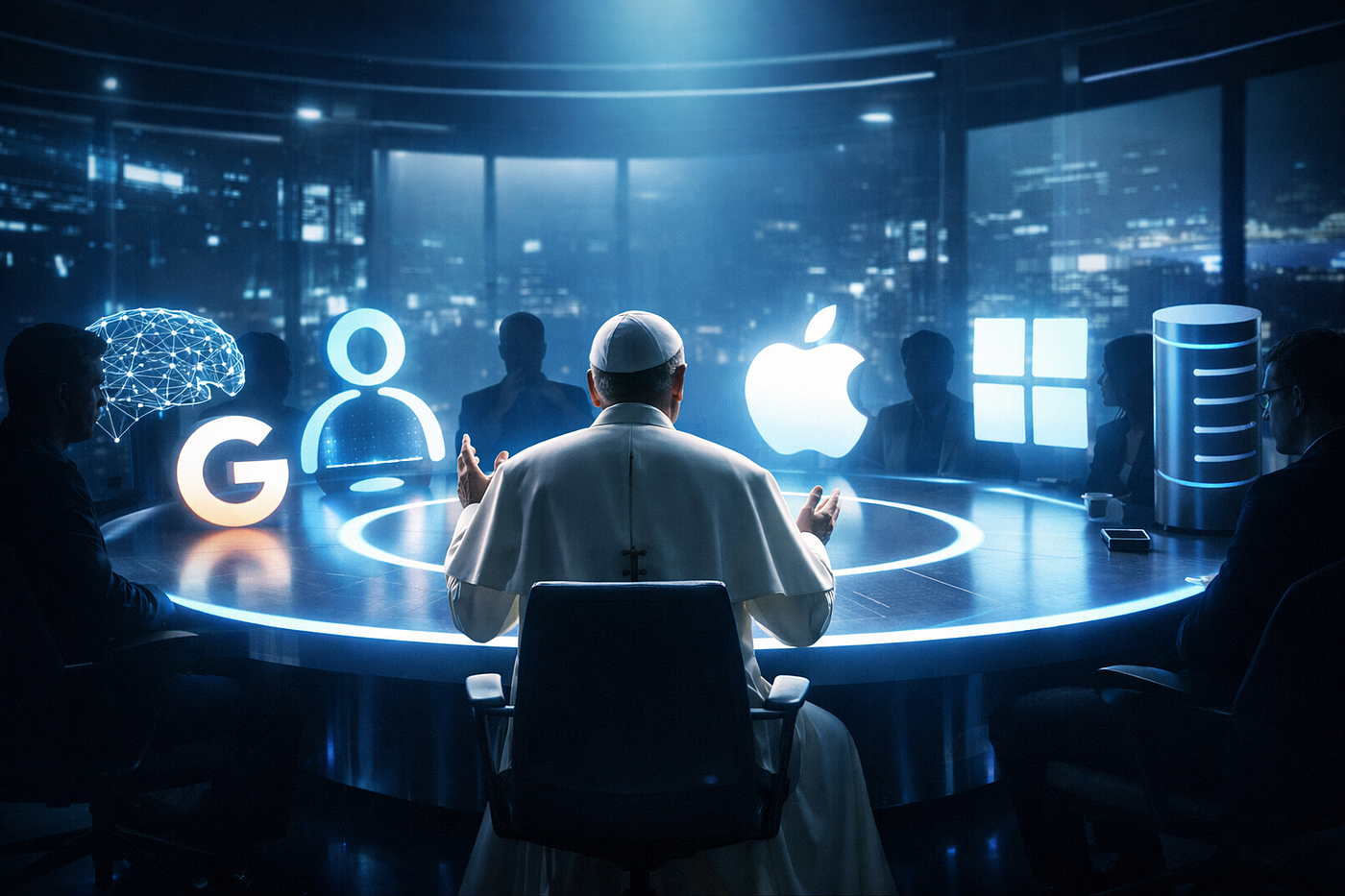
The Pope personally top representatives from the world’s most powerful tech companies to the Vatican and they came. The meeting on April 29th 2026 focused on AI, ethics, governance and global impact, highlighting that the Vatican is fully aware of the influence these companies now hold. AI-generated illustration
The Pope’s May 15th encyclical Magnifica Humanitas is a stron signal. He says: “AI must be disarmed.”
— -
I realized something simple and uncomfortable: AI is a structural threat to the Church’s traditional authority — and the Pope knows it.
AI dominates the Pope’s May 15th, 2026 encyclical, a document that signals a global power shift. The Pope personally invited top representatives from the world’s most powerful tech companies to the Vatican — and they came. The meeting on April 29th, 2026 focused on AI, ethics, governance, and global impact, making it clear that the Vatican fully understands the influence these companies now hold.
Pope Leo XIV’s May 15th encyclical, Magnifica Humanitas, is a strong signal. He says: “AI must be disarmed.” says the press.
When Leo XIV invited the architects of artificial intelligence to the Vatican, people treated it like a meeting. The Pope is the worldwide head of the Roman‑Catholic Church — the institution that shaped the moral backbone of most Western systems. So this wasn’t a polite exchange between old power and new. It was a signal. A very loud one.
They met on April 29, 2026. It wasn’t a meeting. It was a confession.
The Magnifica Humanitas
On May 15th, 2026, the Pope published an encyclical — 141 pages of papal Latin. It is almost entirely about one of the most modern inventions shaping the world: AI.
Some fear losing their jobs. Others are excited about saving time and money. But the encyclical points to something deeper:
The center of human authority has already shifted. The Church — the oldest and most durable power structure in Western history — is no longer the dominant force shaping what people believe, what they fear, or what they call true.
Something else is.
Its headquarters are in California.
— -
The Oldest Power Move in the World
For two thousand years, the Church held something no army, no emperor, and no political system could fully replicate:
The power to define reality.
Not physical reality — the deeper kind. What counts as true. What counts as sin. What happens after you die. What you owe your neighbor. What makes a life worth living.
This is not a small thing. It is, in fact, the only thing that really matters when you are trying to organize human beings at scale. You can rule people by force. But you can only hold them through meaning.
The Church built cathedrals designed to make you feel small on purpose. It structured your week, your year, your entire life around its calendar — before Christ, after Christ. The beliefs it preached gave people a reason to be good when no one was watching. It told you what to do with fear, threat, and guilt. It held the stories that explained suffering.
— -
The New Confession Booth
You already know what replaced the confessional.
For centuries, belief came from the Bible, carried by pastors in churches. Then science took the stage — and the internet became its megaphone, now amplified by AI.
These days, people go to the search bar for help and answers.
When something frightens you at 3am, you don’t call a priest. You type it into Google. When you don’t know what to believe about your health, your politics, your child’s diagnosis — you ask the algorithm. When you need to know if you are normal, if you are loved, if your life is on track — you scroll.
The feed is the new sermon.
The platform is the new parish.
The recommendation engine is the new pastoral care.
Unlike the Church — which had to convince people slowly, over years of attendance, confession, and community — the algorithm knows you within three days. It knows your fears before you have named them. It knows what you will click on before you decide. It knows which version of reality will keep you engaged the longest.
The Church took two thousand years to build that kind of influence. Big Tech took it in twenty.
— -
What the Pope Said
Pope Leo XIV’s Magnifica Humanitas — “The Grandeur of Humanity” — is not a warm blessing of technological progress. Read it carefully and you will find something sharper.
The encyclical names the shift directly:
“The main drivers of technological development are now private, often transnational actors with resources and reach that surpass those of many governments.”
He is not talking about the future. He is talking about now.
He goes further. He critises that a concept called the universal destination of goods
the old Catholic idea that the earth’s resources belong, at some fundamental level, to everyone — to cover “algorithms, digital platforms, technological infrastructure and data.”
In other words: what you built on public data, on public infrastructure, carrying the accumulated thought of all of humanity — that shoul not be private property.
It carries a moral obligation.
The universal knowlegde concentrating it in the hands of a few, he writes, “contradicts the universal destination of goods.”
(Mind you, the church did that for century and had this monopoly for a long time in its libraies and monasteries.)
That is not a gentle suggestion. That is a structural claim about ownership, power, and responsibility.
No government in the world has said it that clearly.
— -
Not Old Power vs. New Power
Here is where most analysis gets it wrong.
Everyone wants to read this as a power struggle.
The Church vs. Silicon Valley.
Ancient institution vs. disruptive startup culture. Incense vs. algorithms. Old world vs. new world.
That is the wrong frame.
Leo XIV is not defending turf. He is drawing a line — not around Church authority, but around something more basic:
human conscience.
The encyclical makes a distinction that is easy to miss but impossible to forget once you see it: AI does not undergo experiences. It does not have a body. It does not feel loss. It does not know — from the inside — what it means to love something and then watch it disappear.
This is not a religious point.
It is an anthropological one.
We are not building tools that think. We are building systems that decide.
The difference matters, because a system that decides has consequences, but no conscience.
It optimizes. It does not feel the weight of what it optimizes for.
Someone has to carry that weight.
The Pope — whatever you think of his institution, whatever your relationship to organized religion — is one of the only people on earth with a platform large enough and independent enough to say it out loud.
— -
The Meeting That Wasn’t a Meeting
The encyclical was presented at the Vatican alongside Christopher Olah, co-founder of Anthropic, the AI safety company. Tech leaders came and listened. The Vatican said they were interested in
“wisdom from the Church regarding how best to serve humanity.”
Maybe it was genuine. Maybe it was the most elegant PR moment of the decade. Possibly both.
But here is what I keep coming back to: they showed up.
The most powerful private actors in human history — companies with resources exceeding the GDP of most nations, systems shaping the beliefs and behavior of billions — sat in a room and listened to a man in white.
Not because he has legal authority over them. Not because he controls their market access. Not because any government made them.
Because something in the room carried weight that money cannot fully replace.
Call it moral authority. Call it symbolic power. Call it the last functioning institution that still speaks the language of human dignity as a non-negotiable — not a product feature, not a user metric, not a variable to be optimized.
— -
The Question Behind the Question
AI is not replacing religion.
It is replacing the function of religion: the power to define what is true, what is real, and what we should fear.
And unlike religion, it does not ask for your belief. It simply learns your behavior, maps your attention, and shapes your world view from the inside. You do not convert to the algorithm. You just use it. Every day. For everything. Until one morning you realize you have not had an original thought in three years that wasn’t suggested to you first. (For many Television as been doing that already for an extended period of time, some few who deciede what you would be fed intelectually in the new, shown and Univeristies.)
For many, television had already been doing this for a long time — a small group deciding what people would be fed intellectually in the news, in what was shown, and even in universities.
That is a more elegant kind of control.
And the Pope — old, slow, dressed in robes that belong to another century — may be one of the few people who sees it clearly enough to name it in public.
— -
What This Reveals About Us
We handed over the throne willingly.
No one forced us to give Google our questions. No one made us give Meta our loneliness. No one required us to feed TikTok our boredom, our insecurity, our need for approval at scale.
We did it because it was useful. Because it was fast. Because it answered the question before we had finished asking it. Because it felt, for a moment, like being understood.
Maybe that is the deepest thing Magnifica Humanitas is pointing at — not the power of the algorithm, but the hunger that made us hand ourselves over to it.
We needed meaning. We needed truth. We needed someone — or something — to tell us we are okay, we are not alone, the world makes sense.
The Church held that function for two thousand years. It did it imperfectly, often violently, sometimes beautifully.
And when something came along that did it faster, the door was already open.
— -
The real question is not whether AI will rule us.
We already know the answer to that.
The real question is why we were so eager to hand over the throne
— and whether we can build something with a conscience before the systems that replaced it forget what conscience is for.
Maybe the Pope didn’t meet AI to bless it.
Maybe he met AI to remind it — and us — that power without conscience is not progress.
It’s just a faster way to get lost.
— -
Just food for thought, some ideas to ponder. I write about the invisible structures behind the things we think we understand — power, meaning, the nervous system of civilization. If this landed somewhere real, follow along.
— -
메타데이터
- post_id
- c2bebd8d152d
- slug
- i-realized-ai-is-a-structural-threat-to-the-churchs-traditional-authority-and-the-pope-knows-it-c2bebd8d152d
- url
- https://medium.com/write-a-catalyst/i-realized-ai-is-a-structural-threat-to-the-churchs-traditional-authority-and-the-pope-knows-it-c2bebd8d152d
- canonical_url
- https://medium.com/write-a-catalyst/i-realized-ai-is-a-structural-threat-to-the-churchs-traditional-authority-and-the-pope-knows-it-c2bebd8d152d
- author_url
- https://medium.com/@up_89997
- status
- ok
- fetched_at
- 2026-06-20 20:29:01