Hot New Roman Numerals
TL;DR use beautiful, I, II, …, VII, …, IX, … up to 10⁹ (this is how:)
Hot New Roman Numerals
TL;DR use beautiful, I, II, …, VII, …, IX, … up to 10⁹ (this is how:)
I’ve always been a fan of the beautiful Roman numerals, their typographical and generally appealing symbolic look made it especially suitable for simple sequential identification (oh, does anybody even cares about any of this aesthetical stuff anymore?..), and I was kinda bummed out about the part where they weren’t as pretty anymore; I’m talking about:
I
II
III
IV
(great so far, right? beautiful, and it continues…)
…
XVII
…
XXXIV
(not IILIV… No? OK)
…
LI
(Really?..)
…
CLX
(OK, I give up, you cannot read this as a number, I have to propose something else:)
So, like before, I … XXXIX-ish all is well, but I don’t like L for 50; V is the symbol of a human hand — with 5 “I” fingers, and X is 2 х V, of course, but L? What is L? How do you represent 5 x X with “L”? I can’t see it… But I can see something else:
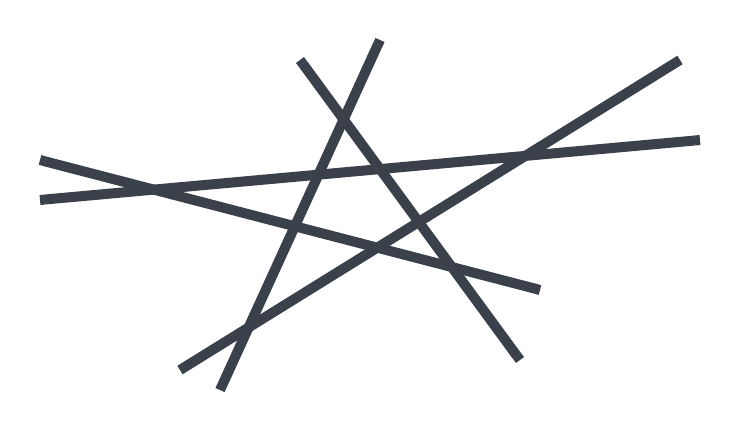
Oh, wait, don’t laugh, you can use any Unicode 5-point star…
⭒⭑︎⭐✰✯✮✭✬✫✪✩☆★…
…and to make it accessible within editors, within context, we can use “‘*****” key (asterisk, also a 5-star!), so numbers will look like…
X☆II. …. 42
or
☆XVI. … 66
…beautiful again… right? Right?
OK, it may be a bit extreme for someone, you know, for a lot of people who try to keep as little symbols in their heads as possible — asterisk by itself won’t do, it’s too small, and ☆, however beautiful it may be (it is, it really is!*), may weird some people out still, so I have another solid option for them… chopping the points off the star... ⬠… Drumroll…
O
Wait. It’s O, which is almost like 0, which is zero, and people know zero, so no. Wait. I agree, you’re right, O is 0 and it’s — in the most common context is associated with zero, but practically, in the context and with the intended use in mind, look:
XOII. … 42
or
OXVI. .. 66
and even
XOIX. .. 49 O. …….. 50 OI. ……. 51
all work very well.
It’s also sends us back to the real contemporary Arabic numerals, where
٥
is a thing (5 actually).
Wait. It’s all nice and fun, but leave zero alone maybe? I don’t care that OIV really rocks 54, but how do I represent zero exactly? OK, no worries, it wasn’t in the original script, yet we’re going integer, not natural now, so zero is:
–
Hey, that’s a minus! Yeah, I know, so? What’s the problem?
… –II. …. -2 –I. ….. -1 –. ……. 0 I. ……. 1 II. …… 2 …
Eh? Eh! Nice! I say nice. It just works.
Now, back to our business, along the natural sequence, we ain’t done yet, we need to cross the 100 barrier, which is classically C.. Meh! Does it look like “double L”? And L was lame in the first place, departing from efficient symbolism and involving the Latin language: Legion, Centurion, oh, give me a break! If I can only join those ☆☆…

Oh… No… LOL. It wasn’t going to work with ☆ really, was it? And with O (“chopped off the rays”), it becomes:
8
or… better yet…
B
(if we keep the latin alpha letters only theme, but break the vertical symmetry…)
Yeah, I know I could go back and revise O to be D, so it will rhyme graphically better, but no, I claim O is as simple as V, graphically, and B is relatively as complicated as X (and D is not as simple as O or V), so, we get:
BXXIII… or 8XXIII?.. (123) BBOVI… or 88OVI?.. (256)
One option is to stop here — hey, we have ways of representing all of IPs nicely with Romanumerals…
BXXVII.–.–.I (localhost)
…as well as the small integers (-399..399 — –BBBXBIX…BBBXBIX) — and call it a day, but for completeness, we’ll try and count to a million as promised.
OK, how 5 x B does look like?.. My brain… Yeah, it’s tough, so let’s just…
Q
…and the rarest-used 2 x Q = 1000 will then be…
Φ
…what? No, no, no Greek letters, alright? Alright, what about…
R
…? Like a Q with one more bit? Unconvincing, agreed, let’s not count up to more than 999 then…
…and for that, QBQXBIX works as far as I’m concerned, and then, for larger sequences, well, just subdivide it positionally:
–/QBQXBIX/QBQXBIX. … (000.999.999)
I/–/–. ………………………. (001.000.000)
Conclusion: numbers up to a 1000 (and from –1000) — anything that may be sequentially identified within reason — are easily representable with the suggested I, V, X, O, B, Q and – symbols, and higher sequentials should be represented with 1000-based subdivision.
Bonus: I personally don’t like any long-term calendars, including Gregorian, so I don’t feel a need to write full year in any of those with “my” numerals (MCMXCVIII looks ridiculous — by design!). As far as I’m concerned, our current era is UNIX era (u.e. — unix epoch), so, the year of writing is OIV u.e., and the time Herr Gutenberg produced the printing press (out of a recently ex-Jewish city of Mainz at the time) was around –QXX u.e.
p.s. Followers of this blog should exercise patience as the announced projects in progress are facing delays due to the author’s wonky personal circumstances.
메타데이터
- post_id
- c2c8b73e811d
- slug
- hot-new-roman-numerals-c2c8b73e811d
- url
- https://medium.com/@costa/hot-new-roman-numerals-c2c8b73e811d
- canonical_url
- https://medium.com/@costa/hot-new-roman-numerals-c2c8b73e811d
- author_url
- https://medium.com/@costa
- status
- ok
- fetched_at
- 2026-07-24 02:21:50

