Rifle vs Bow Hunting: Stalking Distance Requirements & Skill Differences
Choosing between a rifle and a bow is not just about which tool feels right in your hands. It reshapes everything about how you hunt — how…
Rifle vs Bow Hunting: Stalking Distance Requirements & Skill Differences
Choosing between a rifle and a bow is not just about which tool feels right in your hands. It reshapes everything about how you hunt — how close you need to get, how you move through the woods, and how much practice it takes before you are ready to take an ethical shot. For beginners especially, understanding these differences early on can save a lot of frustration in the field. The guides and resources at Deer Hunting Strategies are built specifically to help newer hunters bridge that gap between reading about hunting and actually doing it well.
The Distance Gap That Changes Everything
At the heart of every rifle vs. bow debate is one fundamental reality: distance. A rifle extends your ethical range dramatically. A bow shrinks it — and shrinks it fast. That single difference ripples out into every other aspect of the hunt.
With a rifle, a hunter can realistically engage deer from 100 yards, and skilled long-range shooters can push ethical limits to 300–400 yards with the right caliber and preparation. A bowhunter operating by those same ethical standards needs to be within 40 yards — often much closer. That is not a small gap. That is the difference between spotting a deer at the edge of a field and needing to be practically in its living room.
This distance requirement shapes where you set up, how you move, what scent control looks like, and how much margin for error exists. It is why the two methods feel like almost entirely different sports — even when the goal is the same whitetail standing in the same timber.
Bow Hunting: How Close Is Close Enough?
The 40-Yard Ethical Limit — And Why Record-Book Whitetails Average Just 19 Yards
The widely accepted ethical ceiling for bowhunting deer sits at 40 yards. That is the distance where most bowhunters — even experienced ones — can consistently place arrows within a tight enough grouping to ensure clean, humane kills. Beyond that, variables like wind drift, slight form breaks, and arrow drop begin stacking up in ways that increase the risk of a poor hit.
Here is what makes that number even more striking: deer entered into the Pope and Young record book — the gold standard for bowhunting achievement — were taken at an average distance of just 19 yards. Not 40. Not even 30. Nineteen yards. That is roughly the length of two full-size pickup trucks parked bumper to bumper.
The implication is clear. The best bowhunters in the world are not pushing limits — they are getting close. Really close. That speaks directly to why bowhunting is as much a game of position and patience as it is about shooting ability.
When 30–40 Yards Becomes Your Ethical Ceiling
Most experienced bowhunters set their personal maximum somewhere between 30 and 40 yards. Some highly practiced archers using modern compound bows might push that to 50 or even 60 yards — but that is the exception, not the rule, and it requires a serious investment in both equipment and practice time.
A useful benchmark from ethical bowhunting guidelines: never take a shot at a distance greater than you can consistently keep all arrows within a six-inch circle. That circle roughly represents the kill zone on a whitetail. Many guides recommend practicing at twice the intended hunting distance — so if 30 yards is the hunting max, practice regularly at 60. That buffer builds the consistency needed to perform under pressure when a real deer is standing broadside at first light.
Rifle Hunting: Stretching Your Ethical Range
Why Most Rifle Shots Often Land Around 100 Yards or Less
Despite what long-range shooting content online might suggest, the vast majority of rifle deer kills still happen at 100 yards or less. Terrain, tree cover, hunting pressure, and stand placement all conspire to keep shots shorter than the rifle’s full potential. Most whitetail hunters are set up in stands overlooking food plots, field edges, or funnel points — not open prairie landscapes where 400-yard shots become realistic.
That is actually reassuring for beginners. Getting proficient with a rifle at 100 yards is achievable with moderate practice. A solid zero at the range, a steady rest, and a well-placed shot are entirely within reach for most people relatively quickly. The rifle is often more forgiving than a bow in terms of how fast basic competency develops.
What It Takes to Push Out to 300–400 Yards
Modern centerfire rifles are physically capable of ethical kills at 300 to 600 yards, depending on caliber and the shooter’s capability. But being capable of that shot and being ready to take it ethically are very different things.
Extending ethical range to 300–400 yards demands:
- Understanding ballistics — knowing how a specific round drops over distance and how wind affects it
- Quality optics — a reliable scope with proper magnification, zeroed at distance
- Stable shooting positions — bipods, shooting sticks, or solid rests that eliminate human wobble
- Consistent trigger discipline — the slightest flinch at 300 yards translates to a miss or, worse, a poor hit
- Range time at distance — not just at 100 yards, but actually shooting at 200, 300, and beyond before season
Scopes and stable rests do a lot of the heavy lifting at distance, but they do not replace fundamentals. Rifle hunting at long range is its own discipline — one that rewards dedicated shooters who put in the preparation.
Stalking Skills: Bow vs. Rifle Demands
Bowhunting’s Stealth Requirement: Camouflage, Scent, and Silent Movement
Getting within 19–40 yards of a whitetail without being detected is genuinely difficult. Deer have an exceptional sense of smell, sharp peripheral vision, and ears tuned to catch the snap of a twig or the whisper of clothing against brush. Bowhunting demands that hunters solve all three of those problems simultaneously — and at close range, there is almost no margin for error.
Effective bowhunting stealth involves:
- Scent control — scent-eliminating sprays, dedicated hunting clothing washed in scent-free detergent, and always hunting with the wind in favor
- Camouflage — patterns matched to the specific terrain and season, minimizing visual contrast in the deer’s environment
- Silent movement — slow, deliberate foot placement, avoiding dry leaves, and pausing at any sound the deer makes
- Wind awareness — knowing thermal currents in the hunting area and setting up accordingly
All of this has to happen before the shot even comes into play. In bowhunting, the stalk and the setup often determine success or failure — not the release itself.
Rifle Hunting’s Distance Advantage Shifts the Stalking Game
Rifle hunting does not eliminate the need for woodsmanship — but it does change the terms. Because a rifle hunter can take an ethical shot from 100+ yards, the pressure of getting physically close to the deer is dramatically reduced. Wind direction still matters, and movement discipline is still important, but a hunter who bumps a deer at 80 yards with a rifle still has a shot. A bowhunter in the same scenario almost certainly does not.
That said, still-hunting and spot-and-stalk with a rifle in dense cover does require real stealth. Hunters set up in elevated stands or glassing open terrain are playing a patient, strategic game — not the same cat-and-mouse proximity chess that bowhunting requires. The stalking game with a rifle is more about where to position, while bowhunting is about how close you can get without being detected.
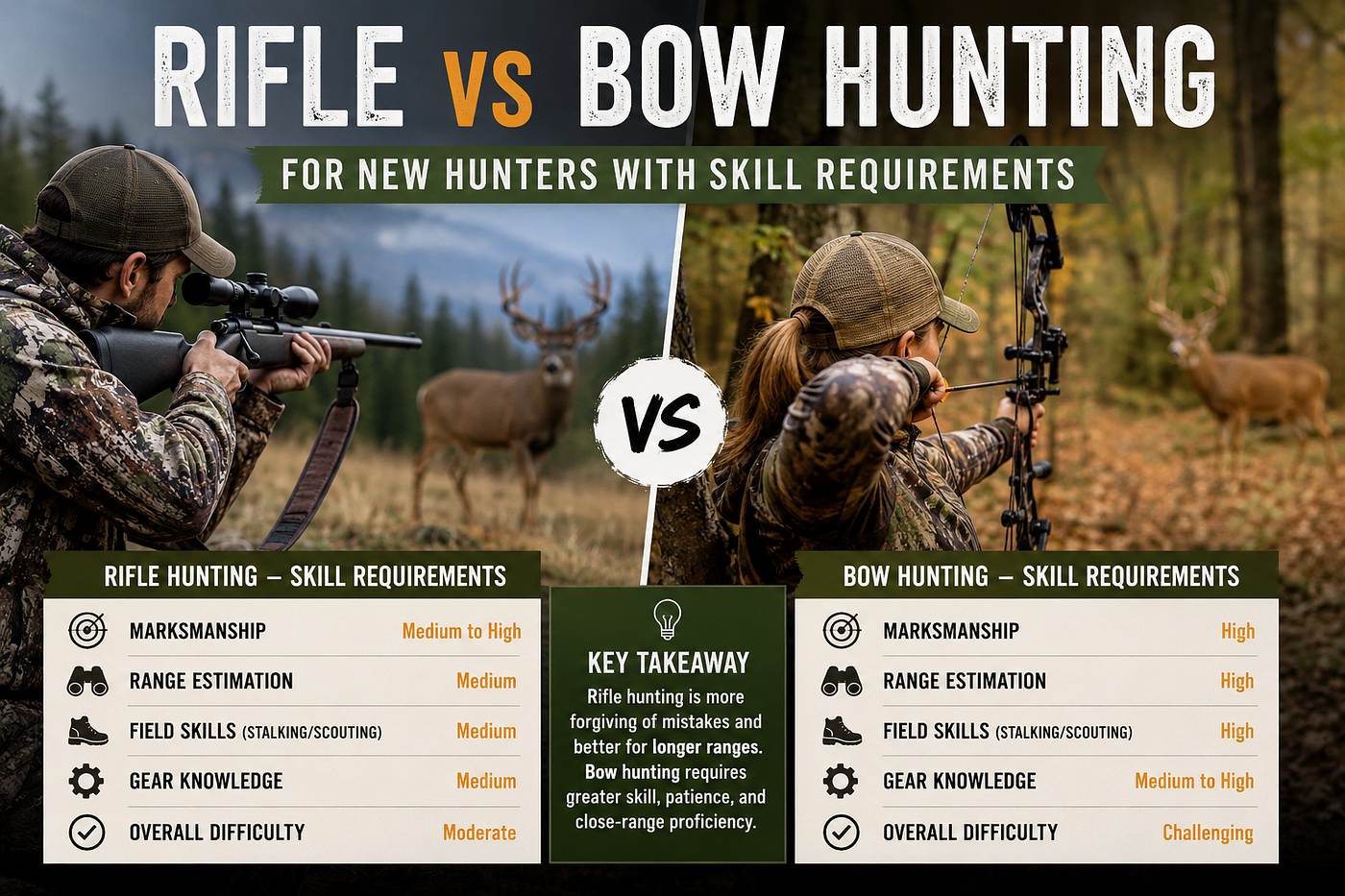
Skill Sets: Which Method Is Harder to Master?
Bowhunting’s Learning Curve: Technique, Consistency, and Judgment
Bowhunting has a steep learning curve — and that is not a criticism, it is simply the reality. Shooting a bow well requires developing repeatable physical mechanics: consistent anchor point, proper grip, smooth draw, clean release. Unlike a rifle, where squeezing a trigger requires minimal physical effort, drawing a compound bow at 50–70 pounds of draw weight and holding steady while a deer stands at 25 yards is a physically and mentally demanding act.
Beyond the shot itself, bowhunters need to develop:
- Distance judgment — accurately estimating yardage without a rangefinder at a moment’s notice
- Shot angle awareness — knowing which angles offer clean pass-throughs to the vitals and which do not
- Animal behavior reading — understanding when a deer is alert vs. calm, and when it is safe to draw
- Consistent practice — shooting regularly, year-round, not just in the weeks before season
The skill ceiling in bowhunting is high. Most experienced bowhunters will say it takes several seasons before everything starts clicking together in the field.
Rifle Hunting: Faster Proficiency, But Precision Still Matters
Rifle hunting generally has a shorter path to basic proficiency. The mechanics of shooting a bolt-action rifle are simpler to learn, scopes handle a lot of alignment work automatically, and practice sessions at the range provide fast, clear feedback. For most beginners, a few trips to the range and solid shot placement fundamentals translate to field readiness at 100 yards relatively quickly.
But basic proficiency does not mean rifle hunting is easy. Quick decision-making under pressure is something that only real hunting experience teaches. Knowing when not to shoot — because the angle is wrong, a deer is too alert, or brush is in the way — is a judgment skill that develops over time regardless of what is being carried. Rifle hunting rewards preparation, patience, and precision. It is faster to learn but still demands respect.
Safety Distances and Local Regulations to Know
Archery Buffers and Elevation Guidance Vary Widely by State and Locality
One area where beginners often get caught off guard is the regulatory side of hunting — specifically, how safety buffer distances differ between archery and firearms hunting, and how dramatically those rules can vary from one jurisdiction to another.
As a general baseline in many states:
- Archery hunters are typically required to maintain a minimum of 50 yards from occupied dwellings
- Firearms hunters often face a minimum of 150 yards from occupied structures — three times the archery standard
Municipal regulations add another layer. Some local ordinances require bowhunters within city or suburban limits to be elevated at least 10 feet off the ground when discharging a bow — a rule designed to direct arrows downward and reduce risk to bystanders.
These numbers are not universal. State wildlife agencies, county ordinances, and municipal codes each set their own rules, and they do not always align. Always verify the specific regulations for the exact area being hunted before setting up. Ignorance of local rules is not a valid defense, and violations can carry serious consequences including loss of hunting privileges.
Choose Your Method Based on How You Want to Hunt
Rifle and bow hunting are not competing philosophies — they are different tools built for different approaches to the same pursuit. The right choice comes down to what kind of experience a hunter wants to have in the woods.
Choose bow hunting if:
- The challenge of extreme close-range hunting is appealing
- Extended seasons — archery seasons often open weeks earlier than firearms — are a priority
- Developing a deep, skill-intensive practice is part of the draw
- Hunting in areas with restricted firearms use, like suburban zones or certain wildlife management areas
Choose rifle hunting if:
- A faster path to field-ready proficiency is the goal
- Hunting open terrain or long field edges where distance shots are likely
- Physical limitations make drawing and holding a bow difficult
- The priority is maximizing shot opportunities across varied conditions
Neither method is better. A hunter who shoots a rifle with discipline and preparation is just as skilled and ethical as a dedicated archer who has spent years perfecting a close-range game. Both require respect for the animal, commitment to clean kills, and genuine investment in getting better at the craft. The best approach is the one that matches the terrain being hunted, the time available to practice, and the kind of challenge that makes waking up at 4 a.m. feel worth it.
For hunters still finding their footing in either discipline, Deer Hunting Strategies offers beginner-focused guides and resources built to help establish a solid foundation — from understanding deer behavior to making smarter, more confident decisions in the field.
메타데이터
- post_id
- c2e7b05de6bc
- slug
- rifle-vs-bow-hunting-stalking-distance-requirements-skill-differences-c2e7b05de6bc
- url
- https://medium.com/@deerhuntingstrategies/rifle-vs-bow-hunting-stalking-distance-requirements-skill-differences-c2e7b05de6bc
- canonical_url
- https://medium.com/@deerhuntingstrategies/rifle-vs-bow-hunting-stalking-distance-requirements-skill-differences-c2e7b05de6bc
- author_url
- https://medium.com/@deerhuntingstrategies
- status
- ok
- fetched_at
- 2026-07-11 16:08:17
