What Level Do You Need to Work With a Language Coach?
A Student Asked, Here’s My Answer
What Level Do You Need to Work With a Language Coach?
A Student Asked, Here’s My Answer
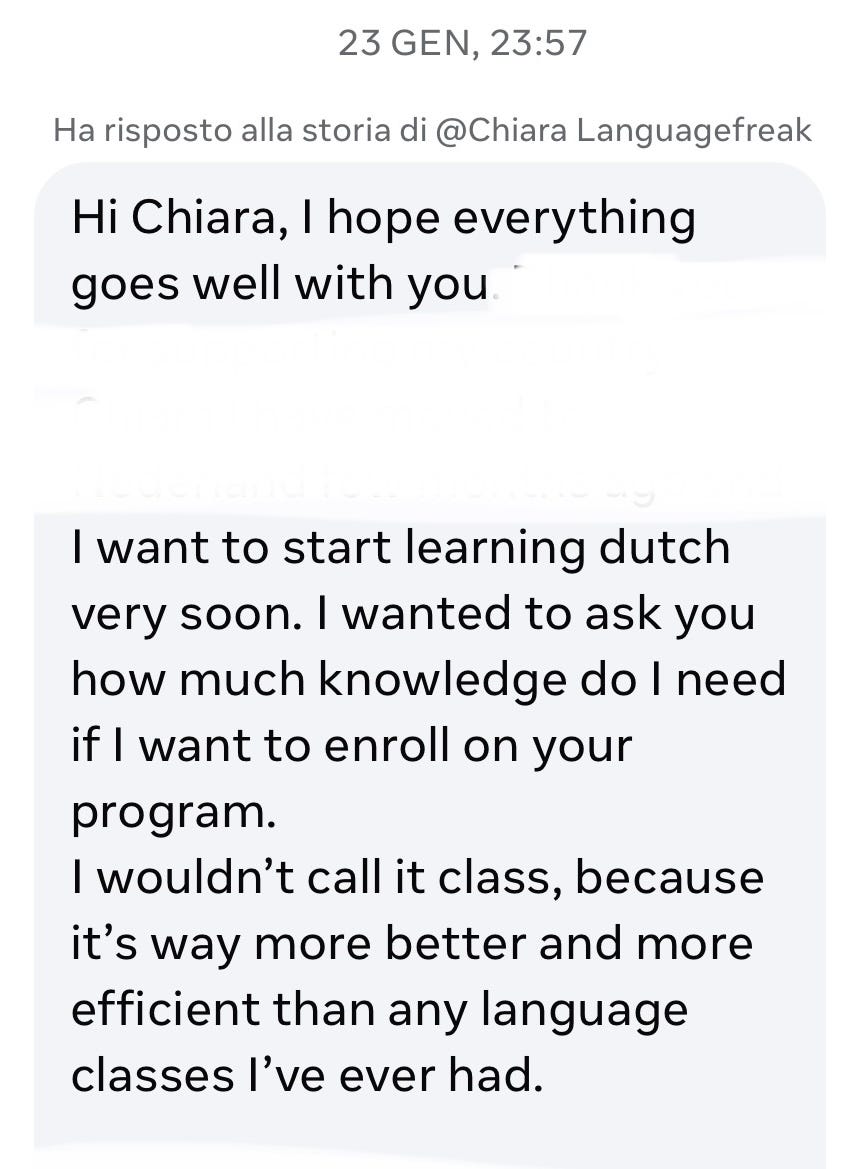
A few days ago, I received this message on Instagram.
It was one of the nicest messages I’ve received. But beyond the kind words, she asked me something important: “What level do I need to work with you?”.
I answered her personally, but I realized this is a question many people have. So here’s my full answer — not just for her, but for anyone wondering the same thing.
The Short Answer
You can work with me as a complete beginner.
But I also understand something else. I understand that the idea of jumping straight into voice messages when you barely know the language? That’s scary. It’s overwhelming. It can feel almost traumatic.
And that’s exactly why I created the journaling program.
It’s a bridge. A bridge from where you are now — maybe you know a few words, maybe you’re just starting — to the point where you can actually speak without that fear crushing you.
This isn’t a class. Let’s be very clear about that. We’re not doing traditional language classes here. What we’re doing is creating a daily interaction with the language in a way that builds your confidence step by step, without throwing you into the deep end before you’re ready.
Why Journaling Works
First of all, journaling is not about writing perfectly. It’s not about grammar exercises. It’s an excuse — an excuse to have an almost daily interaction with the language. To have the language become part of your daily life instead of something you “do” once a week in a class.
Let me tell you about my own experience. In winter 2024, I did a little experiment with Russian. My Russian was maybe A2 level — not very advanced at all. And what I did was simple: I read and wrote a few sentences every day about my life. Just a few sentences. About things that mattered to me.
And I saw what I can only describe as a little miracle.
Because here’s what happened: for every entry I wrote, I would then read it aloud. And then, at a certain point, I started auto-dictating what I was going to write. So instead of thinking and writing, I was saying it out loud, little by little, word by word, and then writing down what I said.
Do you see what happened there? I was connecting my brain to my mouth, not to my pen.
And that’s when everything changed. Because speaking isn’t about writing perfectly — it’s about getting your brain and your mouth to work together in that language.
The Versatility of Journaling
Here’s the beautiful thing: journaling is extremely versatile.
You don’t have to write a diary entry every single day. Some days, yes, I would journal about my life. But other days? I would just note down words I found while watching a video. Another day, I would translate a song that I liked. Sometimes I would just do an exercise.
I have someone I’m working with right now who does exactly this. When there are too many words he doesn’t know from my response, from our interaction, he simply sends me an entry where he takes notes about the expressions he encountered. He’s basically using our interaction as his study material.
It can really be adapted to you, to what works for you, to what you’re interested in.
The Power of Accountability
What really helped me when I did this for Russian was being in an accountability group. I was sending my entry every single day to people who could actually read it and interact with it.
And that’s where I come in for you.
Because I can read what you write. I can interact. I understand what you’re saying, what you’re trying to express. I can give you guidance when you need it. I can correct mistakes that AI might miss.
This is not automated. This is not a bot. This is a daily human interaction with someone who understands your language journey.
How It Actually Works
So what does this actually look like?
Every day at 11 PM, I send you a daily human check-in message on WhatsApp. Just a simple message.
Then you send me a short sample of what you worked on that day. Maybe it’s writing, maybe it’s notes, maybe it’s a little recap of something you learned. And if you feel ready — only if you feel ready — you can send a little audio too.
Now, I’m not going to sit there and correct every single mistake like a teacher with a red pen. That’s not the point, and honestly, that would take too much time and make the program expensive. The journaling program is intentionally very affordable because it’s about guidance, not grammar drills.
But here’s what I do give you: I react with a short comment, a question, some encouragement, maybe a little direction if you feel stuck.
And actually, my reactions can work as optional prompts when you’ve run out of ideas. So it becomes this ongoing conversation that happens once a day, without you needing to write “Hello, how are you?” It’s not formal. It’s just… ongoing. Like the language is just there, inside the things your brain deals with every single day.
A Real Example
I’m doing this with someone right now for Italian, and it’s really cool because it’s such a light interaction. He’s not stressed. He’s not panicking about making mistakes. He’s just… active. He’s engaging with the language every single day.
And you know what happens when you do that? When you eventually want to switch to voice messages, it’s not traumatic anymore. Because you’re already accustomed to expressing yourself. The language isn’t this foreign, scary thing anymore. It’s just part of your day.
The Progression Path
Here’s the path I’m offering you:
You start with journaling. You get comfortable expressing yourself in writing. You build that daily habit. You connect your brain to the language.
Then, when you’re ready — and only when you feel ready — we can switch to voice messages. And by that point, it won’t feel like jumping off a cliff. It’ll feel like the next natural step.
Because you’ve been building confidence this whole time. You’ve been active. You’ve been engaging. You’ve been making the language yours.
Ready to Start?
So if you’re a complete beginner, or even if you’ve been learning for a while but you’re still too scared to speak…
If you want to try this approach, if you want to start building that daily interaction with the language in a way that feels manageable and not overwhelming…
I’m here. I offer this for Italian, English, French, and Dutch.
And remember: you don’t need to be at any particular level. You just need to be willing to show up, even just for a few minutes a day.
That’s it. That’s all it takes.
Originally published at https://www.chiaralanguagefreak.com.
메타데이터
- post_id
- c2e9fcac6989
- slug
- what-level-do-you-need-to-work-with-a-language-coach-c2e9fcac6989
- url
- https://medium.com/@chiaralanguagefreak/what-level-do-you-need-to-work-with-a-language-coach-c2e9fcac6989
- canonical_url
- https://medium.com/@chiaralanguagefreak/what-level-do-you-need-to-work-with-a-language-coach-c2e9fcac6989
- author_url
- https://medium.com/@chiaralanguagefreak
- status
- ok
- fetched_at
- 2026-07-15 18:46:35






