why autism, did, and imaginary friends make perfect sense together
What sounds contradictory to outsiders feels surprisingly logical from the inside.
why autism, did, and imaginary friends make perfect sense together

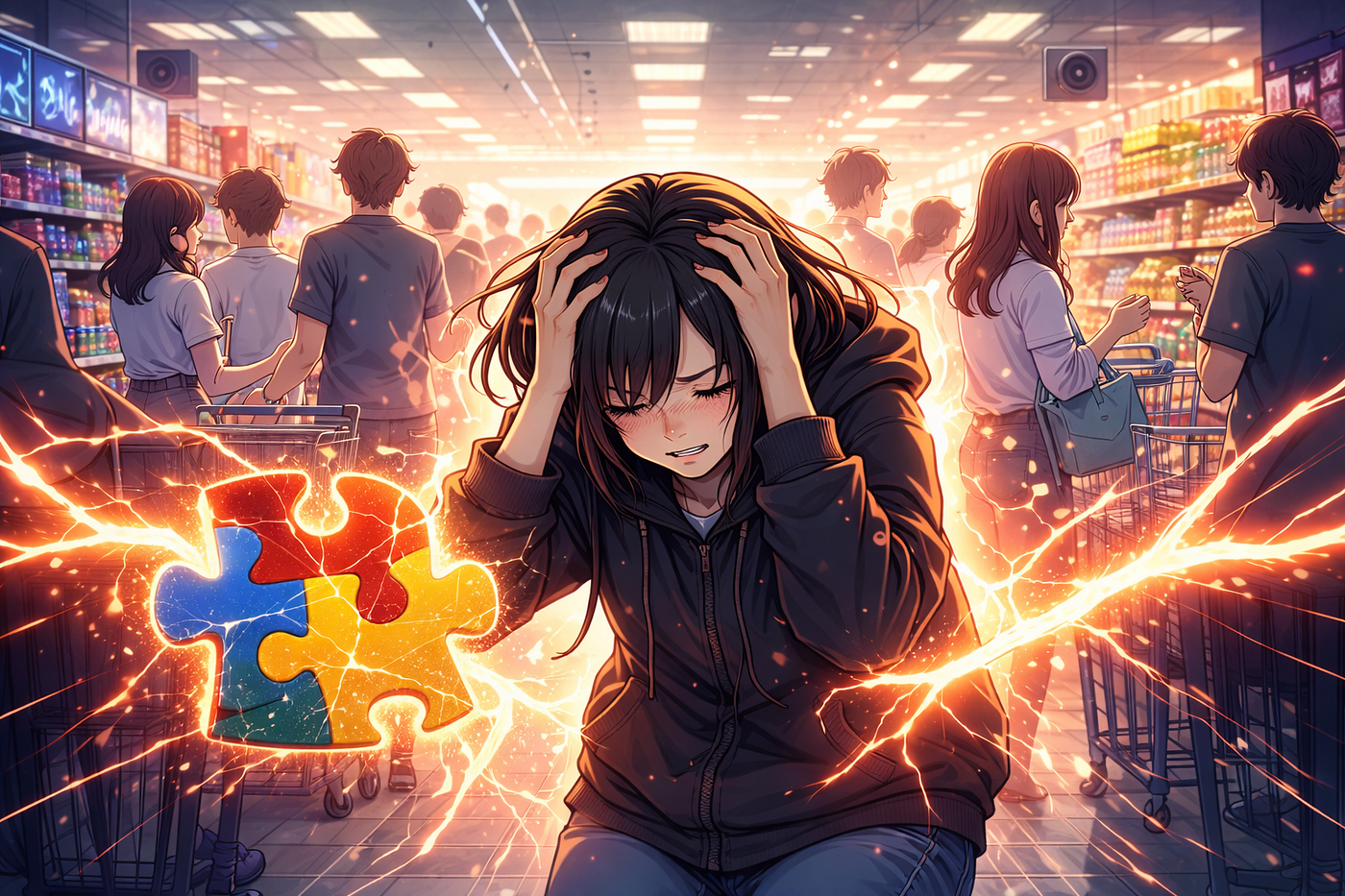
Image developed by the article’s author.
Most people would probably assume that autism, Dissociative Identity Disorder, and imaginary friends have nothing to do with each other. At first glance, I understand why. One is a neurodevelopmental condition, another is a dissociative disorder, and the third is something most people associate with childhood. They seem like completely separate topics that belong in completely different conversations. Yet when I look at my own life, I struggle to separate them. In many ways, they developed alongside each other, influenced each other, and became part of the same story.
I am autistic. I have DID. And I have imaginary friends.
Writing those three sentences together still feels strange because I know how they sound to people who have never experienced any of those things. Some readers will immediately become curious. Others will become skeptical. A few will probably assume that at least one of those statements is exaggerated. The internet has created an environment where unusual experiences are often dismissed as attempts to gain attention, and honestly, I understand the instinct. Extraordinary claims deserve scrutiny. The problem is that sometimes real experiences sound extraordinary simply because they fall outside what most people consider normal.
One of the biggest misconceptions people have is the idea that imaginary friends belong exclusively to childhood. We tend to treat them as a developmental phase, something that appears during elementary school and quietly disappears as we grow older. Popular culture reinforces this idea constantly. Imaginary friends are usually portrayed as cute childhood companions who eventually fade away once a child becomes more mature and socially connected. What people rarely discuss is that some adults continue experiencing forms of imagined companionship long after childhood ends.
The truth is that human beings are profoundly social creatures. We are wired for interaction, conversation, and connection. When those needs are not met, the mind often adapts in surprising ways. You can see small examples of this everywhere. Sometimes you pass someone on the street who appears to be talking to themselves. Sometimes you see an elderly person speaking aloud in an empty room. Sometimes you notice someone carrying on a conversation with nobody physically present. Most people immediately assume that something is wrong, but the reality is often more complicated than that. Conversation is such a fundamental human need that the mind frequently finds ways to create it when external opportunities become limited.
Looking back, loneliness was probably one of the defining features of my childhood. Social interaction never came naturally to me. Like many autistic people, I often felt as though everyone around me had received a set of instructions that I somehow missed. Other children seemed to understand social rules intuitively while I was forced to analyze them consciously. Friendships felt unpredictable. Conversations felt exhausting. Even when I was surrounded by people, I often felt disconnected from them. As a result, I spent a great deal of time alone.
When you spend enough time alone, your inner world starts becoming larger. For some people, that inner world becomes a source of creativity. For others, it becomes a refuge from reality. In my case, it became populated. My first imaginary friend appeared when I was around eleven or twelve years old. At the time, I did not think of it as unusual. It felt natural. There was no dramatic moment when I consciously decided to invent a companion. It simply happened, almost as if my mind had filled an empty space that had existed for a long time.
What makes this difficult to explain is that my experience never resembled the way people typically describe creating fictional characters. When writers create characters, they usually make deliberate decisions. They choose the character’s appearance, personality, habits, and history. My experience never felt like that. One of the longest-lasting figures in my life is someone named Pielmon. Even today, I struggle to explain why she exists specifically as Pielmon rather than as someone else. She never felt like a character I designed. She felt more like a presence I encountered within my own internal world. I realize how strange that sounds, but it remains the most accurate description I can offer.
As the years passed, I became increasingly aware that my experiences did not fit neatly into the categories most people use to understand the mind. Reality and imagination were not always separated by the clear boundaries that people seemed to expect. Human psychology rarely works in such simple ways. The more I learned about myself, the more I realized that many experiences exist in gray areas that are difficult to explain to people who have never lived through them.
What I did not realize at the time was that another pattern was developing alongside all of this. While I was trying to understand my autism and the role imaginary friends played in my life, there were signs of something else happening beneath the surface. At first, the clues were subtle. They appeared in comments from other people, observations that seemed insignificant in the moment but would become much more important later.
People occasionally told me that I seemed different depending on the day. Some noticed changes in my behavior. Others noticed changes in the way I expressed emotions. A few even commented on my voice. There were periods when my voice sounded noticeably softer and others when it sounded deeper. The strangest part was that these shifts were largely unconscious. I was not performing. I was not making a deliberate choice. In fact, I often had no idea what people were talking about when they pointed it out.
Years later, I would discover that those observations were connected to something much larger than I had ever imagined. At the time, however, they were simply fragments of a puzzle that I did not yet know I was solving.
At the time, I had no framework for understanding what was happening. I knew I was autistic. I knew I spent an unusual amount of time in my own head. I knew that my internal world felt far more vivid than most people seemed to experience. What I did not know was that some of the inconsistencies in my behavior were becoming increasingly difficult to ignore.
One of the most unsettling things about dissociation is how invisible it can be from the inside. Popular culture often portrays Dissociative Identity Disorder as something dramatic and obvious. Movies tend to focus on extreme personality shifts, sudden transformations, and sensationalized portrayals that bear little resemblance to how many people actually experience it. The reality is often far quieter and far more confusing.
For those unfamiliar with the condition, DID is generally understood as a dissociative disorder involving distinct identity states, often developing as a response to overwhelming experiences during childhood. Contrary to popular stereotypes, people with DID are not constantly aware of every shift that occurs. In fact, the lack of awareness is often part of what makes the condition so difficult to recognize. You cannot easily observe a process while you are inside it.
Looking back, some of the earliest clues came from other people rather than from me.
Years ago, I worked in an environment where I interacted with the same group of people almost every day. Over time, certain coworkers began making comments that confused me. They would describe me differently depending on when they had spoken to me. One person would say I seemed quiet and reserved. Another would describe me as unusually confident. Someone else would mention that my voice sounded different on certain days. A few people even gave me a nickname behind my back that roughly translated to something unsettling or eerie because they could not understand why I appeared so inconsistent.
At the time, I assumed they were exaggerating.
At the time, I explained those observations away with the same assumptions most people would make. Mood affects behavior. Stress affects communication. Context changes how we present ourselves. Nothing about those explanations seemed particularly unusual, so I accepted them without much further thought.
What I did not realize was that many of the changes people described were happening without my conscious awareness. There were moments when I would hear stories about conversations I barely remembered having. There were reactions from people that felt disconnected from my own memory of events. Sometimes I would feel as though I had somehow missed part of my own day.
The experience is difficult to explain to someone who has never dissociated because it does not feel like waking up and becoming a completely different person. It is usually much more subtle than that. For me, it often felt like gaps, inconsistencies, and moments of confusion that could never be fully explained. Certain memories felt distant. Certain emotional reactions felt disconnected. Sometimes it was as though different parts of my life belonged to slightly different versions of myself.
The frustrating part is that none of this comes with clear labels attached to it. There is no internal notification informing you that dissociation is happening. There is no obvious boundary separating one state from another. Most of the time, life simply continues moving forward while you struggle to understand why certain pieces never seem to fit together properly.
As I learned more about DID, I found myself revisiting experiences that I had previously dismissed. The comments about my voice suddenly felt more significant. The differences people noticed in my behavior felt less random. Even the way I related to my own thoughts started making more sense. For years, I had assumed that everyone experienced their inner world with the same complexity I did. It never occurred to me that what felt normal to me might be unusual to others.
This is where the connection between autism, DID, and imaginary friends began to feel less contradictory and more logical.
All three experiences involved a relationship with an internal world that had become extraordinarily developed. Autism often pushed me inward because social interaction could be exhausting and difficult to navigate. Loneliness encouraged me to spend even more time inside that internal space. Dissociation added additional layers of complexity that I would not fully understand until much later. None of these experiences existed in isolation. They constantly influenced one another.
The result was a life that often looked ordinary from the outside while feeling remarkably different from the inside.
From the outside, there was nothing especially remarkable about me. Most people simply saw a quiet, introverted person who preferred spending time alone. What remained invisible was the amount of activity taking place beneath the surface. They did not see the conversations. They did not see the shifting perspectives. They did not see the constant effort required to make sense of experiences that most people never have to think about.
For a long time, I believed that if I talked honestly about these things, people would assume I was either confused or dishonest. The easiest option was simply to stay quiet. That is what many people with unusual experiences learn to do. They become experts at appearing normal because explaining the truth often requires more energy than remaining misunderstood.
Yet the longer I stayed silent, the more isolated I felt. Not only from other people, but from my own experiences. It is difficult to understand yourself when you spend years pretending that important parts of your life do not exist.
Eventually, I reached a point where I stopped asking whether these experiences looked normal from the outside and started asking a different question.
What if they made perfect sense given the life I had actually lived?
Once I stopped viewing these experiences as isolated phenomena, a different question emerged. Instead of asking why I had imaginary friends, why I dissociated, or why I felt fundamentally different from many of the people around me, I started wondering what all of those experiences had been trying to accomplish.
The answer was not simple, but it was surprisingly consistent.
They were adaptations.
Not necessarily perfect adaptations. Not always healthy adaptations. But adaptations nonetheless.
One of the biggest mistakes people make when thinking about the mind is assuming that every unusual behavior exists for no reason. In reality, the brain is constantly solving problems, even when the solutions it creates seem strange from the outside. If a person loses part of their vision, the brain begins finding alternative ways to interpret the environment. Someone raised in a stressful or unpredictable situation may develop psychological strategies that reduce emotional strain. Human psychology is remarkably creative when it comes to survival.
Looking back, I can see how much of my life was spent adapting to forms of isolation that were difficult to explain. Loneliness is often described as the absence of people, but I do not think that definition is entirely accurate. I have felt lonely in crowded rooms. I have felt lonely in classrooms full of students. I have felt lonely while sitting at tables surrounded by coworkers. The absence that hurt most was never physical. What affected me most was the feeling that nobody truly understood how I experienced the world.
Many autistic people know exactly what I mean.
There is a particular kind of exhaustion that comes from constantly translating yourself. You learn to monitor facial expressions, adjust your tone of voice, and pay attention to body language that seems intuitive to everyone else. Over time, you become skilled at navigating social situations, but that skill often comes at a cost. The more energy you invest in adapting to other people’s expectations, the harder it becomes to determine where the adaptation ends and where your authentic self begins.
For years, I assumed this was simply part of being a person.
Only later did I realize how much effort I was dedicating to appearing understandable to others while feeling increasingly disconnected from myself.
That disconnect created an interesting paradox. As meaningful understanding became harder to find externally, my internal world grew increasingly important. Conversations that never happened in real life continued there. Questions that felt difficult to explore elsewhere found room to exist there. Emotions that rarely seemed to fit comfortably into ordinary discussions became easier to process within that space.
This is one reason I have never viewed my imaginary friends with the same embarrassment that many people seem to expect. Embarrassment usually comes from believing something is pointless or irrational. My experience never felt pointless. Strange, perhaps. Difficult to explain, certainly. Yet when I examine the role those companions played throughout different periods of my life, I see connection where there otherwise would have been isolation.
That does not mean they replaced real relationships.
Nothing can fully replace another human being.
What they provided was something different. They occupied empty spaces during years when those spaces might otherwise have remained vacant.
The same principle applies to many of the mechanisms people develop throughout their lives. Some individuals become deeply attached to fictional characters. Others form strong emotional bonds with books, online communities, or creative projects. Human beings are constantly building bridges toward connection, even when those bridges look unusual from the outside.
The older I became, the more I realized that most people are far less different from one another than they initially appear. Everyone creates narratives that help make sense of life. Internal dialogue is nearly universal, even if it takes different forms from person to person. The desire for belonging is equally widespread. In many cases, the distinction lies less in the existence of these experiences and more in the intensity with which they are felt.
What changed for me was the realization that I no longer needed every aspect of my experience to fit neatly into conventional definitions. For a long time, I believed that understanding myself required choosing a single explanation. Either my experiences belonged to autism, or they belonged to dissociation, or they belonged to imagination. The more I learned, the more artificial those boundaries started to feel.
Human beings rarely exist inside tidy categories.
Experiences bleed into one another. Coping strategies developed for one challenge often influence how we respond to another, while different aspects of identity continuously shape the way we understand ourselves. Trying to separate those elements completely can be far more difficult than most people realize.
Perhaps that is why the title of this essay feels less controversial to me than it probably does to many readers. From the outside, autism, DID, and imaginary friends appear to be unrelated subjects. From the inside, they often feel like different chapters of the same story.
And that story, more than anything else, has always been about learning how to coexist with solitude.
As I grew older, I became less interested in determining whether my experiences fit perfectly within a diagnostic category and more interested in understanding what they revealed about the human mind itself.
Modern psychology often relies on classification. Conditions are separated into categories. Symptoms are grouped together. Diagnostic criteria are established to create clearer distinctions between different experiences. There is enormous value in that approach because it helps clinicians communicate, conduct research, and provide treatment. At the same time, real lives rarely organize themselves according to the neat boundaries found in diagnostic manuals.
Human beings are not collections of isolated symptoms.
A person with autism does not experience autism in a vacuum. A person with DID does not experience dissociation independently of every other aspect of their identity. Loneliness, relationships, environment, personality, memory, trauma, imagination, and countless other factors constantly interact with one another. The result is a psychological landscape that is often far more complex than any single label can fully capture.
Looking at my own life through that lens changed the way I interpreted many experiences that had once confused me.
For years, I approached these subjects as separate mysteries. There were imaginary friends that seemed difficult to explain. There were dissociative experiences that left gaps in my understanding of myself. There was autism, which influenced the way I related to people and navigated the social world. Each element appeared to belong to a different story.
Eventually, I began noticing that all three were responding to many of the same underlying realities.
A highly developed internal world did not emerge randomly. It developed within the context of isolation. Dissociative tendencies did not appear in a vacuum either. They became part of the way my mind processed experiences that often felt overwhelming or difficult to integrate. Autism also influenced how much time I spent relying on internal rather than external forms of understanding.
Viewed individually, these experiences can appear unusual. When considered together, however, they become remarkably coherent.
That realization does not mean every autistic person will have imaginary friends. It does not mean everyone with DID will experience loneliness in the same way I did. Human psychology is far too diverse for simple formulas. What it does suggest is that minds adapt to circumstances, often in ways that make perfect sense once enough context is available.
One reason unusual experiences are frequently misunderstood is that observers only see the outcome. They see the behavior. They hear the story. They notice the symptom. What remains hidden is the long chain of adaptations that produced it.
When people encounter an adult with imaginary friends, the immediate reaction is often confusion. The question that usually follows is obvious: why would someone need that? A more useful question might be what circumstances made that adaptation meaningful in the first place.
The same principle applies to countless aspects of human behavior. Focusing exclusively on whether something appears normal often prevents us from understanding why it exists at all.
Adopting that perspective gradually changed the way I viewed myself. There was a period in my life when many of these experiences felt like evidence that something was fundamentally wrong with me. I wanted simple explanations, clear answers, and a level of certainty that would finally make everything understandable.
Instead, what I found was complexity.
Surprisingly, complexity turned out to be more comforting than certainty. It created space for nuance, accepted contradictions without demanding immediate resolution, and allowed experiences that did not fit neatly into conventional expectations to exist without constant justification.
Today, I no longer see my life as a collection of disconnected oddities that require endless explanation. Instead, I see a series of adaptations developed by a mind attempting to navigate the world with the tools available to it at the time. Some of those adaptations were helpful. Others created difficulties of their own. Most existed somewhere between those extremes. They were simply part of the ongoing process of surviving, learning, and moving forward.
If there is one conclusion I have reached after years of trying to understand autism, DID, and the role imaginary friends played in my life, it is that loneliness changes people in ways that are often invisible. It can push someone toward communities, draw another person into creative pursuits, or transform the inner world into a place rich enough to compensate for what feels absent outside of it.
My own path happened to involve all three.
The irony is that this essay began with topics that seem unusual and perhaps even controversial, yet the conclusion feels surprisingly ordinary.
At its core, my story is not really about autism, DID, or imaginary friends.
It is about connection.
Like most people, I wanted to feel understood. Meaningful relationships mattered. Genuine moments of connection mattered. Finding people who could see beyond labels mattered. At the same time, learning to understand my own mind proved equally important.
Perhaps that is the lesson I wish I had learned earlier.
Survival is not always about becoming normal. More often, it involves understanding the reasons we became who we are. Once I stopped viewing every unusual aspect of myself as a problem that needed to be eliminated, I was finally able to see the larger picture.
The imaginary friends were not evidence of failure.
The dissociation was not evidence of weakness.
The autism was not evidence that I was broken.
Each represented part of a much larger story about adaptation, resilience, and the search for belonging.
That is why autism, DID, and imaginary friends make perfect sense together.
Not because they are identical experiences. Not because one automatically causes the others. The connection exists because all three became intertwined within the same life, shaped by the same search for understanding and influenced by the same desire for connection.
For years, I believed the answer to loneliness existed somewhere outside of me. What I eventually discovered was more complicated and far more human. Relationships matter. Community matters. Being understood matters. Yet self-understanding matters too.
Sometimes the goal is not to erase the unusual parts of yourself.
Sometimes the goal is learning how to live with them, understand them, and recognize the role they played in helping you survive long enough to become the person writing the story today.

💛 Support the Author
I rarely talk about this openly, but I think honesty matters.
I am a Brazilian autistic writer trying to build a life through writing. Unfortunately, Medium does not allow writers from Brazil to join the Partner Program, which means that despite the thousands of hours I invest into researching, writing, editing, and publishing articles, I currently earn nothing from my work here.
Writing is not a hobby for me. It is one of the few things that gives structure, purpose, and meaning to my life.
I live with autism and struggle with depression. Some days are manageable. Other days, simply getting out of bed feels overwhelming. There have been periods in my life when I completely lost hope for the future. There have been moments when continuing forward felt impossible.
Even during those difficult periods, I kept writing.
I kept researching autism, mental health, relationships, loneliness, and the experiences that shape our lives because I know there are people reading these articles who see themselves in them. Many readers have told me that my work helped them feel understood, less isolated, or more hopeful. Those messages mean more to me than I can express.
The reality, however, is that creating this content takes time, energy, and resources that I often struggle to afford.
Your support helps me continue studying mental health, creating new articles, improving my content, investing in future Twitch streams, purchasing the tools I need to work, and maintaining the stability necessary to keep creating.
If my writing has ever helped you, taught you something, comforted you during a difficult moment, or simply made you feel less alone, I would be deeply grateful if you considered supporting my work.
Please do not assume that someone else will.
Independent creators survive because individual readers decide that their work is worth supporting.
You can support me through my Linktree:
Every contribution, regardless of size, genuinely makes a difference. Even a small donation helps me continue creating, learning, and sharing knowledge with others.
Thank you for reading.
Thank you for being here.
And thank you for giving my work a place in your life. 💛
메타데이터
- post_id
- c2fc8649bc53
- slug
- why-autism-did-and-imaginary-friends-make-perfect-sense-together-c2fc8649bc53
- url
- https://medium.com/@higgoraraujo/why-autism-did-and-imaginary-friends-make-perfect-sense-together-c2fc8649bc53
- canonical_url
- https://medium.com/@higgoraraujo/why-autism-did-and-imaginary-friends-make-perfect-sense-together-c2fc8649bc53
- author_url
- https://medium.com/@higgoraraujo
- status
- ok
- fetched_at
- 2026-06-10 21:21:38