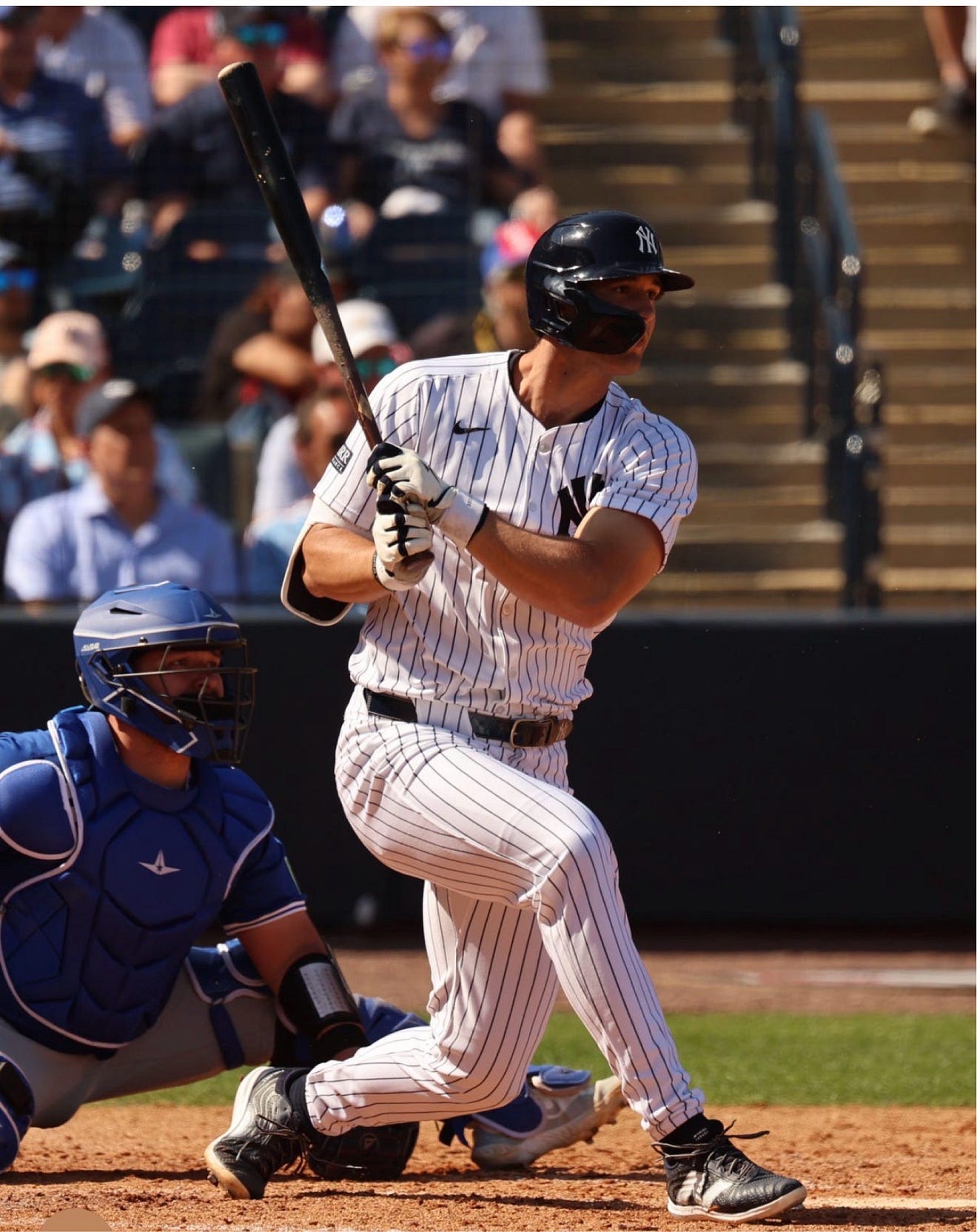
What It’s Really Like to Be the New York Yankees’ Team Physician
By Dr. Christopher S. Ahmad, MD — Head Team Physician, New York Yankees | Orthopedic Surgeon, NewYork-Presbyterian / Columbia University
What It’s Really Like to Be the New York Yankees’ Team Physician
By Dr. Christopher S. Ahmad, MD — Head Team Physician, New York Yankees | Orthopedic Surgeon, NewYork-Presbyterian / Columbia University
There is a moment — a specific, unmistakable moment — that every physician who treats professional athletes knows intimately. It happens in the bottom of the eighth inning of a playoff game, or on the morning of Opening Day, or in the quiet of a stadium tunnel at 11 PM when a pitcher has just walked off the mound clutching his elbow. It is the moment when medicine and sport collide at maximum intensity, and every decision you make carries consequences far beyond the exam room.

For the past 17 years, I have lived in that moment as the Head Team Physician for the New York Yankees. It is the most demanding, most rewarding, and most humbling role in my career as a board-certified orthopedic and sports medicine surgeon. And it is nothing — absolutely nothing — like what you see on television.
“There is nothing more special than helping athletes restore their dream of getting back to sports, whether it’s a high school player or a Yankees player.”
The Phone Call That Changes Everything
When a Yankees player sustains an injury during a game, the first call comes to me before the crowd has stopped buzzing. Within minutes, I need to assess the nature of the injury, determine whether the player can return to the field that night, coordinate with the team’s athletic training staff, and begin forming a treatment plan — all while a stadium full of 50,000 fans watches, and while front office staff, coaching teams, agents, and national media prepare to weigh in.
Managing that pressure is something medical school does not fully prepare you for. What it does prepare you for is the clinical work: the examination, the diagnosis, the surgery if necessary, and the long road of rehabilitation that follows. I completed my orthopedic surgery residency at New York-Presbyterian / Columbia University Medical Center, followed by a sports medicine fellowship at the Kerlan-Jobe Orthopedic Clinic in Los Angeles — where I trained directly under Dr. Frank Jobe, the physician who invented Tommy John surgery in 1974. That foundation is what allows me to perform at the level required when the stakes are at their highest.
But the human side — the side that involves sitting across from a pitcher who has just learned his season is over, or helping a positional player understand a complex rehabilitation protocol when he desperately wants to play — that is learned entirely on the job.
What ‘Team Physician’ Actually Means
The title ‘team physician’ sounds straightforward. In practice, it encompasses a dozen different roles simultaneously. On any given day, I might be performing a pre-game evaluation of a player with a chronic knee condition, reviewing MRI scans from the previous evening’s game, consulting with the general manager about the return-to-play timeline of an injured starter, conducting a video-based biomechanical analysis of a pitcher’s throwing mechanics, and then flying to meet a minor-league prospect for a pre-contract physical evaluation.
My role with the Yankees sits alongside my work as a professor at Columbia University’s Vagelos College of Physicians and Surgeons and as an orthopedic surgeon at NewYork-Presbyterian, where I treat hundreds of athletes from all walks of life — from Little League players and high school pitchers to recreational weekend warriors and professional athletes from other sports. The Yankees role informs all of that work, and vice versa.
“Being able to help an athlete prevent injuries in the first place is also rewarding. The most fulfilling aspect is keeping their dream alive.”
Contrary to what some people assume, being a team physician for a major league franchise does not mean treating only the elite. Some of the most meaningful clinical work I do is with young athletes who come to my practice at Columbia after sustaining a sports injury that threatens their participation in the sport they love. The skills, techniques, and innovations developed at the highest level of professional sport ultimately benefit athletes at every level — and that trickle-down effect is something I take enormous pride in.
The Elbow Epidemic: A Problem the Yankees Helped Me Understand
No injury has defined my career more than the ulnar collateral ligament (UCL) tear — the injury repaired by Tommy John surgery. Over more than two decades, I have performed over 1,000 Tommy John procedures, making technical innovations to the original technique to improve outcomes, reproducibility, and recovery times. My most recent development is the Triple Tommy John (TJ3) procedure, a more comprehensive reconstruction that I believe represents the new benchmark in UCL repair.
The Yankees gave me an extraordinary lens through which to study this injury. Serving as team physician for a roster that includes some of the most elite pitchers in baseball — and managing their care at the highest possible stakes — has sharpened my clinical thinking in ways that years of research alone never could. Every decision I make for a Yankees pitcher informs the research I publish, the surgical techniques I refine, and the preventive protocols I recommend for youth athletes.
What alarms me most, as both a clinician and a researcher, is how rapidly UCL tears and Tommy John surgeries are increasing in young players — some as young as 13 or 14. I now serve on a Major League Baseball research committee alongside other leading orthopedic surgeons, including Dr. James Andrews, specifically to address this epidemic. The data is clear: velocity-focused training, insufficient recovery time, year-round play without adequate rest, and early sports specialisation are all contributing factors.
The warning signs of a UCL injury every pitcher and parent should know:
- Pain or tenderness on the inner side of the elbow after throwing
- A decrease in throwing velocity without a clear mechanical explanation
- Tingling or numbness in the ring finger and little finger
- A ‘popping’ sensation during a throw, followed by acute pain
- Swelling on the medial (inner) side of the elbow
If a young pitcher experiences any of these symptoms, the right answer is to stop throwing immediately and seek evaluation from a sports medicine physician. Early intervention often means the difference between conservative treatment and surgery.
The Weight of High-Profile Cases
One of the greatest challenges of being the Yankees’ team physician is managing injuries that attract enormous media attention. When a high-profile player is injured, the cascade of stakeholders is immediate and intense: the player, his family, his agent, the coaching staff, the front office, national sports media, and the fans. Each of these parties has a legitimate interest in the outcome — and they do not always agree on what that outcome should be.
My obligation, always and without exception, is to the patient. That sounds straightforward, but in the world of professional sport, it requires constant vigilance. A player may feel pressure to return before he is medically ready. A coaching staff may need clarity on timelines that medicine cannot always provide with certainty. The media will speculate regardless of what is said or unsaid. Navigating all of this while keeping the athlete’s health and long-term wellbeing at the centre of every decision is the defining challenge of the role.
What I have learned, over 17 years, is that transparency and trust are the foundations of everything. When a player trusts that his physician is telling him the full truth about his injury — not a commercially convenient version of the truth — that trust enables better outcomes. Players heal better when they understand their injury, participate meaningfully in their treatment decisions, and believe in the rehabilitation plan.
“My obligation, always and without exception, is to the patient. In the world of professional sport, that requires constant vigilance.”
From the Yankees to Your Community: Why This Matters Beyond the Bronx
People sometimes ask me why I continue to maintain a full clinical practice treating non-professional athletes when my Yankees role is so demanding. The answer is simple: the innovations developed at the elite level only have value if they reach the broadest possible population of athletes.
Every young pitcher in New York, New Jersey, and across the country who comes to my practice at Columbia University deserves the same level of evidence-based, technically advanced care as a major league player. The surgical techniques I refine while treating Yankees pitchers, the rehabilitation protocols I develop in collaboration with the team’s training staff, the injury prevention research I conduct through Columbia’s Department of Orthopedic Surgery — all of it informs how I treat every athlete who walks through my door.
I founded the Baseball Health Network, a non-profit organisation dedicated to promoting the health and safety of young athletes, precisely because I believe that access to elite sports medicine knowledge should not be limited to those who play professionally. The goal is a future where fewer young athletes require Tommy John surgery in the first place — because the coaches, parents, and physicians around them have the information they need to keep them healthy.
What I Would Tell a Young Athlete Today
If there is one message I could send to every young baseball player, soccer player, swimmer, or tennis player in New York and beyond, it would be this: your body is more valuable than any single season. Rest is not weakness. Pain is not something to play through. And early evaluation by a sports medicine physician is never something to delay out of fear.
The most rewarding cases in my career are not the ones where I performed the most complex surgery. They are the ones where a thorough evaluation and a well-designed conservative treatment plan meant surgery was never needed at all. Keeping an athlete healthy and competitive without an operating room is always the preferred outcome.
As a board-certified orthopedic and sports medicine surgeon practising in New York City, I see athletes of all ages and ability levels at my Columbia University practice. Whether you are a professional athlete, a collegiate player, a high school student, or a recreational adult who wants to stay active for life, the principles of evidence-based sports medicine apply equally. Injuries do not care about your level of competition — and neither does exceptional care.
About Dr. Christopher S. Ahmad, MD
Dr. Christopher S. Ahmad is a board-certified orthopedic and sports medicine surgeon at NewYork-Presbyterian / Columbia University Irving Medical Center, where he serves as a Professor and Vice Chair of the Department of Orthopedic Surgery. He is the Head Team Physician for the New York Yankees and has held that role since 2009. Dr. Ahmad has performed over 1,000 Tommy John surgeries and is the developer of the innovative Triple TJ3 reconstruction procedure. He is the founder of the Baseball Health Network and has authored more than 200 peer-reviewed articles. He has been recognised as a Best Doctor in America every year since 2005.
To schedule an appointment: (212) 305–4565 | drahmadsportsmedicine.com
메타데이터
- post_id
- c31a5d3d93fb
- slug
- new-york-yankees-team-physician-orthopedic-surgeon-dr-christopher-ahmad-c31a5d3d93fb
- url
- https://medium.com/@drchristophersahmad/new-york-yankees-team-physician-orthopedic-surgeon-dr-christopher-ahmad-c31a5d3d93fb
- canonical_url
- https://medium.com/@drchristophersahmad/new-york-yankees-team-physician-orthopedic-surgeon-dr-christopher-ahmad-c31a5d3d93fb
- author_url
- https://medium.com/@drchristophersahmad
- status
- ok
- fetched_at
- 2026-06-09 15:37:30