O! America Lost in the Fog
250 years — it’s all right
O! America Lost in the Fog
250 years — it’s all right
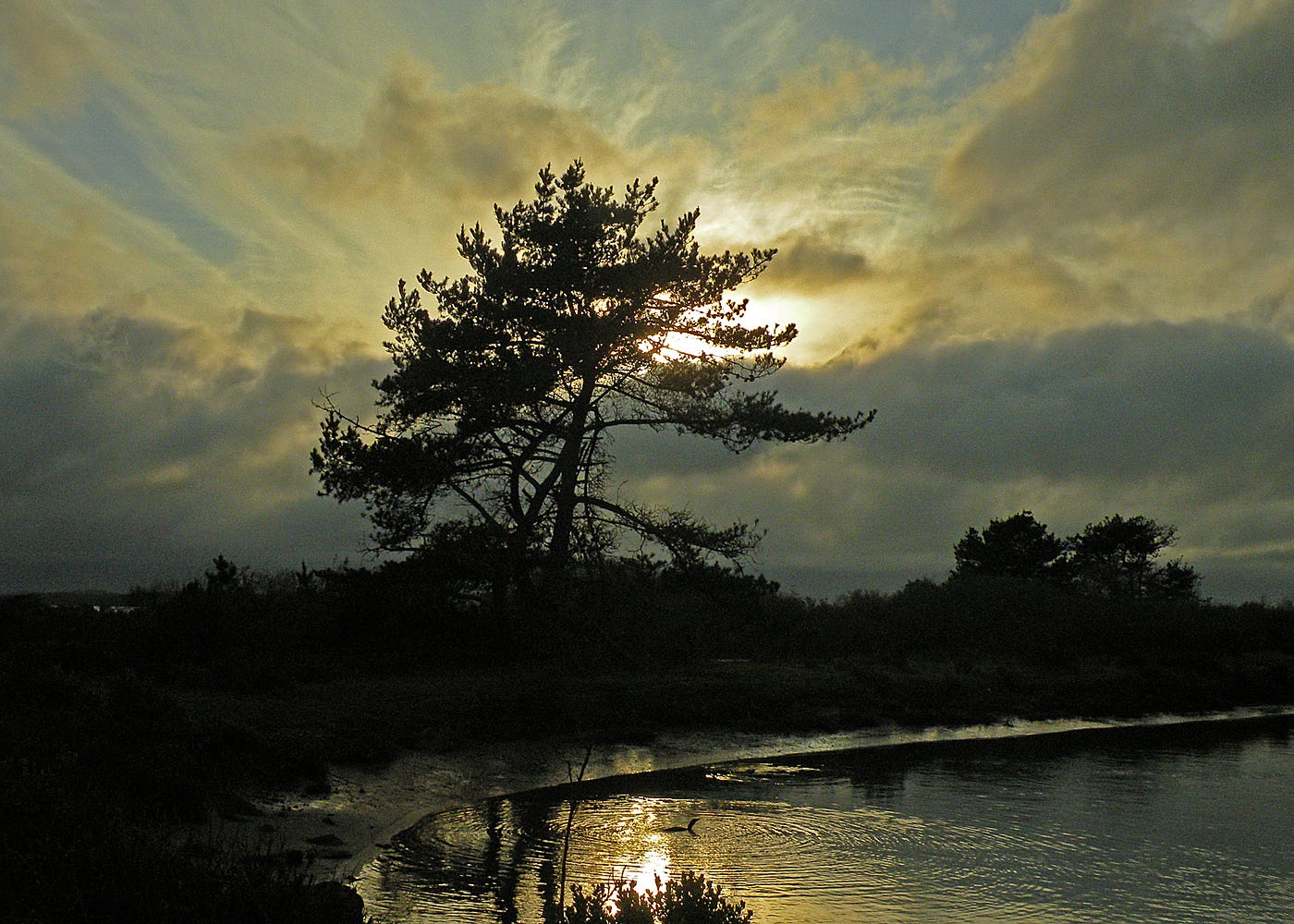
Bright sun bursting through clouds over pine tree in the estuary at Morro Bay — Photo by Ruth Ann Angus
It is May, and already the summer fog has arrived in Morro Bay. The weather guy on TV names it “May Gray,” this fog that envelopes the trees, the houses, the streetlights, and the entire 576-foot volcanic plug we call Morro Rock — that natural wonder that graces the entrance to our harbor. On gray days like this, locals will say, “The Rock isn’t out today,” confounding new visitors to our town who sometimes believe that the thing disappears at times.
This gray day matches my mood lately as my spirits decline under the barrage of rhetoric regularly regurgitated by my country’s leaders. I am often as sad as the dismal, featureless skies, hearing of the daily attacks on our democracy. I look for something to brighten my disposition.
On Saturdays, I am listening to the Broken Spoke folk music show on the local NPR radio station. I like this show because the DJ is a woman who often plays songs by performers I knew during the 1960s in Greenwich Village — like one from Richie Havens played on last Saturday’s show. I listen to this station all day, beginning at noon and continuing with other shows until 6 PM when it’s time for dinner. But not the first Saturday in May.
This is Derby Day in Kentucky, and I spend the entire afternoon watching the spectacle. I like horses. I’m not much of a rider anymore, but there is nothing quite like a good gallop on a fine animal. Which is why I enjoy watching the races.
Pomp and drama and overwhelming patriotism erupt. The audience, whether in person or on TV, waits excitedly for the announcement of who will perform the national anthem. Military figures stand erect, holding the flag. This year, one of them sings the Star-Spangled Banner. The song brings tears to my eyes. I am thinking of our country’s 250th anniversary of our independence.
As the song is played, people in the stands place their hands over their hearts and appear to sing along, “The bombs bursting in air, gave proof through the night, that our flag was still there.” And then the question. “O say, does that star-spangled banner yet wave? O’er the land of the free and the home of the brave?”
With tears in my eyes, I gaze out the window at the foggy mist, this gray May — this gray country. And I can’t help but cry for the land of the free, home of the brave.
Oh! America. Lost in the fog.
The race is on. The horses chosen. Bets are made. The odds favor one horse based on the animal’s previous performance. The jockeys are interviewed. Heart wrenching stories are heard. The announcers make their choices. The race begins.
Nineteen horses thunder down the track, clods of dirt flying in their faces. We think about the stories told today, about the elderly owner who lost his wife this year, and she was his inspiration. He has a good horse in the race. He might win. We think about owners and trainers who, over the years, have won and are trying once more for those roses. The odds on their horses are good. We hear the stories the jockeys tell. We see owners you never expected to have a racehorse. Or the woman trainer hoping for a first, but a woman trainer has never had a winning horse in the Derby. Then there are two jockeys, brothers. One on the favored horse — odds 5–1, one on the woman trainer’s horse — odds 25–1.
The camera follows the horses, concentrating on those at the lead, tight upon the rail. They streak past the crowded stands; they pound around the bend. There they are. The predicted winner and others with good betting odds, all in a bunch up front. They are almost home.
But wait a minute!
What do we see? Who is that horse?
He comes on determinedly to the outside, and everyone knows that the distance is shorter on the rail, longer on the outside. But he isn’t slowing down!
The jockey bent over his back, glancing to his left, sees his brother on the favored horse. I thought he might wave to him. Only that little horse just keeps going, passes him.
What!
The crowd is screaming. The announcers are hollering. I am crying.
That little horse won the Kentucky Derby.
Then instantly they show the rerun, but this time from above, showing all the horses streaming down the track. Look! That little horse was DEAD LAST. Presumably lost in the fog. But no, he goes all the way around on the outside and in those last few yards, beyond the bend, nearly to the wire, on he comes and keeps going. He wins the Kentucky Derby!
What are the odds? Certainly not 25–1. Oh, and a woman trainer! What are the odds?
It is 4:30 PM, and the fog has been hanging on all day. Then suddenly, the sunlight streams through my window. The fog lifts. And above the screaming from the TV, I can hear in my head Richie Havens on the radio last Saturday with that raspy voice, that thundering, frenetic beat of his guitar, singing:
“HERE COMES THE SUN! HERE COMES THE SUN! AND I SAY, IT’S ALL RIGHT!”
Is it coincidence that the horse is named GOLDEN TEMPO?
Oh America! What are our odds? The race is not lost yet. From dead last. On the outside. To the winner’s circle.
“Here Comes the Sun” was written by George Harrison in early 1969 at Eric Clapton’s country home, inspired by the relief of spring arriving after a “long, cold, lonely winter”. Harrison wrote it while skipping a stressful Beatles business meeting at Apple Corps. The song symbolizes renewal and the joy of escaping professional pressure.
Listen to it:
[embed]
Link to lyrics for Here Comes the Sun: https://genius.com/The-beatles-here-comes-the-sun-lyrics
메타데이터
- post_id
- c31e537a9cc5
- slug
- o-america-lost-in-the-fog-c31e537a9cc5
- url
- https://medium.com/soulfight/o-america-lost-in-the-fog-c31e537a9cc5
- canonical_url
- https://medium.com/soulfight/o-america-lost-in-the-fog-c31e537a9cc5
- author_url
- https://medium.com/@yeswecanpeacebuilders1
- status
- ok
- fetched_at
- 2026-06-10 18:44:10