How to Maximize Endur Season 2 Points: A Guide to Become A Contributor to Starknet Liquid Staking
Starknet Is Rewriting How Staking Works
How to Maximize Endur Season 2 Points: A Guide to Become A Contributor to Starknet Liquid Staking
Starknet Is Rewriting How Staking Works
Most Layer 2 networks treat staking as an afterthought. Validators secure the chain, stakers earn yield, and the two exist in parallel without much structural overlap. Starknet took a fundamentally different path.
For the first time on any L2, Starknet embedded both STRK and BTC directly into its consensus security model. Validator staking power is derived from a dual-asset weighting system where STRK accounts for 75% and BTC accounts for 25% of total staking power. This means Bitcoin holders can now stake BTC to help secure a Layer 2 network and earn rewards for doing so, without losing custody and without relying on wrapped token workarounds.
The result has been a structural shift in onchain capital behavior. Over 1 billion STRK is now staked, locking roughly 22% of the circulating supply and anchoring the network’s economic security. On the BTC side, more than 600 BTC have been staked trustlessly in under six months. Total network TVL has also grown 40% since this dual staking model gained traction.
Starknet isn’t just scaling Ethereum. It’s building a capital coordination layer where two of crypto’s most important assets, STRK and BTC, actively participate in securing and growing the network.
But staking alone introduces a constraint that every proof-of-stake network faces: locked capital.
Where Endur Fits: Liquid Staking as Starknet’s Liquidity Layer
When you stake STRK or BTC natively on Starknet, your assets contribute to consensus security, but they sit locked for the duration of the unbonding period (21 days for STRK, variable for BTC). That capital earns staking rewards, but it can’t do anything else.
Endur solves this by issuing liquid staking tokens (LSTs) that represent your staked position while keeping it fully composable across DeFi. Your staked assets continue earning base staking rewards. But the LST you receive can simultaneously be deployed into lending markets, automated vaults, liquidity pools, and borrowing strategies.
This is why Endur has become the leading and only dedicated liquid staking provider on Starknet. With over 73 million xSTRK in circulating supply and 160 BTC LSTs active across five DeFi pools, Endur functions less like a standalone staking product and more like Starknet’s core liquidity infrastructure. The V2 staking upgrades expanded the protocol’s architecture to support exactly this: routing staked capital across the ecosystem without breaking security assumptions.
Right now, roughly $45M in BTC and $49M in STRK are actively staked on Starknet. But only 21% of that is parked in liquid staking. The rest is locked, idle, and earning a single yield stream when it could be earning three. Endur’s mission is to close that gap, and Season 2 of the Endur points program is the mechanism designed to accelerate it.
Endur Season 2: How the Points Program Evolved
Season 1 of Endur’s points program had one job: drive adoption of xSTRK as Starknet’s first liquid staking token. The mechanics were simple. Stake STRK, receive xSTRK, accumulate points based on your balance. It worked. Endur captured the entire Starknet LST market and even returned all protocol fees generated during the period, roughly $40,000, back to the community.
But Starknet’s DeFi landscape changed faster than the incentive model could keep up. BTCFi went live. Lending markets matured on Vesu. Automated vaults launched on Troves. Concentrated liquidity infrastructure on Ekubo reached production quality. Suddenly, the ecosystem had real downstream destinations for liquid staking tokens that didn’t exist during Season 1.
Season 2 was rebuilt from the ground up to match this new reality.
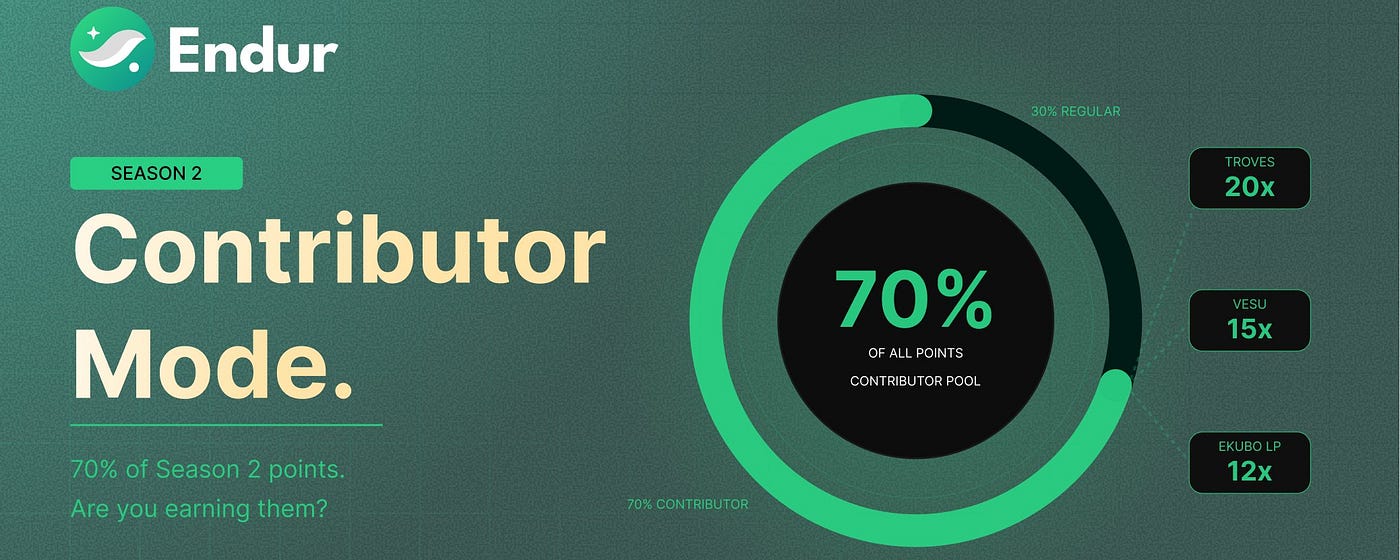
The core change: points are no longer distributed evenly across all holders. The weekly pool of 288,000 points is now split into two tiers based on what your capital is actually doing.

Total Season 2 emission is capped at 7.5 million points across 26 epochs. There is no infinite emission. Once the cap is hit, the program ends.
This capped structure changes the math. In an uncapped program, passive holding works because you accumulate against an ever-expanding denominator. In a capped program, every point is scarce. The 70/30 split makes the strategic choice clear: Contributor actions give you access to 2.3x more weekly emissions from a pool that serves fewer participants, since most users default to passive holding.
The rest of this guide covers exactly how to enter Contributor Mode, which strategies carry which multipliers, and how to think about deploying capital across Starknet’s DeFi stack based on your risk appetite and yield preferences.
You can track your live points, multiplier status, and epoch history on the Endur rewards dashboard.
How to Farm 70% of Season 2 Points: The Contributor Playbook
Contributor Mode activates when your liquid staking tokens leave the staking contract and enter Starknet DeFi. The protocol tracks on-chain actions across specific partner protocols and applies multipliers that determine your share of the 70% Contributor pool each epoch.
There are three primary pathways. Each targets a different risk profile and level of active management.
Path 1: Automated Yield Through Troves Vaults
Multiplier: 20x | Category: Contributor | Effort: Low | Risk: Low-to-Moderate
Best for users who want the highest multiplier with zero daily management.
When you deposit Endur LSTs into Troves, your assets enter automated strategies that capture yield through concentrated liquidity positions built on Ekubo’s AMM infrastructure. The vault handles range selection, rebalancing, and compounding. You earn yield on top of your base staking rewards while your capital remains actively utilized every epoch.
Troves Ekubo Vaults activate a 20x multiplier and move you directly into the Contributor category. The eligible pools are:
- Ekubo xsBTC/solvBTC
- Ekubo xtBTC/tBTC
- Ekubo xWBTC/WBTC
- Ekubo xLBTC/LBTC
- Ekubo xSTRK/STRK
This is the lowest-effort path into Contributor Mode. You deposit LSTs, the vault routes them into optimized LP positions, and you capture the 20x multiplier without touching a single parameter.
The Hyper Vault Nuance
Troves also operates Hyper Vault strategies that use Vesu’s lending and borrowing loops to leverage your Endur LSTs up to 4–5x. These vaults fall under the Regular User category (1x base multiplier, no explicit Contributor tag).
However, because Hyper Vaults hold 4–5x the underlying LST exposure through recursive leverage, they effectively accumulate points at 4–5x the base rate due to the amplified position size.
Both are legitimate strategies. Ekubo Vaults maximize Contributor pool access. Hyper Vaults maximize leveraged LST exposure with compounding yield. Choose based on whether you’re optimizing for points allocation or total LST yield.
Path 2: Manual Liquidity Provision on Ekubo
Multiplier: 12x | Category: Contributor | Effort: High | Risk: Moderate
Best for experienced LPs who want direct control over range selection and rebalancing.
DEX liquidity is the backbone of any functioning DeFi ecosystem. Tight spreads, deep order books, and minimal failed trades all depend on active liquidity providers. Season 2 rewards this directly because it represents real economic contribution to Starknet’s execution quality.
When you LP in Endur LST/native pairs (xWBTC/WBTC, xSTRK/STRK, or any BTC LST variant against its base asset), your capital improves pricing for every trader on the network, reduces slippage on larger trades, and makes Starknet a more reliable execution venue.
In return, your position earns three layers of value:
- Trading fees from swap volume flowing through your range
- Structural LST appreciation from staking reward accrual embedded in the token
- 12x Contributor multiplier on your Endur Season 2 points
The trade-off is active management. You’re selecting concentration ranges, monitoring utilization, and rebalancing as market conditions shift. If you’re comfortable with concentrated liquidity mechanics, this is a high-control path. If not, the Troves Ekubo Vaults automate the same underlying strategy with a higher multiplier.
Find all eligible pools at ekubo.org/starknet/positions.
Path 3: Lending and Borrowing on Vesu
Multiplier: Up to 15x (supply) / 3x (borrow) | Category: Contributor | Effort: Medium | Risk: Low-to-Moderate
Best for users who want to maintain full asset exposure while unlocking additional capital.
Lending markets are where liquid staking tokens transform from passive yield instruments into productive collateral. This is the strategy for anyone who wants their BTC or STRK exposure intact while extracting additional utility from it.
Supply side: Deposit xSTRK, xWBTC, or any supported Endur LST into Vesu’s lending markets. Your LST continues accruing base staking yield. You earn lending interest from borrower demand. And you receive up to a 15x Contributor multiplier on your Endur points.
Borrow side: Use your deposited LSTs as collateral to borrow BTC, STRK, stablecoins, or other assets. This unlocked capital can be redeployed into other Contributor actions (LP on Ekubo, deposit into Troves), creating a compounding loop where each step earns its own yield layer plus points. Borrowing earns a 3x Contributor multiplier.
What makes this particularly compelling right now: BTC borrowing on Starknet is heavily subsidized through the 100M STRK BTCFi incentive program. Some borrow positions are running near net-positive rates, where the STRK incentives effectively cover the borrowing cost.
This is the capital efficiency loop that Season 2 was designed to reward: stake on Endur, receive LSTs, supply to Vesu, borrow against them, and redeploy the borrowed capital into additional DeFi activity. Each step in the chain compounds your effective points rate.
Choosing Your Strategy: Risk Appetite vs Yield Preferences
Not every Contributor strategy fits every user. The right path depends on two variables:
If you prioritize simplicity and want the highest multiplier with minimal management, Troves Ekubo Vaults (20x) are the default answer. Deposit LSTs, the vault handles everything, and you’re in Contributor Mode immediately.
If you prioritize capital efficiency and want to maintain full exposure while unlocking liquidity, the Vesu supply + borrow loop (15x + 3x) lets you keep your LSTs, borrow against them, and redeploy into additional strategies. This works best for users who think in terms of capital utilization rates, not just APR.
If you prioritize control and want to manage your own ranges, fees, and rebalancing, manual LP on Ekubo (12x) gives you direct access to concentrated liquidity mechanics with full transparency over your position.
If you want leveraged exposure without Contributor complexity, Troves Hyper Vaults (1x base, 4–5x effective) give you recursive lending exposure that amplifies both your LST yield and your point accumulation through position size rather than multiplier status.
You can also combine strategies. Supply on Vesu (15x), borrow against it (3x), and deposit the borrowed assets into Troves Ekubo Vaults (20x). The multipliers don’t stack multiplicatively, but each action independently earns its own Contributor points from the 70% pool.

The Bigger Picture: Why This Program Exists
Endur’s contributor-first incentive design isn’t an isolated experiment. It maps directly onto the structural goals of Starknet’s ecosystem growth.
The Starknet Foundation’s 100M STRK BTCFi Season targets three outcomes: deeper BTC-denominated liquidity, capital-efficient borrowing markets, and active DeFi participation. Every Contributor action on Endur, whether it’s LPing on Ekubo, supplying to Vesu, or depositing into Troves, directly advances one of these three goals.
As BTC staking continues to grow and Starknet moves toward its target of 30% staking participation in 2026, liquid staking infrastructure becomes the critical layer that determines whether staked capital sits idle or actively strengthens the network’s DeFi economy.
Season 2 runs for 15 epochs more with a hard cap of 288,000 points per week. More multipliers and partner integrations are expected before the season closes.
메타데이터
- post_id
- c3281efbe6b9
- slug
- how-to-maximize-endur-season-2-points-a-guide-to-become-a-contributor-to-starknet-liquid-staking-c3281efbe6b9
- url
- https://medium.com/@endur_fi/how-to-maximize-endur-season-2-points-a-guide-to-become-a-contributor-to-starknet-liquid-staking-c3281efbe6b9
- canonical_url
- https://medium.com/@endur_fi/how-to-maximize-endur-season-2-points-a-guide-to-become-a-contributor-to-starknet-liquid-staking-c3281efbe6b9
- author_url
- https://medium.com/@endur_fi
- status
- ok
- fetched_at
- 2026-07-19 20:22:47



