The Most Expensive AI Mistake Is Reaching for the Wrong Tool
The race to slap a large language model onto every conceivable software problem has officially reached the point of absurdity.
The Most Expensive AI Mistake Is Reaching for the Wrong Tool
The race to slap a large language model onto every conceivable software problem has officially reached the point of absurdity.
Artificial intelligence is a deep, seventy-year-old discipline, but looking at the current tech landscape, you would be forgiven for thinking “intelligence” was invented in late 2022. There is a reflex in the industry right now that goes something like this: A business problem pops up. Someone in the room says, “Let’s use AI for this.” But what they actually mean is, “Let’s call an LLM.”
The next thing you know, a prompt is hacked together, an API key is wired in, and a trillion-parameter model running on a cluster of GPUs is sweating over a job that a 50-line Python script could have crushed in microseconds for a fraction of a cent.
Sometimes, an LLM is exactly the right call. Most of the time, it isn’t. And the gap between those two realities is where a massive amount of money, latency, and system reliability quietly vanishes into the cloud.
The Swiss Army Knife Problem
The confusion makes sense. A large language model is general enough that it can attempt almost anything you throw at it, giving it the illusion of being the ultimate universal tool. The barrier to entry has evaporated: you no longer need a PhD in statistics to build an “AI feature”; you just need an API key and a credit card.
But “can attempt” is not the same as “is the right tool for the job.” A Swiss Army knife can technically slice a loaf of bread. You’d still rather have a bread knife.
This isn’t a manifesto against generative AI. When you have a genuine language problem, these models are nothing short of magic. Rather, it’s an argument for matching the tool to the actual physics of the problem. It’s a reminder of just how much heavy lifting can be done with simple, boring, thoroughly understood algorithms.
Once you name the actual problem you’re trying to solve, the right method usually picks itself. Here is a working catalogue of the “old ways” that are still the best ways.
Sorting things into buckets
A staggering amount of what we call “AI work” in the enterprise is just basic classification. You’re simply deciding which bucket a piece of data belongs in.
Take spam filtering. It ran flawlessly for years on Naive Bayes — a statistical method so lightweight it could practically run on a toaster. Routing a customer support ticket to the billing department instead of tech support, tagging a legal document by its contract type, or figuring out if a customer product review is angry or happy? These are classic jobs for logistic regression or a Support Vector Machine (SVM) trained on a few thousand labeled examples. Figuring out what language a text is written in is handled by tiny n-gram models that execute instantly.
Sure, you could prompt an LLM to do any of this. But it would be slower, cost significantly more per API call, and give you an answer you can’t perfectly reproduce.
More importantly, classical models offer something LLMs fundamentally lack: strict explainability.
If a model denies a customer a loan, and you are audited by regulators, an LLM might say, “Based on the text, the applicant seems risky.” A classical decision tree algorithm will tell you exactly why: “Income is less than $50k AND Previous Default equals True.” In regulated industries like finance, healthcare, and insurance, explainability isn’t a nice-to-have; it’s a legal requirement.

Finding the weird stuff
Spotting the odd one out is its own distinct family of problems, and LLMs are terrible at it.
Catching a fraudulent credit card swipe in the millisecond before the transaction clears, flagging a weird server login from an unexpected IP address, predicting a part failure on a manufacturing line before a machine physically breaks, or finding a suspicious spike in network traffic — these are anomaly-detection problems.
The true workhorses here are isolation forests, autoencoders, one-class SVMs, and basic statistical thresholds.
These algorithms don’t try to understand what the data means; they just aggressively look for what doesn’t fit the established shape. They are built to run continuously, in real-time, on cheap hardware, processing millions of events per second.
Asking a language model to scan a massive table of server logs to find the weird rows is using the wrong sense entirely. It’s trying to read when it should be measuring.
Predicting a number
If your system’s final output needs to be a number instead of a sentence, you have probably left LLM territory entirely.
How much inventory should the warehouse order next month? What will the power grid demand look like tomorrow at 5:00 PM when everyone turns on their air conditioning? Which enterprise software users have a high probability of churning next quarter? What’s the expected sale price of this house given its square footage and zip code?
These are regression and time-series forecasting problems. You solve them with linear and ridge regression, gradient-boosted trees like XGBoost or LightGBM, and statistical forecasting methods like ARIMA.
Gradient boosting, in particular, quietly runs a massive chunk of the global economy. It powers credit scoring, actuaries’ insurance pricing, and global retail demand forecasting. None of it uses a language model.
Why? Because language models don’t actually understand math. They understand tokens. To an LLM, the numbers “9” and “10” are just character sequences, not quantities on a number line. They don’t inherently know that 999 is less than 1,000 unless they’ve seen that exact comparison in their training weights. When you ask an LLM to predict revenue, you are essentially using a dictionary to do calculus.
Matching and finding
A lot of what feels like “artificial intelligence” to an end-user is really just highly optimized similarity matching.
Search ranking, “did you mean” spelling suggestions, and surfacing similar documents were built for decades on TF-IDF, cosine similarity, and BM25. That “Customers who bought this also bought” widget on Amazon isn’t a chatbot pondering your deep desires; it’s collaborative filtering and matrix factorization. Catching the fact that “Jon Smith” and “John Smith” in your messy CRM are the same guy is just fuzzy string matching and Levenshtein distance.
These methods do not require deep neural networks. They are mathematically simple, entirely transparent, and incredibly cheap to run at massive scale.
Finding the best arrangement
Some of the most valuable AI running in production today doesn’t learn from historical data at all. It just searches and optimizes.
Finding the fastest route across town for an Uber driver relies on Dijkstra’s algorithm and A* search — methods older than most of the software engineers implementing them. Building an airline crew roster, a high school timetable, or an Amazon last-mile delivery schedule is a job for constraint solvers and linear programming. Balancing warehouse inventory across a continent is pure operations research.
These problems have hard, unforgiving constraints and a strict mathematical definition of “best.” A pilot legally cannot fly more than a certain number of hours. A truck cannot hold more than its physical volume.
An LLM has no reliable way to honor hard constraints. You need a mathematical solver that guarantees it won’t break the rules, not a generative model that hallucinates a highly plausible-looking schedule where a driver is somehow in two cities at once.
Seeing
When the input is pixels, the right tool is almost never a text-based language model.
Reading a handwritten postcode on an envelope, spotting a microscopic defect on a silicon wafer production line, or detecting whether there is a face in frame before an autonomous car moves — these are computer-vision tasks. They are handled by Convolutional Neural Networks (CNNs) and, for the simpler ones, classical techniques like edge detection and template matching.
This is still deep learning, so it is not “simple” in the same way a linear regression is, but it is a completely different and far more efficient lineage of AI, purpose-built from the ground up to understand spatial relationships rather than linguistic ones.
When words actually are the job
To be fair, the whole point of this article is pragmatism, not being a contrarian for the sake of it.
You absolutely reach for an LLM when the core problem is language, meaning, and semantic intent. Drafting marketing text. Summarizing a chaotic 50-page legal PDF. Answering open-ended questions across a massive internal company knowledge base. Writing boilerplate code. Extracting structured JSON data from completely free-form text that has no consistent shape.
These are the tasks where classical methods fall flat on their face, and the language model earns every single penny of its staggering compute cost.
The Middle Path: LLMs as the Interface
The real architectural skill is knowing where the boundary lies between these two worlds.
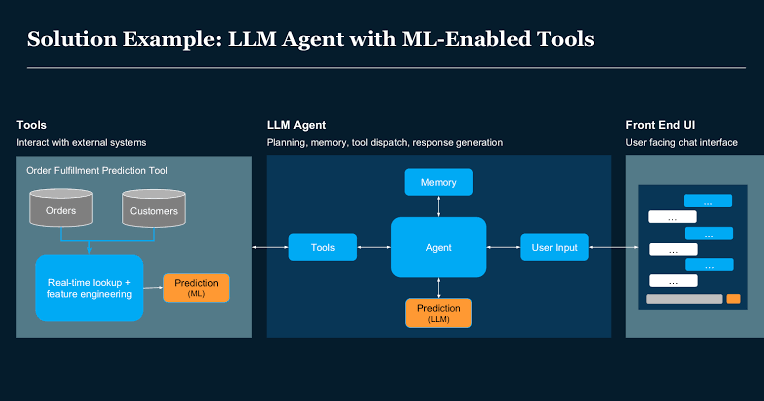
In a lot of modern, high-performing systems, the most elegant design is a hybrid architecture. You let a fast, cheap, mathematically sound classical model do the actual thinking and make the decision, and you let the LLM sit at the very edge of the system acting purely as the interface.
In this setup, the LLM translates the human’s messy, natural-language request into a structured database query. The classical machine learning model or SQL database executes the query and returns a raw number. Finally, the LLM takes that raw number and translates it back into a conversational sentence for the human.
The LLM is the friendly front desk. It shouldn’t be the engine room.
The Reality Check
Before you build anything, before you write a single prompt or spin up a single GPU, ask yourself a few brutally honest questions:
- What does the input actually look like? Is it numbers, an image, or free text?
- How many times a day is this going to run? If it’s a million times, what is your budget per run?
- How fast does the answer need to come back? Do you have three seconds, or thirty milliseconds?
- Does a human auditor need to understand exactly how the system arrived at its answer?
- What happens if the model hallucinates and gets the answer wrong?
Work through those, and the absurdity of the current hype cycle becomes obvious. Burning a trillion parameters and a network round-trip to do what a decision tree can do locally in a microsecond isn’t sophistication. It’s just bad, expensive engineering.
The competent move is very often the boring one. The developers getting the most real-world value out of AI right now are the ones who never confuse the newest tool with the right tool. AI is a massive, multi-faceted toolbox. The large language model is one incredibly brilliant tool inside that box. Reaching for it every single time is like owning a fully stocked workshop, but choosing to use your power drill to hammer in a nail just because it happens to be the loudest thing on the bench.
메타데이터
- post_id
- c329b77b457f
- slug
- the-most-expensive-ai-mistake-is-reaching-for-the-wrong-tool-c329b77b457f
- url
- https://medium.com/@heman.mohabeer/the-most-expensive-ai-mistake-is-reaching-for-the-wrong-tool-c329b77b457f
- canonical_url
- https://medium.com/@heman.mohabeer/the-most-expensive-ai-mistake-is-reaching-for-the-wrong-tool-c329b77b457f
- author_url
- https://medium.com/@heman.mohabeer
- status
- ok
- fetched_at
- 2026-06-09 15:37:30




