From Solo Genius to AI Workforce: Multi-Agent Orchestration
Why the future of generative AI isn’t a smarter model, it’s a smarter team!
From Solo Genius to AI Workforce: Multi-Agent Orchestration
Why the future of generative AI isn’t a smarter model, it’s a smarter team!

For most of the last three years, the dominant question in AI has been: how big can we make the model? Bigger context windows, more parameters, deeper reasoning chains. And while frontier models have grown astonishingly capable, anyone who has tried to ship a real product on top of them has hit the same wall: a single AI agent, no matter how brilliant, behaves like a talented freelancer asked to run an entire company single-handedly. It can write code, draft emails, analyze spreadsheets, and reason about strategy, but ask it to do all of those things in sequence, under pressure, with shifting context, and the cracks appear. Instructions get forgotten. Hallucinations creep in, token budgets balloon, and output quality drifts.
This is why the conversation in 2026 has quietly shifted. The frontier isn’t a smarter solo agent anymore. It’s a coordinated team of them.
Multi-agent orchestration is the art of building a corporate department out of AI. You hire specialists, you give them roles, you set up communication channels, you appoint a manager, and you let them collaborate on a problem the way a real org chart would. It sounds like overengineering but for complex, ambiguous, or high-stakes workflows, it consistently produces better results than throwing one giant prompt at one giant model.
The Anatomy of a Multi-Agent System
Before getting to patterns and frameworks, it helps to understand the three primitives that every orchestration system is built on. Skip any one of these, and the whole thing falls apart.
Specialized agents: Each agent is a model instance with a tightly scoped system prompt, a clearly defined role, and access to a specific subset of tools. One might be a “Senior Python Reviewer” whose only job is to evaluate code for correctness. Another might be a “Data Visualization Expert” with access to a charting library and nothing else. The discipline here is restraint: the temptation is always to give an agent more capability, but specialization is precisely what makes the system work!
Shared context, or memory: Agents need a place to read and write what’s been done so far. Sometimes this is a structured “ledger” of completed tasks; sometimes it’s a vector database; sometimes it’s just a running transcript the orchestrator maintains. Without it, agents repeat each other’s work, lose sight of the original goal, or contradict each other halfway through a task.
Inter-agent communication protocols. This is the rulebook for how agents interact. Do they pass clean structured handoffs, like an assembly line? Do they debate each other in natural language until they reach consensus? Does one agent have veto power over the others? These choices sound abstract, but they determine whether your system feels like a well-run team or a roomful of people talking over each other.
Four Patterns That Cover 90% of Real-World Workflows
Multi-agent systems aren’t a single architecture. They’re a family of organizational structures, and choosing the right one for the job matters more than choosing the right framework. Here are the patterns you’ll see in production today.
1. The Sequential Pipeline
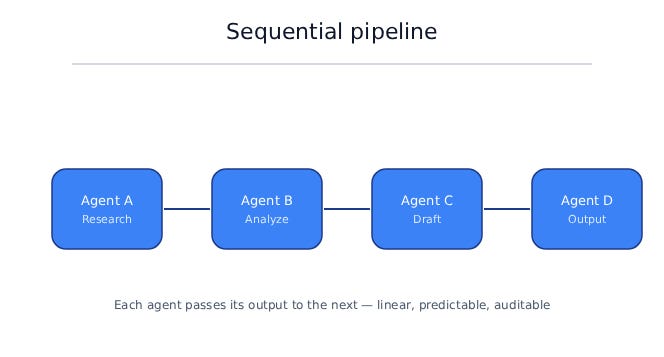
The simplest and most predictable pattern. Agent A finishes its work and hands the output directly to Agent B, who hands it to Agent C, and so on. There’s no looping back, no debate, no parallel branches. just a linear flow of work.
Example: A research workflow where a Scraper Agent collects raw web data, passes it to an Analyst Agent that identifies key trends, which then hands off to a Writer Agent that drafts a polished report.
Pipelines shine when the task is well-understood and the steps are stable. They’re easy to debug, easy to audit, and easy to explain to non-technical stakeholders. The weakness is rigidity: if step two needs information that only step four would surface, you’re stuck.
2. Concurrent Fan-Out / Fan-In
When subtasks are independent, running them sequentially is just wasted time. The fan-out pattern dispatches work to multiple agents in parallel, then collects and merges their outputs through a final synthesis step.
Example: A user submits a pull request for review. The orchestrator simultaneously spins up a Security Agent, a Style and Linting Agent, and a Performance Agent. Each independently inspects the diff. A final Synthesizer Agent consolidates their feedback into a single coherent code review comment.
This pattern is a latency lifesaver, but it requires that the subtasks really are independent and that your synthesizer is smart enough to reconcile conflicting opinions without just averaging everything into mush.

3. The Hierarchical Supervisor
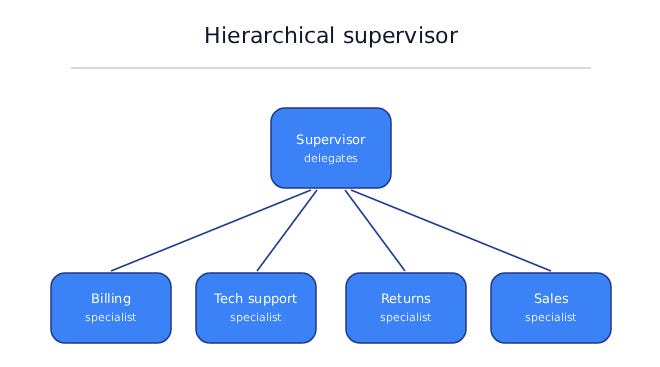
Here, a “manager” agent interprets the user’s request, decomposes it into subtasks, delegates each one to a specialist, monitors progress, intervenes when something stalls, and assembles the final answer. This is the pattern most analogous to how a human team actually works.
Example: A customer service system where a Triage Agent reads the incoming message, classifies it, and routes it to either a Billing Agent, a Tech Support Agent, or a Returns Agent. The triage agent stays in the loop, ready to re-route if the specialist hits a dead end.
Hierarchies handle ambiguity beautifully. They’re the right choice when you don’t know in advance which specialists a task will need. The trade-off is that the supervisor becomes a single point of failure, and a poorly designed manager prompt can cascade errors across the whole system.
4. The Debate / Reflection Loop
A newer pattern, particularly popular in research and high-stakes reasoning. Two or more agents generate competing solutions, then critique each other’s work across multiple rounds until they converge or until a judge agent picks a winner.
Example: A legal contract review where one agent argues for the buyer’s interests and another for the seller’s. A third agent reads the debate and produces a balanced redline.
Debate is expensive in tokens and time, but for problems where correctness matters more than speed, the quality gains are often worth it.

The Frameworks Worth Knowing in 2026
The ecosystem has matured considerably in the last two years. A few frameworks have emerged as the dominant choices, each with a different philosophy.
CrewAI is the gentlest on-ramp. You define agents with backstories, goals, and tasks, then assemble them into a “crew.” You can have a working prototype running in under twenty lines of Python. The trade-off is that under the hood, CrewAI makes a lot of decisions for you, which can become a constraint as your needs grow.
LangGraph, from the LangChain team, takes the opposite approach. It models agent workflows as explicit directed graphs. Nodes are agents or tools, edges are transitions, and the entire execution is stateful and deterministic. This makes it the go-to for production systems that need human-in-the-loop approvals, time-travel debugging, or strict observability. The learning curve is steeper, but the payoff is control.
AutoGen and Microsoft’s Agent Framework, the heirs to Microsoft’s original AutoGen research, lean heavily into the conversational and debate-style patterns. They’re particularly strong for systems where agents need to iterate, critique, and refine each other’s outputs before producing a final answer.
There are also more specialized options worth knowing: Anthropic’s Claude Agent SDK for tightly tool-integrated workflows, OpenAI’s Swarm for lightweight handoff-based systems, and a growing number of vertical-specific frameworks for coding agents, research agents, and customer-service agents.
The honest advice: don’t pick a framework first. Pick a pattern first. The framework should follow.
Why This Is Worth the Complexity
Multi-agent systems are objectively more work to build than a single well-prompted model call. So why bother?
The biggest win is quality through specialization. A model with a narrow scope and a focused prompt outperforms the same model trying to juggle a dozen instructions at once. not because it’s more capable, but because it’s less distracted. Each agent in a well-designed system is operating closer to its peak.
The second win is modularity. Need a new capability? Drop in a new specialist agent. Want to upgrade your code reviewer? Swap one agent without touching the others. Compared to a monolithic prompt that you have to rewrite from scratch every time a requirement shifts, this is liberating.
The third win is cost optimization. You can deploy your most expensive, highest-reasoning model like Claude Opus, GPT-5, or Gemini Ultra at the orchestrator level, where intelligent routing decisions matter most. The downstream worker agents can run on much cheaper, faster models, because their scope is narrow enough that they don’t need frontier-level reasoning. The cost savings at scale can be dramatic.
The Trade-offs Nobody Wants to Talk About
If multi-agent systems were a clean win, everyone would already be using them. They’re not, and there are real reasons why.
Token multiplication is real. When agents talk to each other, especially in debate or hierarchical setups, your token consumption can grow super-linearly. A simple user query that would have cost one API call now costs fifteen. Watching your bill in the first week of running a multi-agent system in production is a humbling experience.
Latency adds up. Every hop between agents adds round-trip time. Sequential pipelines are particularly slow. If your use case demands sub-second responses, multi-agent orchestration is probably the wrong tool.
Debugging is genuinely hard. When a single prompt fails, you can usually see why. When a chain of seven agents produces a bad result, tracing the failure back to its source is detective work. This is why frameworks like LangGraph invest so heavily in observability and replay tooling; without them, you’re flying blind.
Failure modes compound. If each agent in a five-agent pipeline is 95% reliable, your overall reliability is roughly 77%. That math doesn’t lie, and it’s why retry logic, validators, and fallback paths aren’t optional in serious systems.
Where This Is Heading
The trajectory from here seems clear. We’re moving from agents that talk to each other in natural language toward agents that communicate through structured protocols. The early standards for inter-agent messaging are starting to crystallize. We’re moving from hand-coded orchestration toward orchestrators that can dynamically reshape their own teams based on the task at hand. And we’re seeing the first hints of long-running agent systems that operate over days or weeks rather than minutes, maintaining persistent memory and goals.
None of this replaces the underlying model. The frontier still matters. But the leverage is increasingly in the layer above the model, in how you decompose problems, route work, manage state, and coordinate specialists.
The freelancer era of AI is winding down. The org chart era is just getting started.
If you’re starting your own multi-agent project, my advice is the same as for any team: start small, hire for specialization, and make sure someone is genuinely in charge. The principles that make human teams work make AI teams work too! which, when you think about it, shouldn’t be surprising at all.
메타데이터
- post_id
- c32e289d3a8c
- slug
- from-solo-genius-to-ai-workforce-multi-agent-orchestration-c32e289d3a8c
- url
- https://medium.com/@m.derakhshan/from-solo-genius-to-ai-workforce-multi-agent-orchestration-c32e289d3a8c
- canonical_url
- https://medium.com/@m.derakhshan/from-solo-genius-to-ai-workforce-multi-agent-orchestration-c32e289d3a8c
- author_url
- https://medium.com/@m.derakhshan
- status
- ok
- fetched_at
- 2026-06-09 15:37:30



