Why DePIN Is the Missing Layer in Cloud Storage
For years, cloud storage has been treated as a solved problem. Businesses upload files, backups, media assets, application data, and…
Why DePIN Is the Missing Layer in Cloud Storage
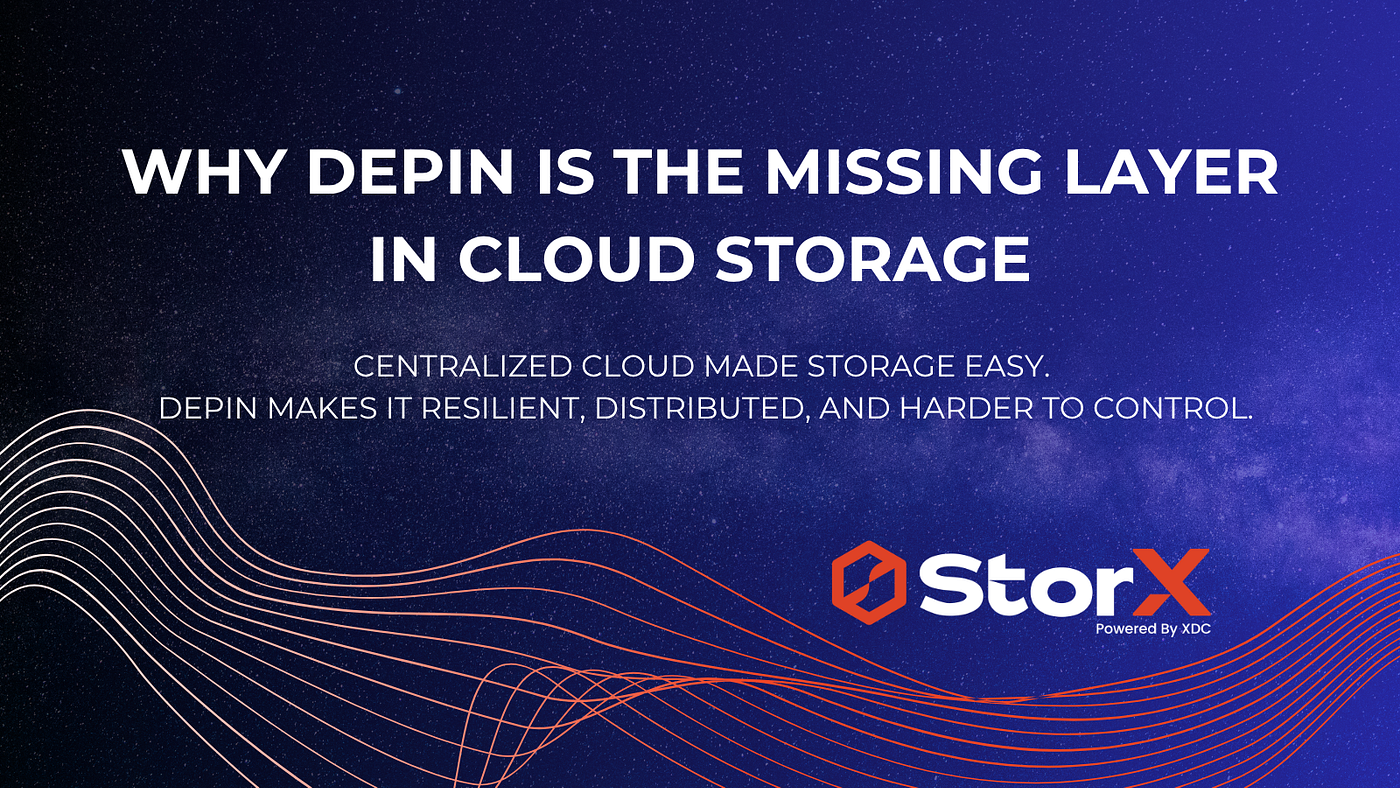
For years, cloud storage has been treated as a solved problem. Businesses upload files, backups, media assets, application data, and customer information to a cloud provider and assume everything will remain available, secure, and accessible.
But as the digital economy continues to grow, the weaknesses of centralized storage are becoming harder to ignore. Cloud storage is no longer just about where data sits. It is about who controls access to it, how much it costs to move it, how exposed it is to centralized failure, and whether a single provider can restrict, throttle, or shut it down.
That is where DePIN enters the conversation.
DePIN, short for Decentralized Physical Infrastructure Network, introduces a different model for building and operating infrastructure. Instead of relying on one centralized operator, DePIN networks are powered by distributed participants. In the context of storage, this means data does not depend on one company, one server region, or one centralized control point.
A DePIN-based storage network can distribute encrypted data across independent nodes, creating a storage layer designed for resilience and decentralization from the ground up. This matters because storage is one of the most sensitive parts of any digital business. If storage fails, applications break. If access is restricted, operations stop. If data is exposed, trust is lost. If costs become unpredictable, scaling becomes harder.
Centralized cloud platforms helped businesses scale faster, but they also introduced new dependencies. Many companies now face problems such as vendor lock-in, egress fees, account and access risks, and single points of failure. Once data is stored with a major cloud provider, leaving can become expensive and operationally painful. Moving data out of centralized platforms can create unexpected costs, especially as storage needs grow. At the same time, centralized providers can suspend, restrict, or terminate access based on policies users may not fully control.
For many teams, the problem is not that centralized cloud does not work. The problem is that it gives too much control to too few providers.
StorX Network brings the DePIN model to cloud storage. Files uploaded to StorX are encrypted, split, and distributed across a network of independent node operators. This removes the need to trust a single centralized provider with complete control over the data layer.
For businesses, the key advantage is not only decentralization. It is practical decentralization. StorX is S3-compatible, which means teams can connect it with existing tools, SDKs, and workflows without needing to rebuild from scratch. That matters because adoption depends on simplicity.
A CTO may care about resilience. A DevOps lead may care about migration. A Web3 founder may care about censorship resistance. StorX addresses all three through one storage model: decentralized, encrypted, and compatible with existing S3 workflows.
It is easy to assume decentralized storage is only for blockchain-native projects. That is no longer true. The need for secure, distributed, and predictable storage applies to SaaS companies storing customer data, media companies managing large files, Web3 platforms protecting decentralized applications, backup and disaster recovery teams, and enterprises looking to reduce centralized cloud dependency.
The common requirement is simple: “We need storage that no one can shut down.”
That is the emotional and operational reason DePIN storage matters.
One of the biggest barriers to decentralized infrastructure adoption is migration friction. If a storage solution requires teams to rewrite applications, rebuild pipelines, or train teams from zero, adoption becomes difficult. StorX reduces that barrier through S3 compatibility, allowing teams to use familiar tools and workflows while gaining the advantages of decentralized storage.
For DevOps teams, the value is clear: “It just works with our existing S3 setup.”
That is what makes decentralized storage practical for real businesses. It does not ask teams to abandon the systems they already understand. Instead, it gives them a decentralized alternative that can fit into existing workflows.
Cloud storage is entering a new phase. The first phase was about convenience. The second phase was about scale. The next phase will be about control, resilience, privacy, and predictable access.
DePIN gives storage a new foundation. Instead of trusting one centralized provider, businesses can use a distributed network where data is encrypted, fragmented, and stored across independent nodes.
StorX Network is building for that future. Not by asking businesses to abandon what already works, but by giving them a decentralized alternative that fits into the workflows they already use.
The future of cloud storage will not be controlled by one provider.
It will be distributed. It will be encrypted. It will be S3-compatible. And it will be powered by DePIN.
About StorX:
StorX is a decentralized cloud storage network that empowers users to store their data securely in the cloud. Each file uploaded on StorX is split and encrypted into multiple fragments to autonomous storage nodes operated by individual operators worldwide. Designed as a collection of independent storage networks, no particular operator has complete access to your data. StorX is faster than legacy centralized storage providers and also allows users to save substantial amounts on costs compared to a centralized cloud. StorX enables users with spare storage capacity to lease space and earn great returns in SRX tokens.
$SRX is listed on multiple tier exchanges like BingX, MEXC, LCX, Coinstore, Probit, Bitmart, Biconomy and Bitrue. To know more about StorX Network, Visit https://storx.io
Don’t forget to follow us on our social channels:
메타데이터
- post_id
- c3302b6dc9dc
- slug
- why-depin-is-the-missing-layer-in-cloud-storage-c3302b6dc9dc
- url
- https://medium.com/storx-network/why-depin-is-the-missing-layer-in-cloud-storage-c3302b6dc9dc
- canonical_url
- https://medium.com/storx-network/why-depin-is-the-missing-layer-in-cloud-storage-c3302b6dc9dc
- author_url
- https://medium.com/@storxnetwork
- status
- ok
- fetched_at
- 2026-07-10 03:40:03