What Our Grandmothers Knew About Men That We Forgot
How the matriarch changed between the front porch and the podcast.
What Our Grandmothers Knew About Men That We Forgot
How the matriarch changed between the front porch and the podcast.
Florence, Arizona. Sometime in the late 1990s
Two old ladies, Rosemary and Dorothy, sit on a couple lawn chairs on the back porch of a small stucco house near the edge of town. There’s a small glass topped table between them with two ice cold Coors Banquets and a pack of cigarettes Rosemary just grabbed from the freezer.
Dorothy is a widow, old Arizona Anglo, I think. She wore capri pants, still listened to Frank Sinatra, and knew everyone in town.
Rosemary has been her best friend for forty years. Irish Catholic, and kept a bottle of Jameson Whiskey under the kitchen sink next to the dish soap, separate from the rest of the booze in the liquor cabinet. Why, I have no idea, but she probably had a reason. Rosemary had that Irish storyteller gene in her, which she passed on to her granddaughter Jonatha, who is sprawled out on a sunworn lounge chair a few feet away.
A police scanner is on inside the kitchen, audible through the screen door. It has been on since just after dinner. Codes and dispatch and units responding. No one is listening, just catching what matters.
The conversation isn’t a single topic. Names of people in town come and go. A car passes on the street and grandma or Dorothy may know whose it is. Dorothy saw something at the IGA on Tuesday. Grandma heard something after Mass on Sunday.
Another widow down the street has stopped coming to the Tuesday rosary group. Grandma called but no answer, so she is going to drive over there tomorrow with a casserole.
The Mendez boy has been over at his mother’s every day this week. Something is going on there. Dorothy heard the same thing from someone at the diner. The new teenager at the gas station looked at the Sanchez girls in a way Dorothy didn’t like. She’ll mention it to the Sanchez grandmother next time she sees her.
The scanner picks up a domestic call. An address on the south side. Both women stop and listen. They both know which family it is before the address is given.
“Second time this month.”
Dorothy nods.
I’m drinking a root beer or cream soda. I’m maybe 13, not part of the conversation, but more importantly not excluded from it either. They do not lower their voices. They don’t change what they would have said.
I am the granddaughter and the granddaughter hears what the women say. I don’t realize what I am watching. I think my grandma is sitting on her patio drinking a beer with her friend. I do not yet know I am watching the operational matriarchs of a small Arizona town do their work from a pair of aluminum lawn chairs.
Eventually Dorothy says she should head home. But she’ll be there another two hours, listening to the scanner. They will be on duty until well past when the bats come out.
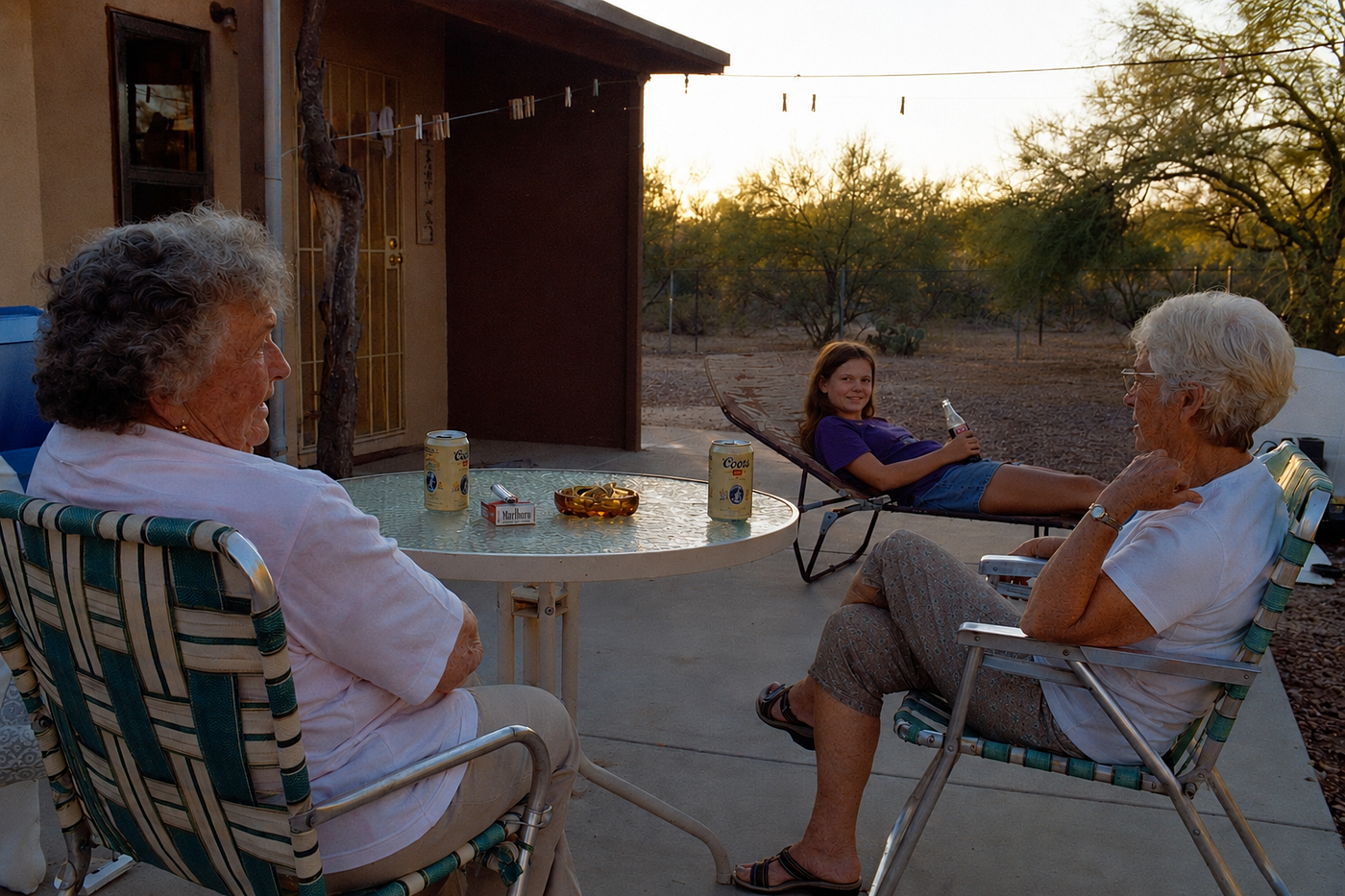
Image Create by CHatGPT
Womens’ Intelligence
What Grandma and Dorothy were doing on the porch was not gossip. It was the operating system of the town’s safety.
Between the two of them, they could read a husband from the way his wife’s mouth set when his name came up. They could tell which child in a family was being hit and which one was just shy. They could tell which man in town was a kind man and which one was not.
They did not generalize. They knew the men in town by name. Carl hit his wife. The one teacher at the high school who drank. The new contractor who took a deposit and disappeared. The pharmacist’s son who had come back from California in a hurry. The widower on Pinal Street who could be counted on for anything. Each one was a known individual, filed in forty years of accumulated knowledge about who he had been when he was twelve and what his mother had been like and which way the family had always tipped.
The vocabulary was small. That family’s had trouble for years. He’s not a kind man. Her mother was the same way. Something’s not right with that one. He made his bed, now he’s gonna have to lie in it. Any one of those five phrases would carry years of judgment about someone’s character.
Words that were foreign were predator, trauma, red flag, toxic, gaslighting, and narcissist. They were never uttered, and if they were they would have carried no meaning.
And information moved. Rosemary called Marge. Marge called Helen. Helen mentioned it at choir practice. By Wednesday, every woman who played pinochle at the parish hall who needed to know about the Mendez situation knew. There was no announcement or meeting. The transmission happened through phone calls, chance encounters, and quick exchanges in the produce aisle at the IGA.
Most importantly, the talk led to an action. The widow got the casserole. The wife’s sister got the phone call. The Sanchez grandmother got the word about the kid at the gas station. None of this was the work of the police or the Church or the social services office. This was the work of women, done by women, for women and their daughters and their sons.
Rosemary’s body fired the threat-detection chemistry the same way her grandmother’s did on the prairie and her great-grandmother’s did in County Cork. She noticed a signal. She assessed it. She took an action. The action produced an outcome. Her body registered the outcome. Then the chemistry came back down.
She was not afraid. She was not anxious. She was competent. Vigilance was her job and she was good at it. She was not unusual either. Every town in America was full of women like Rosemary.
The Biology
There is a reason every town was full of Rosemarys.
Human women are the only great ape that lives decades past their fertility. Female chimpanzees die not long after they stop reproducing. The same for gorillas. The same for orangutans. The species is done with them and the body winds down.
Human women are different. Fertility ends around fifty. Women routinely live thirty, forty, fifty more years. Half the female life span happening after her last birth. No other primate does this. We are evolutionarily strange.
Evolution does not maintain a non-reproductive class of females for no reason. There has to be a payoff, something about the older woman conferred enough survival benefit to her descendants that the species selected for her continued life. Daughters with living mothers had more grandchildren who survived than daughters without. Across enough generations, the species kept building the kind of woman whose body could persist long after her last birth.
The payoff was Rosemary and Dorothy listening to the police scanner while slammin’ Coors Banquets on the porch.
What grandmothers had back on the African savanna that younger women did not was time. Decades of accumulated observation. She had watched the band’s children get sick. She had watched pair bonds fail. She had watched which men turned out to be trustworthy and which did not. Her nervous system was the most accurate threat detector in the band by a wide margin, and the accuracy was a function of how long she had been watching.
Her hardware was built for it. The female nervous system is more active in threat-detection contexts than the male. Women score much higher on reading subtle social cues, facial micro-expressions, vocal stress, and environmental anomalies. This is not training, this is hardwiring. The wiring reaches its peak performance in the woman who has been running it on real data for fifty years.
The species made a different deal with male longevity. Men age out sooner. They do not get the same post-reproductive period of life that women get. Their bodies were not built for it. Nor were their brains. If they were as vigilant as the women they would have never left the cave to hunt. The matriarch role is not a parallel of the patriarch role. It is specific to the female.
The women in the aluminum chair in Florence were not nostalgia. Grandma Rosemary was not just a quirky old lady with a fridge full of Coors Banquets and a police scanner. She was a biological adaptation hundreds of thousands of years in the making, running the program her species had selected for.
The Unused Matriarch.
Rosemary died and her role died with her. The chemistry did not.
Every woman still has the nervous system Rosemary had. The amygdala. The social-monitoring circuitry. The pattern recognition. The capacity to read a room. The capacity to read a man. The hardware her great-grandmother carried out of County Cork is still sitting in her granddaughter’s body in Phoenix or Seattle or Brooklyn. The species did not have time to evolve out of it in three generations. It is still in there.
The body does not know the role is gone. The circuit fires the way it was selected to fire. It looks for inputs. It looks for something to watch.
It was designed for a specific task. The body picks up a signal. The body assesses it as a possible threat or as nothing. If it is nothing, the body moves on. If it is a possible threat, the body takes an action, and the action produces an outcome. Then the outcome closes the cycle. The chemistry comes down and the body rests.
Rosemary ran it a dozen times a week for forty years. It worked.
Today’s granddaughters’ nervous systems run the first two steps and then stop. She picks up a signal from a podcast about a woman who was killed in 1987. Her body assesses it as a threat. The chemistry fires the same way Rosemary’s did when the scanner picked up the domestic call on the south side.
Then nothing. There is no action to take. The woman in 1987 is dead. The killer is in prison. The granddaughter is in her kitchen forty years later. The cycle doesn’t close and the chemistry has nowhere to go.
The next signal arrives as she is scroling on Instagram about date rape. Then the documentary she half-watched last weekend. Then cable news this afternoon. Her body is told, every day, that a new threat exists. Her body fires the chemistry every time, but the chemistry never resolves.
The grandmother’s chemistry was a wave that came up and came down. The granddaughter’s chemistry is a wave that came up fifteen years ago and has yet to come down. The body has been mobilized for a decade and a half. The cortisol stays elevated and her sleep gets worse. The trust gets even worse than that.
She has been told she has anxiety. She has been told to meditate and to journal. She has not been told that her nervous system is doing exactly what it evolved to do, but it’s doing it on the wrong inputs, with no resolution available.
She is the unused matriarch. Not a woman whose chemistry is dormant. A woman whose chemistry is captured. Running ancestral matriarch software on industrial content delivered through iPhone screens while she takes the train to work and through earbuds while she chops onions for family dinner a few hours later.
She scrolls to an Instagram reel about Seven Signs Her Boyfriend is a Narcissist. A news alert about a missing woman in Indiana. A TikTok about love bombing. A Medium article about why she doesn’t feel safe around men anymore. A carousel titled He’s Going to Hurt You. A reel about how to spot a sociopath on a first date. Then a thread about coercive control.
Some of us still run it on real inputs. I read men for a living. They sit across from me in person. I clock them in real time. My body amps up, and when the read is done, it comes down. Same cycle Rosemary ran on the porch.
Most women do not get that anymore. Most women get a feed. Reels, articles, and podcasts. Fear mongering. Male bashing. Toxic masculinity essays. Narcissistic abuse checklists. Husbands who turned out to be killers. Dating-app horror stories. Believe women. Protect your peace. A steady I.V. drip of generalized male threats delivered directly to her nervous system.
The chemistry fires and fires but never closes the loop. The matriarch is wide awake at midnight, on duty for nothing, heart racing, watching shadows on a screen.

Image Created by ChatGPT
메타데이터
- post_id
- c341d56d4b49
- slug
- what-our-grandmothers-knew-about-men-that-we-forgot-c341d56d4b49
- url
- https://medium.com/@jonathacz99/what-our-grandmothers-knew-about-men-that-we-forgot-c341d56d4b49
- canonical_url
- https://medium.com/@jonathacz99/what-our-grandmothers-knew-about-men-that-we-forgot-c341d56d4b49
- author_url
- https://medium.com/@jonathacz99
- status
- ok
- fetched_at
- 2026-06-09 15:37:30