The Scream: A Deeper Analysis of Edvard Munch’s Anxiety-Wrought Piece
What was really happening in Munch’s life while he painted that timeless classic?
The Scream: A Deeper Analysis of Edvard Munch’s Anxiety-Wrought Piece
This article deals with mental health issues and mentions verbal childhood abuse. Please read at your own risk.
I don’t know about you, but I learned a lot about The Scream when I was in elementary school. I don’t mean fundamental facts about the reasons Munch had for painting The Scream, but we did talk about the piece and how it made us feel, and we learned when it was painted and where it is now. When I was a kid, The Scream scared me. The bright orange sky in the background, the terrified, inhuman, ghostly face. There was nothing attractive about the picture back then. But, over time, it became one of my favorite paintings. There was something intriguing about the tumultuous picture Munch created in 1893, and I wanted to figure out what it was.
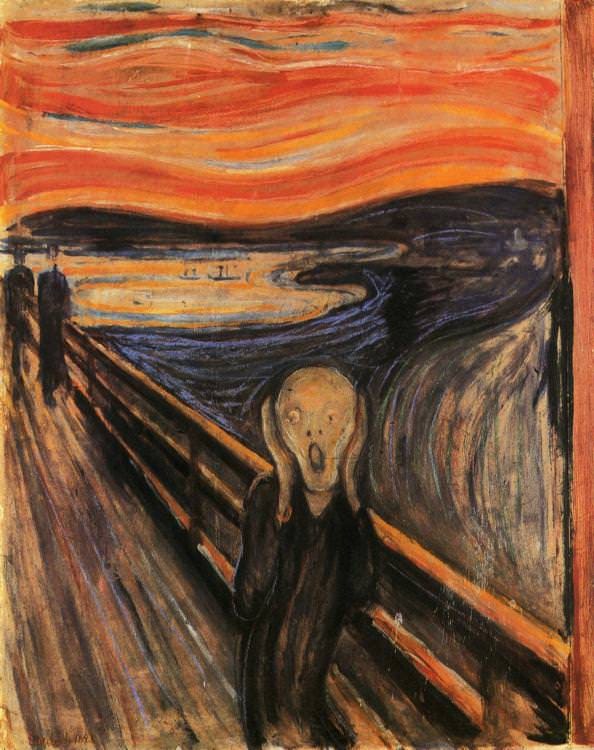
“The Scream” by Edvard Munch
According to Munch himself, The Scream was a picture he painted to represent his soul. Rather than adhering to the art style of the time — that is, painting pictures meticulously to realistically represent the subjects in them — he chose to use an unrealistic style to paint his emotions, rather than focus on realism and perfectionism in his art. Munch explained that he painted a moment of existential crisis. He was walking down a road similar to the one in the painting, while the sun was setting, creating a beautiful, vibrant background. His friends were walking with him, but, looking out at the sky in front of them, he stopped, while they continued walking. He then described having what we would now consider to be a panic attack; he suddenly became tired, anxious, claustrophobic, and the weight of nature and of the world hit him all at once.
So, what caused such an enormous reaction in Munch’s mind that day? Panic attacks can be a normal thing for many people, and most will experience at least one in their lives. But Munch’s was an attack mixed with an existential crisis. Was there something more going on in his life that could have led to a momentary breakdown or disassociation from reality? The answer is yes. Before his breakdown, one of his sisters was committed to a mental asylum because of her severe mental health issues. In addition to that, he struggled with the loss of his mother at five years old, and at about thirteen years old, his lost one of his sisters. Both died of tuberculosis. In fact, his past was incredibly traumatic, which likely contributed to both his existential crisis and the idea to go through with painting The Scream. As a child, he suffered from health issues and missed a lot of school — the issues even caused him to be unable to go outside in the winters. His father was verbally abusive and used Munch’s dead mother to further the verbal abuse, claiming she would not be proud of her children. Later, he suffered more abuse at the hands of his father because he disliked Munch’s career. His early works suffered criticism at the hands of the general public. It’s clear that the trauma of his childhood inflicted many mental health issues on him, and the continued abuse and stress of his career certainly weren’t helping.
There are other analyses out there that believe that The Scream and Munch’s description of the existential crisis that followed it are clear signs of depersonalization disorder. The disorder creates feelings of disconnection from one’s self and one’s environment, as if they are suddenly observing their own body, rather than being attached to it. Depersonalization order is thought to stem from childhood abuse. The disorder can cause extreme stress and panic attacks. It is believed that what Munch described as he experienced an existential crisis on the bridge away from his friends resembles an effect from depersonalization disorder. Considering that Munch exhibited signs of severe stress and also admitted to having been verbally abused by his father throughout his childhood, it is highly possible that he did suffer from such a mental illness. Since he mentioned having anxiety and also exhibited signs of depression, for example, it’s likely that this isn’t the only mental illness he had. Whatever else he suffered from, it’s almost one hundred percent guaranteed that it had an effect on his existential crisis on the bridge. The Scream was not simply a product of stress, or an uncharacteristic moment of panic. It symbolizes the darkly troubled times Munch was experiencing as he dealt with mental illness and trauma, and his attempt to rationalize and explain his experience through what he knew best; painting.
After painting The Scream, Munch checked himself into a mental health hospital because he claimed he was hearing voices. The Scream was not the only byproduct of horrible anxiety and nonexistent mental health. Although it is arguably the most famous of Munch’s works, his other paintings focused around mental health as well. Some paintings were portraits of his dead sister. His piece titled Anxiety, painted after The Scream, looks eerily similar to the famous painting.

“Anxiety” by Edvard Munch
Although Munch had painted dark and depressing scenes long before he began working on The Scream, the latter seemed to have the most impact on him. In Anxiety, he literally copies the entire background of The Scream onto the painting. The figures in the back are the same, and even the clothes are similar. There are, however, two major differences. There are many people this time, all facing towards the viewer. And none of them are actually screaming.
What could such a follow-up mean? Was it an attempt to rationalize his own mental health issues and troubling anxiety? Was it a way to tell society that all of us are together in our fears and worries, that perhaps there were hundreds of thousands of people that had walked before him on that bridge, concerned about their own problems? Was he simply trying to console himself by painting other people going through the crisis he suffered that night? Perhaps he did not suffer from a deep, engrained obsession with his own painting, but he certainly thought about it. The follow-up to The Scream was not just to make more money, or gain more recognition. Throughout his life, he had spoken on his problems with becoming famous and being recognized through his art and often expressed dislike that he had become popular for his works. Perhaps he painted it for himself, then, as a conclusion to the terrifying crisis he suffered. Maybe he created it for other people, to show them that we are all together, even in suffering. It’s hard to say. Anxiety plays on the collective fear. In The Scream, the tortured individual on the bridge is all alone.
I believe that The Scream is such a famous painting because we can all relate to it. It is completely timeless. Anxiety is something that many people suffer, and the time period we are in has not changed that. We are human. We go about our lives, and we experience things that we would rather not have experienced. The Scream still scares me, but for a different reason. No longer is the ghostly face frozen in horror the point of my concern. It is the fact that the painting itself is so relateable that its fame has withstood hundreds of years. Its popularity has not faded. When we look at the painting, we see ourselves in it, frozen in a perpetual scream of horror. It is our anxiety, our hurt, our suffering, our mental illness. We, too, suffer alone.
메타데이터
- post_id
- c36d9bbbb4cd
- slug
- the-scream-a-deeper-analysis-of-edvard-munchs-anxiety-wrought-piece-c36d9bbbb4cd
- url
- https://medium.com/everything-art/the-scream-a-deeper-analysis-of-edvard-munchs-anxiety-wrought-piece-c36d9bbbb4cd
- canonical_url
- https://medium.com/everything-art/the-scream-a-deeper-analysis-of-edvard-munchs-anxiety-wrought-piece-c36d9bbbb4cd
- author_url
- https://medium.com/@sophiasb
- status
- ok
- fetched_at
- 2026-08-05 22:16:30




