Enjoy local stability
Life during wartime in Ukraine
A-CULTURATED MAY PROMPT
Enjoy Local Stability
Life during wartime in Ukraine

Antonov An-225 Mriya (from Ukrainian “мрія”: “a dream”) was the largest and heaviest aircraft ever built. A photo by RexPol over the Ukrainian flag background, license: CC BY-SA 4.0.
13.05.2026
It was a warm, sunny spring day on May 13. I was working from home and had plans for the evening to join an international writing event, where I would write in silence while attending a quiet meeting with others.
A siren sounded.
I rolled my eyes and landed my gaze on the phone. I checked the WhatsApp channel of the UA Air Force and the ongoing alerts map. The warning was about Russian shahed drones flying further away.
For some time, I had been successfully ignoring it, until I received a notification on my phone about something approaching my city: a distinctive beeping sound from an app, in addition to the ordinary alert already announced.
It was time to pack my computer and go to the bomb shelter, which happens to be very close.
We are more accustomed to attacks at night, but sometimes the enemy changes tactics and tries creative ways to kill. At night, it’s annoying and cold to go somewhere or just to get out of bed, but this was daytime.
The place was spacious, clean, with light and benches. I don’t want to create an impression that all shelters are like that. More often than not, they are unpleasant and humid, can be called a shelter only nominally, or are nowhere near.
Alternatively, people declare their corridors a shelter or sleep in bathtubs, which sometimes become their coffins.
The best shelter is a subway for those who have this option in the vicinity. The ones who mastered the art of predicting the enemy sometimes go there before the curfew with a mat and even a tent to spend the night with comfort.
In an emergency situation (when you hear an approaching sound of a drone or a rocket), anything far away from windows will do, or you can just drop to the ground and make yourself small so that the drone won’t “see you”, and you won’t see it. If you have a bit more time, any place a bit safer than the current one is preferable. It could be a basement, an underground passage, or a parking lot.
In the shelter, there were a lot of people. More were coming, ones with the same reaction strategy. Everyone had something to do: a lady was working on a computer while a schoolboy was playing video games on his, and another woman was having an online work meeting. A group of adolescents and supposedly their teacher, as it seemed, were preparing their upcoming theater play. A girl was doing some kind of exercises on a mat, probably she was a dancer in this troupe, then a lady came with a dog, which joined the girl on the same mat, stretching its back in an Anahatasana.
Some people were just talking. Kids were playing and making noise. Last time they were so noisy I didn’t hear a shahed explosion and only realized it happened after seeing smoke further away outside. This time that didn’t happen: our air defense forces shot down the drones posing the immediate threat, so I went home to ignore a few more alerts and have the writing meeting.
Many others were leaving with me after checking the “tactical information” from the chats. But everyone knew: most likely after drones in the day, rockets will follow in the night, so it’s better to sleep at a reasonable time so as not to be tired in case there is an attack at night.
I was able to sleep and wake up still in my house, but 24 citizens of a residential building in Kyiv weren’t: a rocket destroyed a whole building section.
War is nothing new. My grandmother was born in the Western part of Ukraine during the Polish-Ukrainian war, which, in turn, happened after WW1. Her father died from a grenade explosion near his house before having a chance to meet her. During WW2, she saw a nazi soldier at her door demanding food.
My other grandmother survived Holodomor in the central part thanks to her parent’s creative ways of searching for and storing food so that the Soviets wouldn’t find it. For example, when they were warned about a raid to confiscate food, they would turn off the heating and put the grain they had inside a still-hot stove, where the communists wouldn’t think of looking.
Our grandparents taught us to plant gardens and to prepare canned food just in case. We didn’t understand why we had to bother when it was not a problem to go to the nearby store and buy whatever any time we didn’t feeling like cooking, and dismissed the older generation for being boring.
In early 2022, the food cans were very helpful for some people under occupation. Maybe our grandchildren, at least while young, won’t understand the weird old people we will become. I hope so, but we will have to teach them anyway.
A friend from abroad decided to save for a house. A big house on his own land: a good prospect for stability. I think it’s a great idea and I’m looking forward to good news, photos and complaints about annoying plumbing work.
Normally, apart from the benefits of living in your house, it is safe to assume that a house can be passed on to future generations. Real estate, along with bank bonds, is considered a rather low-risk investment, while stocks are viewed as risky, and options trading is speculation. Ironically enough, the “risky” foreign shares, ETFs, and even options in some cases are now maybe the most stable financial instruments for Ukrainians who have access to them. Though buying options is still dangerous but also for a non-typical reason: you never know if there will be internet or electricity tomorrow, or even if you will be alive tomorrow to sell or execute a position in time — and trading options requires daily monitoring.
Meanwhile, the “stable and long-term” investments are risky because a rocket or a Shahed can destroy a house in a second, it can be occupied, or we just don’t know if we can heat it in winter. A bank can go bankrupt, a country can announce a default, or worse. It can happen not only in Ukraine though, and not only in third-world countries. In 2008, Americans could feel for themselves that stability is an illusion.
It’s all a matter of probabilities, of course. There is usually no reason to worry about the “most doom’’ scenarios. Even if it happens, the time period preceding it could be long enough to benefit from calmness. For example, we don’t worry about a nuclear attack, tactical or strategic. Not only because it is unlikely, or it’s hard to prevent on our own, but in a way also because if it happens, maybe we wouldn’t live to face the consequences anyway.
More on investments. A great investment for us is our defense, even if it’s in the form of volunteering: the stronger the army, the safer civilians are.
As for speculation, as I have recently learnt, there is a great option for foreigners to bet on Polymarket, on whether some town you have never been to, so dear to its citizens, will be occupied by date X.
You may also bet on the details of the end of the war, but it would be surprising if you predict it correctly.
Ukrainians are not used to stability. Basically, for every generation, unimaginable and surreal things happen. The stable nuclear station with a “peaceful atom” exploded. The one thing that remained stable soon after this event was the celebration of the May Day parade in Kyiv (about 90km from Chornobyl), Moscow, and other cities: no matter the radiation, a few days after the disaster, the squares and streets of big cities in the USSR were full of unsuspecting families with children invited by the Soviet government to imitate stability. Until the foreign governments made them acknowledge what happened, the Kremlin kept silent. At least the prison of peoples turned out to be not very stable, too, and soon followed the station, though with Russia taking the unproportional and unfair amount of wealth in comparison to the other republics.
We aren’t used to passing something on from generation to generation either. Not that our ancestors didn’t have anything. Some had to sell all their jewelry to communists just to buy food in 1932–33, some were deported or killed, and people from the middle of nowhere in Russia substituted them in their houses but remained connected to the “Russian world”.
Not just Ukrainians but also Crimean Tatars were deported. The Soviets have almost deported our family member to Siberia, but I guess sometimes corruption has a positive side. Now Russians are deporting Ukrainian children.
The Soviets took half of the land near the house of my grandparents. Later, when Ukraine already gained independence, half was taken by the family of one of my aunts, though it was not fair because the grandparents had more than two children.
At some point around 15 years ago, the house of my grandmother, though temporarily, changed ownership. Corruption in Ukrainian institutions made it possible. If you think Ukraine is as corrupt as the media portrays it now, you don’t know how many improvements and reforms have been made, though the civil courts have been left almost untouched.
Our civil society had been growing strong, influencing the institutions, the quality of life was improving, life felt almost stable. Then the war started. And civil society become even stronger.
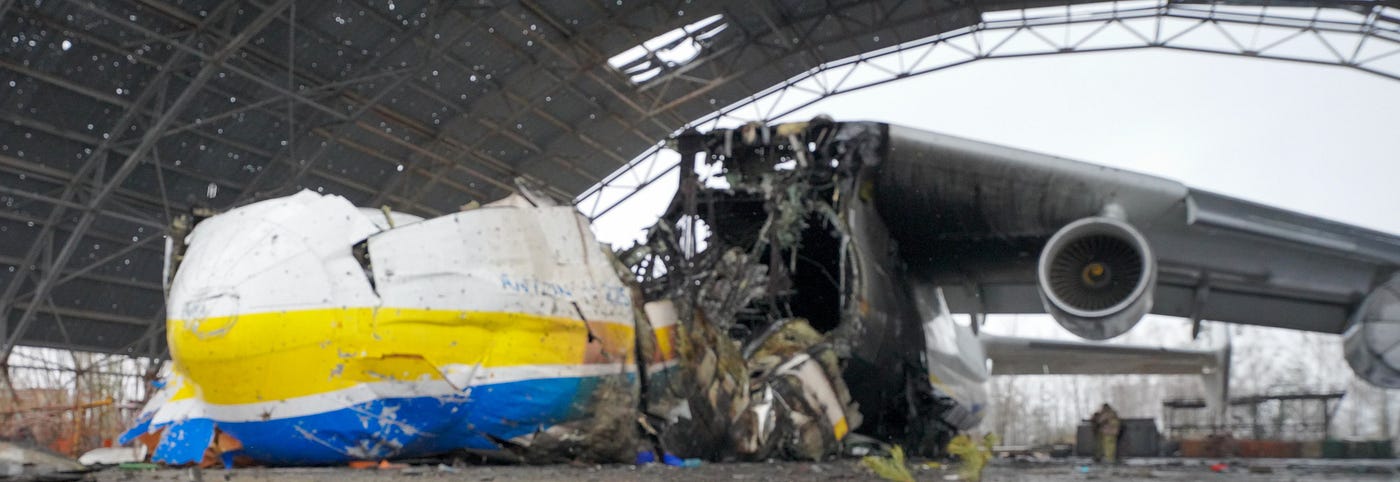
The dream shattered by Russia. Photo by Oleksandr Ratushniak. License: CC BY-SA 4.0.
Due to the Russian attacks on the civilian energy infrastructure, we may have electricity cutoffs for 12 hours a day. But there is some predictability: every house is assigned a schedule so that we can usually plan for the time with electricity.
This way, the system is balanced better, and the distribution of electricity is closer to being just. Only one should be careful to remember to switch off the lights in an already dark bedroom so that the light won’t wake her up in the middle of the night according to the schedule.
Many of us have power banks, UPSes, and headlamps, optic cable internet, which works during electricity cutoffs. Internet providers and other businesses use diesel generators, and some ordinary people do too. Now in spring the situation is fine, the winter of 2026 was horrible: during the coldest times (down to -25C) Russians destroyed much of the central heating infrastructure, not to mention that it is a problem just to be without electricity in this weather.
Many people had to remove water from heating pipes; otherwise, in some cases, the pipes were ruptured by expanding ice.
A tent inside an apartment can increase the temperature by a few degrees.
It is impossible to repair everything before the start of the next heating season.
In Cuba the oil supplies have run out leaving the citizens without electricity too. The blockade by the USA is a great danger to civilians, starting with those most vulnerable in need of medical attention. At least winters are not harsh.
People are adaptable and creative by nature and benefit from intergenerational experience. People can live in harsh conditions and uncertainty, start over, sometimes multiple times: after evacuations, deportations, or tragedy.
I did a renovation in 2023. Not because I wanted to, but because of degraded pipes. I thought: either I would get a chance to enjoy the revolution, or I would be dead and wouldn’t care anymore. As there is not much to plan for the event of death except making a will, I decided to do a good enough renovation for the event of being alive for some more time. Now I’m hesitating regarding more long term renovations: I will not do the one that can wait.
24.05.2026, some time after 1 am.
This time in the shelter, the atmosphere was rather uneasy. Everyone except the dogs was quiet. One dog was periodically barking, and another one was whining. The whole of Ukraine didn’t sleep. Russians had been launching kinzhals, ballistic missiles, and drones. We were warned about the possible launch of boyarishnik, the Russian wonderwaffel. Just kidding. Oreshnik, actually. Russians may be good at propaganda, but branding is not their strength. Anyway, I don’t believe they will use it according to the design (nuclear), so the threat of many other weapons is greater.
There were rumors that they have used an “empty” Oreshnik on Kyiv tonight. The USA has warned Ukraine because Russia must notify them about the use of intercontinental missiles. It is always a good idea to pay attention to the warnings the USA gives to their citizens in your country, and especially to events like when they evacuate their embassies.
Well, there was something positive here also that night: a family opened a computer and were watching the boxing match of Olexandr Usyk. An elderly couple opposite to them was commenting the fight out loud. I was too sleepy so I was just getting the news from them. Sounds like our cossac was winning. Now the family was leaving so I followed: the alert is ongoing but it seems the rockets were most likely to be further away at the moment.
This turned out to be one of the largest attack of the year and mainly on Kyiv: 90 rockets of different kinds and 600 drones. Reportedly, while most likely Kyiv was intended as a target, an Oreshnik was used against a garage cooperative in Bila Tserkva. Another such missile could have malfunctioned and landed on the occupied part of Donbas, or maybe this was within the margin of error. Also as an aftermath of the night we could see that the subway is not 100% safe from the attacks either: the Lukyanivska metro station was damaged, a man was injured. But still it is one of the best options for safety.
Usyk won, BTW.
The news regarding the possible active involvement of Belarus in a war is making me anxious. I didn’t write “the war” because I don’t actually know if Russia is considering attacking Ukraine from the North: e.g. the Northwestern part or/and Kyiv again, or attacking the Baltic countries. I won’t be surprised by either at this point. Well, right now they don’t have enough men there but they are considering their options and checking weather forecasts: meteorological and political. One option would be just to attack from the air, this way they will increase the coverage of our territory with ordinary ballistic missiles and would make troubles for our anti aircraft forces. Our army, in turn, is also considering the options.
26.05.2026
In this calm sunset, I was walking in the city center breathing in the warm air and nice moments to remember: the fragrance of the blooming city, smiling people, and last sun rays. How temporary is this?
Stability is an illusion. Yet we need this illusion to continue being sane.
Enjoy local stability and low perturbations while you can, and aim to keep your mental health at an acceptable condition. But have some canned food suitable for a few days, and may you eat it only so as not to let it spoil, or because of laziness.
This story was inspired by A-Culturated’s monthly writing prompt (PROMPT). Click here to explore the prompt and share a piece of your own!
메타데이터
- post_id
- c36fecdfe7b9
- slug
- enjoy-local-stability-c36fecdfe7b9
- url
- https://medium.com/a-culturated/enjoy-local-stability-c36fecdfe7b9
- canonical_url
- https://medium.com/a-culturated/enjoy-local-stability-c36fecdfe7b9
- author_url
- https://medium.com/@alinita
- status
- ok
- fetched_at
- 2026-06-11 11:25:07