Built for Danger: Why Evolution Made Men Stronger
Why did evolution make men stronger and more risk-tolerant? Across species, sex differences follow survival, not just attraction. This…
Built for Danger: Why Evolution Made Men Stronger
Why did evolution make men stronger and more risk-tolerant? Across species, sex differences follow survival, not just attraction. This essay traces how strength and risk became a single strategy, and why that logic may be fading. We lean on the selfish gene theory of evolution, which targets the survival of the gene more than the survival of the individual.
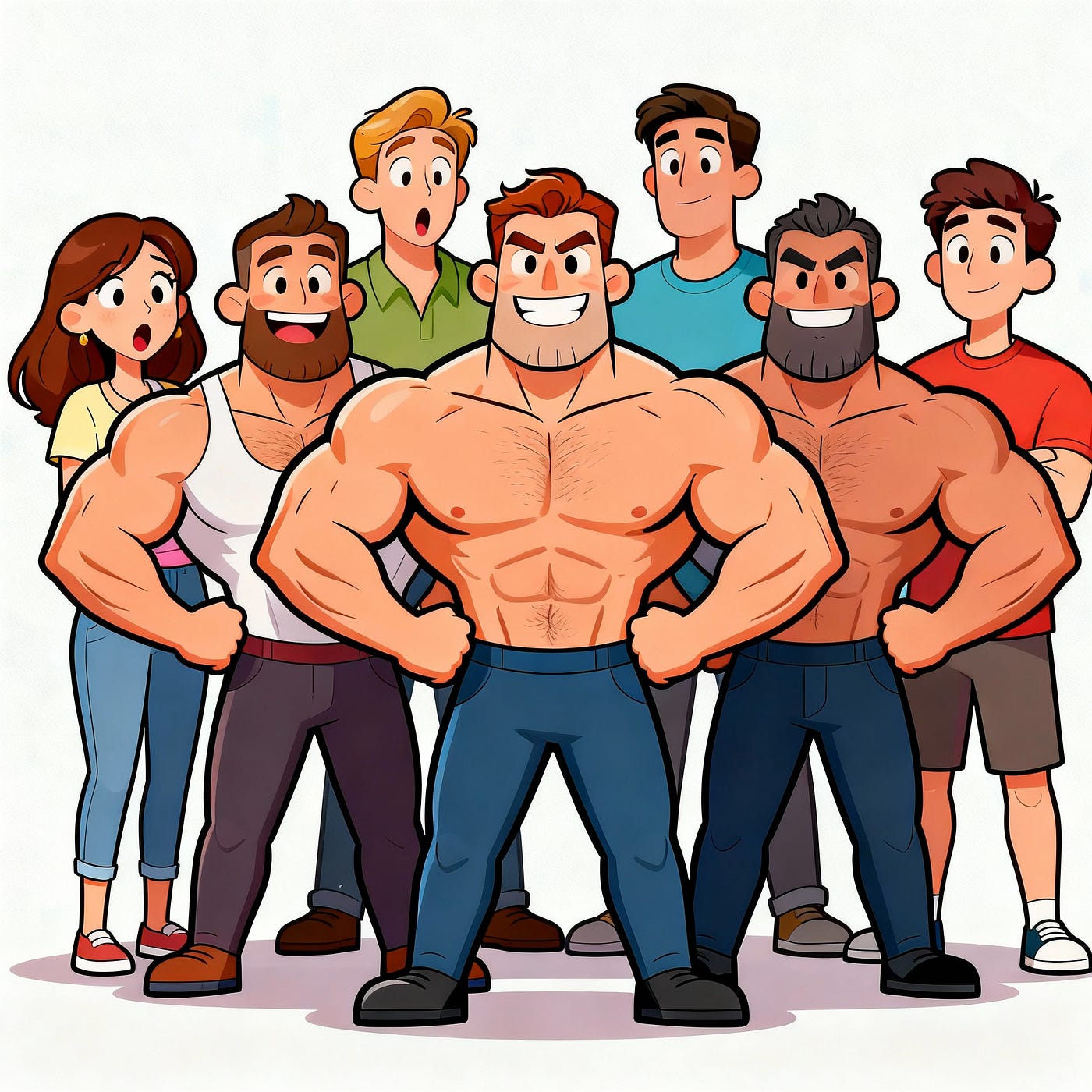
Image made with Sora
Across mammals, including humans, males carry more muscle and gain strength faster from training. Higher testosterone drives protein synthesis; estrogen favors endurance and recovery. These are textbook facts, but why did evolution shape us this way? There are basically three ways for a gene to survive and spread in a population, there need to be some form of selection. From Darwin we have natural selection and sexual (mate) selection, while biologists W. D. Hamilton and George C. Williams gave us the selfish gene. The evolutionary mechanism is then to make sure a gene survives in a population, which may not necessarily benefit the carrier, as is the case of alarm calls with bird species. The call benefits the group and indirectly the gene (or set of genes) that encodes the behaviour.
For humans, male strength, may make some point to sexual selection: perhaps bigger biceps attracted mates. Yet the pattern is broader. Among insects and some fish, females are the larger fighters, and in many species, the stronger sex appear to depend on ecology, not courtship. In humans, I think the evidence points more to natural selection on the basis that the group or society benefits, and less to female preference : survival in dangerous environments where speed, muscle, and risk-taking kept groups alive.
Let us look at risk. What if men were stronger yet refused to fight or confront a danger? Evolution’s answer was to pair muscle with risk-taking. On average, create men who are drawn to danger, speed, and confrontation. The phrase “boys will be boys” reflects this as a condensed historical narrative of reproductive competition. But perhaps even more so, being prone to taking risk will also in itself make men take on roles in society that carries high risk, like seamen in the old days, to miners in modern day, and soldiers across all times. Then muscles are paired with these risky activities and shape men to certain roles.
Our muscles are modest beside a leopard’s but a good match against our own kind. Human strength was forged to face one another, a quiet echo of the conflicts and wars that still shadow us.
The question is till there: why are men, on average, the stronger sex? The usual answer is protection as we alluded to above. Yet if females are more reproductively valuable, why didn’t nature make them the protectors? That is the conundrum. The answer might be found in the different reproductive roles of males and females, and how a group of people, a tribe or larger society, need to recoup from loss of its members. Some are more valuable than others, judged from the view of growing the group, while other may be “sacrificed”. And this is how men became the muscular risk taking gender. The gene system that encodes that survives in the society, even though it is in no way beneficial for the individual male.
When danger looms, two things matter: physical capacity and willingness to engage. Evolution seems to have paired these traits, and appears to have channeled them into males, making them both stronger and more risk-tolerant, while females became the “weaker sex”. Of course, variation exists: many women outpace many men in strength or courage. Still, men are built to add muscle faster, and in sports we see this in abundance.
Sex as Investment Strategy
Biological sex can be viewed through the lens of reproductive investment. Females commit heavily to producing eggs, enduring pregnancy, and nurturing offspring. This creates a fundamental disparity: one male can sire numerous offspring, while a female produces only a limited number. This difference shapes both risk tolerance and reproductive value. The number of offspring in a society is tied to the number of females, much more than the number of males. Therefore, number wise, females are more important to the growth of society.
Strength and Selection
Throughout human evolution, threats demanded swift, powerful responses. Someone had to lead the charge. The individual who did needed speed, strength, and, from a genetic standpoint, a degree of expendability. We need to maximize the combination of strength, risk-taking, and, from the view of the growth of society, those individuals should be disposable or their role could easily be replaceable. Note that this is only viewed from the mechanisms that enhance the size and growth of society. Love and affection is another dimension.
The Brutal Math
In a population evenly divided by sex, one might assume equal importance for both. Yet, reproductively, the logic diverges. If 80% of men perish in conflict, the survivors can still sustain population growth, assuming a 1 to 4 ratio of men to women. If 80% of women die, extinction becomes a real threat. This is where the concept of male disposability finds its biological basis.
We see this pattern also in what we may call the livestock paradox. How can we eat more meat than ever while livestock populations continue growing? The answer lies in biological disparity, and follows the logic laid out above. In cattle ranching, most male calves become beef cattle, while females are kept for breeding. One bull can service many cows, so fewer breeding males are needed. This reproductive efficiency makes the strong, muscular male economically redundant beyond a small breeding pool.
War, Politics, and the Male as Stake
History demonstrates that societies send men and not women, to war. From Napoleon’s armies to the World Wars and conflicts in Ukraine, men are dispatched while women are often shielded. This is not because men are better soldiers, but because, reproductively, societies can afford to lose them. This pattern leaves marks on bodies, cultures, and gender roles.
A simple simulation illustrates this dynamic. In a conflict between two tribes where one sends men, the other women, the tribe that protects its women grows faster over generations. Reproductive investment theory drives this outcome, and evolution adjusts populations accordingly.
Identity, Gender, and the Future
What happens when peace prevails, and survival no longer hinges on physical danger? Male strength and disposability lose their purpose. Gender, as a societal necessity rather than a biological fact, begins to fade. Identity shifts from being dictated by reproductive roles to something individuals choose, perhaps a fluid spectrum of roles untethered from survival’s demands. As long as we live under the pressures of natural selection, life mirrors those forces. When we transcend them, new forms of identity and purpose become possible.
메타데이터
- post_id
- c375d25d3ea9
- slug
- built-for-danger-why-evolution-made-men-stronger-c375d25d3ea9
- url
- https://medium.com/@yoonsen/built-for-danger-why-evolution-made-men-stronger-c375d25d3ea9
- canonical_url
- https://medium.com/@yoonsen/built-for-danger-why-evolution-made-men-stronger-c375d25d3ea9
- author_url
- https://medium.com/@yoonsen
- status
- ok
- fetched_at
- 2026-06-16 19:09:56