decltype in Modern C++ Explained — A Complete Guide
decltype is a compile-time type specifier introduced in C++11 that inspects the declared type of an entity or deduces both the type and…
decltype in Modern C++ Explained — A Complete Guide
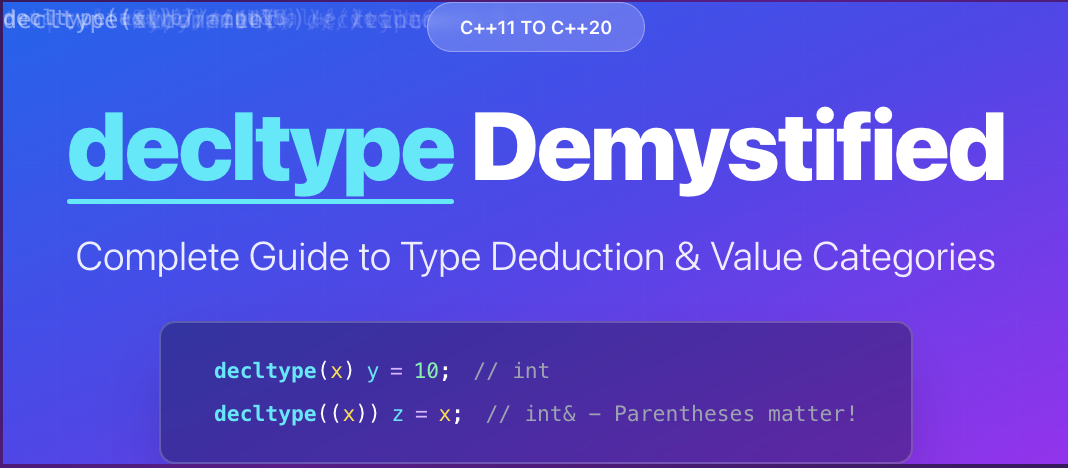
decltype is a compile-time type specifier introduced in C++11 that inspects the declared type of an entity or deduces both the type and value category of an expression without evaluating it. The name stands for "declared type".
Key Characteristics of decltype:
- Compile-time only: Type deduction happens during compilation, producing zero runtime cost
- Non-evaluating: Expressions inside
decltypeare never executed, only analyzed for their type - Value category preservation:
decltypepreserves whether an expression is an lvalue, xvalue, or prvalue, encoding this information in the resulting type (through references) (Want to know about C++11 value categories have a look at this **post**.)
Basic Syntax:
decltype(expression)Have a look at this example how decltype is used:
int x = 42;
decltype(x) y = 10;  // y has type int

const int& z = x;
decltype(z) w = x;   // w has type const int&
Why decltype is Needed at all in the first-place ?
Before C++11, there was no way to determine the exact type of an expression at compile time. This created several following problems:
Problem 1: Template Return Type Deduction Its almost impossible to correctly write the return type for all types.
// Before C++11 - impossible to write correctly for all types
template<typename T, typename U>
??? multiply(T a, U b) {
    return a * b;  // What's the return type?
}
Problem 2: Complex Type Expressions Consider a scenario, When your code is using containers with complex type or even simple type for that matter if somehow a developer change the container type then the developer also have to change all the places where its iterator is declared, this can cause the code to break.
// Hard to maintain - if container type changes, code breaks
std::vector<int> vec;
std::vector<int>::iterator it = vec.begin();
Problem 3: Perfect Forwarding Return Types It was cumbersome and difficult, how do we preserve the exact return type in case of Prefer Forwarding.
// How do we preserve the exact return type?
template<typename Func, typename... Args>
??? wrapper(Func f, Args&&... args) {
    return f(std::forward<Args>(args)...);
}
With decltype these problems can be easily eliminated. Have a look at the below code with decltype :
// Solution 1: Template return type
template<typename T, typename U>
auto multiply(T a, U b) -> decltype(a * b) {
    return a * b;
}

// Solution 2: Type inference
auto it = vec.begin();  // Type automatically deduced

// Solution 3: Perfect forwarding
template<typename Func, typename... Args>
auto wrapper(Func f, Args&&... args) -> decltype(f(std::forward<Args>(args)...)) {
    return f(std::forward<Args>(args)...);
}
How decltype Works in C++11
In C++11, decltype has two completely different behaviors depending on whether the argument is parenthesized or not.
Form 1: Variable decltype (unparenthesized id-expression) Returns the exact declared type of a variable, including references.
int x = 5;
int& rx = x;
int&& rrx = std::move(x);

decltype(x)    // int
decltype(rx)   // int&
decltype(rrx)  // int&&
Form 2: Expression decltype (anything else, including parenthesized)
In this Form decltype returns type based on value category as follows:
- prvalue →
T - lvalue →
T& - xvalue →
T&&
int x = 5;

decltype((x))     // int&  (lvalue)
decltype(x + 1)   // int   (prvalue)
decltype(std::move(x))  // int&& (xvalue)
So here is an example where you can see how parenthesis matter and so important when used inside declytype since it changes the behaviour completely:
int i = 42;

// Safe: returns int (copy)
decltype(auto) fn_A(int i) {
    return i;      // decltype(i) = int
}

// DANGEROUS: returns int& (reference to local variable!)
decltype(auto) fn_B(int i) {
    return (i);    // decltype((i)) = int&
}

int main() {
    int a = fn_A(10);  // OK
    int& b = fn_B(10); // Undefined behavior - dangling reference!
}
Type Deduction Rules for decltype
Below are the rules that can help you use decltype in correct context and also understand what would be decltype return:
Rule 1: Un-parenthesized Variables
int x;
const int cx = x;
int& rx = x;
const int& crx = x;

decltype(x)    // int
decltype(cx)   // const int
decltype(rx)   // int&
decltype(crx)  // const int&
Rule 2: Parenthesized Variables
int x;

decltype((x))   // int& (always lvalue reference for variables)
Rule 3: Member Access
struct S {
    int member;
};

S s;
S f();

decltype(s.member)       // int&  (lvalue)
decltype(f().member)     // int&& (xvalue - temporary object)
decltype(S::member)      // int&  (even outside class context)
Rule 4: Function Calls Function call expressions take the return type of the function:
int func();
int& func_ref();
int&& func_rref();

decltype(func())       // int
decltype(func_ref())   // int&
decltype(func_rref())  // int&&
Rule 5: Operators
int a = 5, b = 10;

decltype(a + b)   // int (prvalue)
decltype(a = b)   // int& (assignment returns lvalue reference)
decltype(++a)     // int& (pre-increment returns lvalue reference)
decltype(a++)     // int (post-increment returns prvalue)
decltype(a > b)   // bool (prvalue)
Rule 6: Literals and Constants
decltype(42)        // int
decltype(3.14)      // double
decltype("hello")   // const char(&)[6] (array reference)
decltype(nullptr)   // std::nullptr_t
Rule 7: Value Category Rules

Evolution in C++14
C++14 introduced significant improvements to make decltype easier to use.
decltype(auto)
The biggest addition was decltype(auto), which combines auto type deduction with decltype rules.
Without decltype(auto) (C++11)
template<typename Container>
auto getElement(Container& c, int index) -> decltype(c[index]) {
    return c[index];
}
With decltype(auto) (C++14)
template<typename Container>
decltype(auto) getElement(Container& c, int index) {
    return c[index];  // Preserves reference if c[index] returns reference
}
This enhancement support in decltype has several key benefits like preserving value category, simpler return type deduction, and also variable initialization.
- Preserves Value Category
std::vector<int> vec = {1, 2, 3};

decltype(auto) elem = vec[0];  // int&, can modify
elem = 42;  // Modifies vec[0]

auto elem2 = vec[0];  // int, copy
elem2 = 42; // Does NOT modify vec[0]- Simpler Return Type Deduction
// C++11
template<typename F, typename... Args>
auto wrapper(F f, Args&&... args) -> decltype(f(std::forward<Args>(args)...)) {
    return f(std::forward<Args>(args)...);
}

// C++14 - much cleaner!
template<typename F, typename... Args>
decltype(auto) wrapper(F f, Args&&... args) {
    return f(std::forward<Args>(args)...);
}- Variable Initialization
int x = 5;
int& rx = x;

decltype(auto) y = rx;   // y is int&
auto z = rx;             // z is int (copy)
Function Return Type Rules in C++14:

Note: Parentheses in return statements with
decltype(auto)change the return type from value to reference, which can lead to dangling references!
decltype(auto) f1() { return 5; }        // Returns int
decltype(auto) f2() { int x = 5; return x; }   // Returns int
decltype(auto) f3() { int x = 5; return (x); } // Returns int& - DANGEROUS!
Evolution in C++17
C++17 brought conceptual changes to how prvalues work, affecting decltype indirectly.
C++17 introduced Guaranteed Copy Elision: C++17 changed prvalues to be initialization expressions rather than temporary objects.
struct S {
    S() { std::cout << "Constructor\n"; }
    S(const S&) { std::cout << "Copy\n"; }
};

S factory() { return S(); }

// C++14: Constructor, Copy (maybe elided)
// C++17: Constructor only (guaranteed)
S s = factory();

decltype(factory())  // Still S (prvalue), but semantic change
Structured Bindings with decltype:
C++17 introduced structured bindings, which work well with decltype:
std::pair<int, double> getPair() {
    return {42, 3.14};
}

auto [i, d] = getPair();

decltype(i)  // int
decltype(d)  // double

// With references
auto& [ri, rd] = getPair();  // Error: can't bind to temporary

std::pair<int, double> p = getPair();
auto& [ri, rd] = p;  // OK
decltype(ri)  // int&
Template Argument Deduction for Class Templates:
// C++17
std::pair p{1, 2.0};  // std::pair<int, double>
decltype(p)  // std::pair<int, double>

// Works with complex expressions
decltype(std::pair{1, 2.0})  // std::pair<int, double>
Evolution in C++20
C++20 introduced **concepts and constraints**, which heavily use decltype in requires expressions. Easy to understand with examples:
Requires Expressions:
#include <concepts>

template<typename T>
concept Addable = requires(T a, T b) {
    { a + b } -> std::same_as<T>;  // decltype((a + b)) must be T
};

template<typename T>
concept HasSize = requires(T t) {
    { t.size() } -> std::convertible_to<std::size_t>;
};
decltype in Abbreviated Function Templates: decltype works well with Abbreviated Function Templates:
// C++20 abbreviated function template
void process(auto x) {
    using T = decltype(x);
    T copy = x;
    // ...
}

// Equivalent to:
template<typename T>
void process(T x) {
    T copy = x;
    // ...
}
Concepts with decltype:
template<typename T>
concept Container = requires(T t) {
    typename T::value_type;
    { t.begin() } -> std::same_as<typename T::iterator>;
    { t.size() } -> std::same_as<typename T::size_type>;
};

template<Container C>
decltype(auto) getFirst(C& c) {
    return *c.begin();  // Preserves reference type
}
Summary Table

Final Thoughts
decltype is a powerful feature that enables:
- Type introspection at compile time
- Perfect forwarding of return types
- Generic programming with exact type preservation
- Metaprogramming with type computations
Understanding the two forms of decltype (variable vs expression) and value categories is crucial for avoiding bugs. The evolution from C++11 through C++20 has made decltype progressively more powerful and easier to use, especially with decltype(auto) in C++14 and concepts in C++20.
Remember: Parentheses matter! decltype(x) and decltype((x)) can be completely different types.
I hope you enjoyed reading this !! Feel free to leave your feedback in the comments !!!
If you’re serious about passing technical interviews, try PracHub. It helped me structure my preparation with advanced mock sessions. [**Check it out here**] and start practicing. (Disclosure: This is an affiliate link).
메타데이터
- post_id
- c389abd7a6ca
- slug
- cpp-decltype-explained-guide-c389abd7a6ca
- url
- https://towardsdev.com/cpp-decltype-explained-guide-c389abd7a6ca
- canonical_url
- https://towardsdev.com/cpp-decltype-explained-guide-c389abd7a6ca
- author_url
- https://medium.com/@sagarmadala
- status
- ok
- fetched_at
- 2026-06-23 03:48:11