1938, Evian: the birth of international inaction
Evian publicly demonstrated that the international community recognized the problem but did not intend to take responsibility for it.
1938, Evian: the birth of international inaction
Evian publicly demonstrated that the international community recognized the problem but did not intend to take responsibility for it.
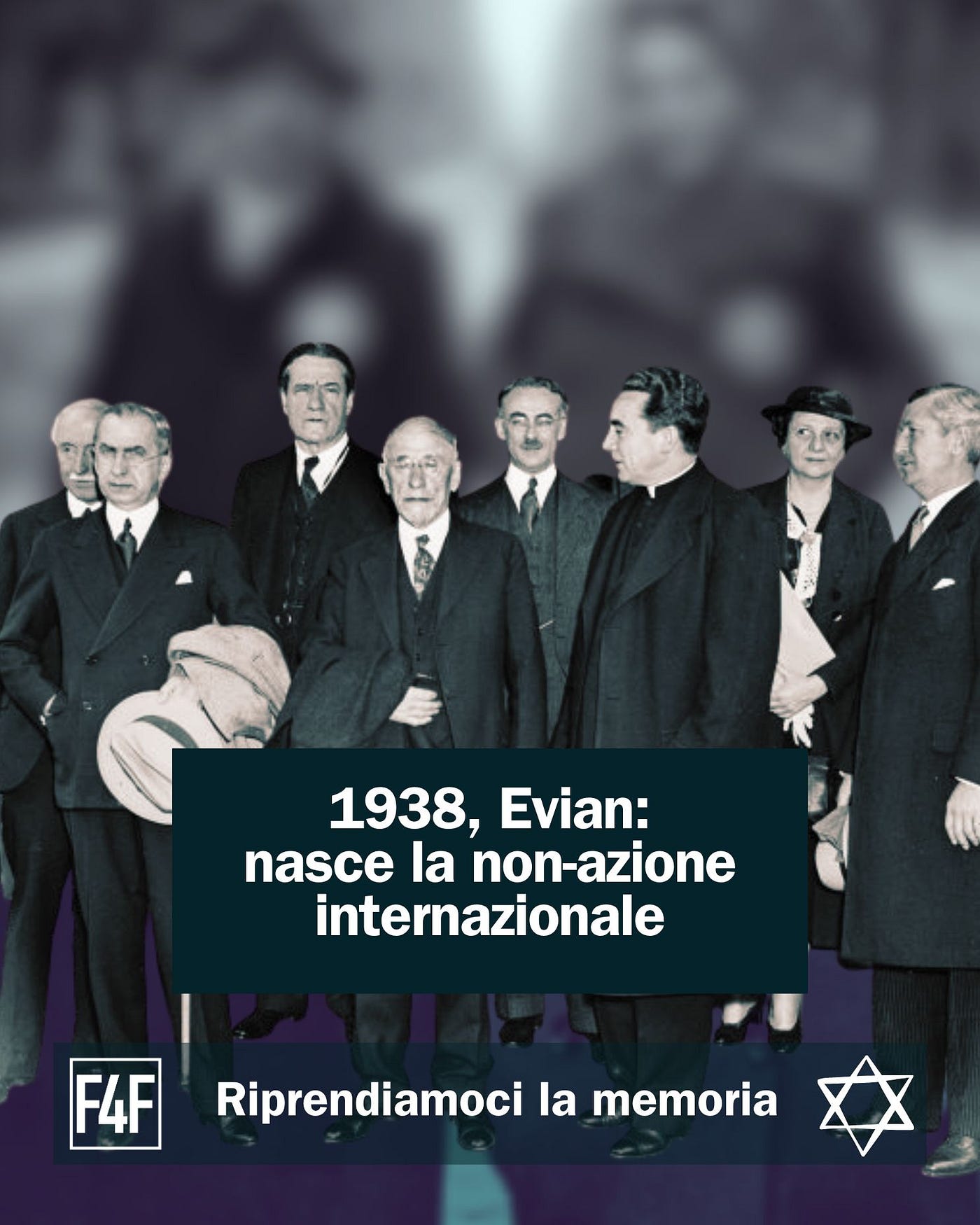
1938, Evian: the birth of international inaction
Between 1938 and 1944, as the persecution of European Jews gradually turned into systematic extermination, the democratic powers made a series of decisions — and above all non-decisions — that contributed decisively to the absence of escape routes and the lack of concrete rescue measures. This six-year period shows a political consistency that can be found in archives, minutes, memoirs, and parliamentary records: the protection of Jews was never an operational objective of Allied strategies.
1. 1938: Evian and the formal birth of international inaction
In July 1938, shortly after the annexation of Austria and the sudden creation of 180,000 new refugees, thirty-two countries met in Évian-les-Bains to discuss the issue of German and Austrian refugees.
Officially, all delegates expressed sympathy for the victims and recognized the seriousness of the situation. But the real content of their statements was different.
France declared that it had reached its “saturation limit.”
Latin American countries introduced stringent conditions: minimum capital, certificates of good conduct, employment guarantees.
The United States strictly maintained the immigration quotas established in 1924, which were not increased even in the face of the impending crisis.
The United Kingdom confirmed a cautious line, limited to declarations of principle, without additional commitments.
No country was willing to change its legislative constraints or open new immigration channels. Golda Meir, who was present as an observer, later recalled the experience as a “series of expressions of sorrow without political will.”
The conclusion was clear: Evian publicly demonstrated that the international community recognized the problem but did not intend to take responsibility for it.
2. Strict migration policies: the US and the UK between constraints and choices
In the United States, quota legislation remained unchanged throughout the war. The combination of restrictive criteria, complex bureaucracy, and security concerns prevented tens of thousands of people who could have obtained visas from entering the country. The State Department maintained an extremely cautious approach, justified by internal reasons — the risk of inflation and labor competition — and national security concerns.
In the United Kingdom, immigration policy was further tightened with the 1939 White Paper. Mandatory Palestine was closed to Jewish immigration beyond a pre-set limit of 75,000 entries in five years. After 1944, any further arrivals required Arab consent, which was not granted. This policy was not an administrative accident: it was part of a deliberate strategy to avoid demographic change in the Middle East at a time when the region was of decisive strategic importance to London.
Both countries, albeit for different reasons, maintained an identical line: no substantial change to immigration policies, even when persecution became publicly known.
3. Information available but without consequences: Pilecki and Karski
The lack of action was not due to a lack of information.
Witold Pilecki, who infiltrated Auschwitz in 1940, wrote detailed reports on the structure of the camp, the deportations, and the killings. After his escape in 1943, he explicitly asked the Allies to bomb the railway infrastructure leading to the Auschwitz-Birkenau complex.
His requests were not taken into consideration.
Jan Karski, an emissary of the Polish underground state, visited the Warsaw ghetto and a transit point to Bełżec. Between 1942 and 1943, he presented his reports in London, Washington, and the Vatican, meeting with high-level officials and President Roosevelt.
Again, the information did not translate into operational measures.
Many years later, Karski summed up the experience as follows:
“It was easy for the Nazis to kill Jews because they did it. The allies considered it impossible and too costly to rescue the Jews because they didn’t do it. The Jews were abandoned by all governments, church hierarchies, and societies, but thousands of Jews survived because thousands of individuals in Poland, France, Belgium, Denmark, Holland helped to save Jews. Now, every government and church says, “We tried to help the Jews,” because they are ashamed, they want to keep their reputations. They didn’t help, because six million Jews perished, but those in the government, in the churches they survived. No one did enough.”
4. 1943: The Bermuda Conference as a textbook case of inaction
Convened in April 1943, while the first systematic reports of the “final solution” were circulating in Western capitals, the Bermuda Conference was presented as an attempt to address the problem of European refugees.
In reality, the limits were set from the outset:
no specific discussion of the persecution of Jews;
no revision of American quotas;
no use of Palestine as a destination;
no evacuation plan or rescue corridor;
no sending of food parcels to camp inmates.
Richard Law, head of the British delegation, described all proposals involving negotiations, prisoner exchanges, or substantial changes to existing policies as “fantastic proposals,” calling for “the problem to be defined in limited terms.”
The United States did not send a delegation with decision-making powers.
Decisions were referred to the Intergovernmental Committee on Refugees, which already lacked funds and a mandate.
Yad Vashem retrospectively defined Bermuda as “a public relations exercise aimed at silencing protests without introducing effective solutions.”
In the House of Lords on July 28, 1943, Lord Davies expressed documented frustration: no one understood what had really happened behind closed doors, and every concrete step seemed to have been postponed.
The only tangible result was the transfer of 630 refugees already present in Spain and North Africa. No measures were taken regarding the Jews still in the occupied territories.
5. 1944: the Hungarian case and the missed opportunity
The German occupation of Hungary in March 1944 opened a window of opportunity lasting a few months during which international intervention could have saved tens of thousands of people.
Two initiatives were proposed — and rejected.
The Eichmann–Brand proposal
Joel Brand, emissary of the Jewish Committee of Budapest, brought a request for negotiation to the Allies.
As soon as he arrived in Syria, he was detained by the British authorities and was unable to present his proposal.
The plan was never analyzed.
The evacuation plans drawn up by neutral diplomats and the Red Cross
The Foreign Office rejected them, believing that making an exception would create “an unmanageable precedent” and call into question the British line on Palestine.
No alternative was defined.
After the war, a Foreign Office diplomat summed up that position as follows:
“What would I do with a million Jews? Where would I put them?”
Although uttered in a later context, the phrase accurately reflects the administrative logic of the war years.
6. Conclusion: non-action as structural policy
Between 1938 and 1944, the international community responded to the persecution of European Jews without changing the political, diplomatic, and military instruments at its disposal.
The US State Department, the British Foreign Office, and the intergovernmental structures created in Evian and Bermuda operated according to a logic of containment, not intervention.
In January 1942, in Wannsee, Nazi Germany defined the administrative organization of the extermination.
In April 1943, in Bermuda, the Allied powers chose not to introduce any extraordinary measures to counter it.
The two conferences are not similar in nature or purpose, but together they clarify a fundamental historical fact: the extermination was possible also because, when there was still room for intervention, the states that could have acted decided not to do so.
메타데이터
- post_id
- c3a0a4f5d149
- slug
- 1938-evian-the-birth-of-international-inaction-c3a0a4f5d149
- url
- https://medium.com/the-judean-peoples-front/1938-evian-the-birth-of-international-inaction-c3a0a4f5d149
- canonical_url
- https://medium.com/the-judean-peoples-front/1938-evian-the-birth-of-international-inaction-c3a0a4f5d149
- author_url
- https://medium.com/@Free4Future
- status
- ok
- fetched_at
- 2026-06-15 20:49:13