From Automotive to FinTech: How Vlada’s UX Journey Redefined Human-Centered Design
Meet Vlada, a senior UX designer with a rich background spanning automotive, FinTech, and data science. Her career journey has taken her…
From Automotive to FinTech: How Vlada’s UX Journey Redefined Human-Centered Design
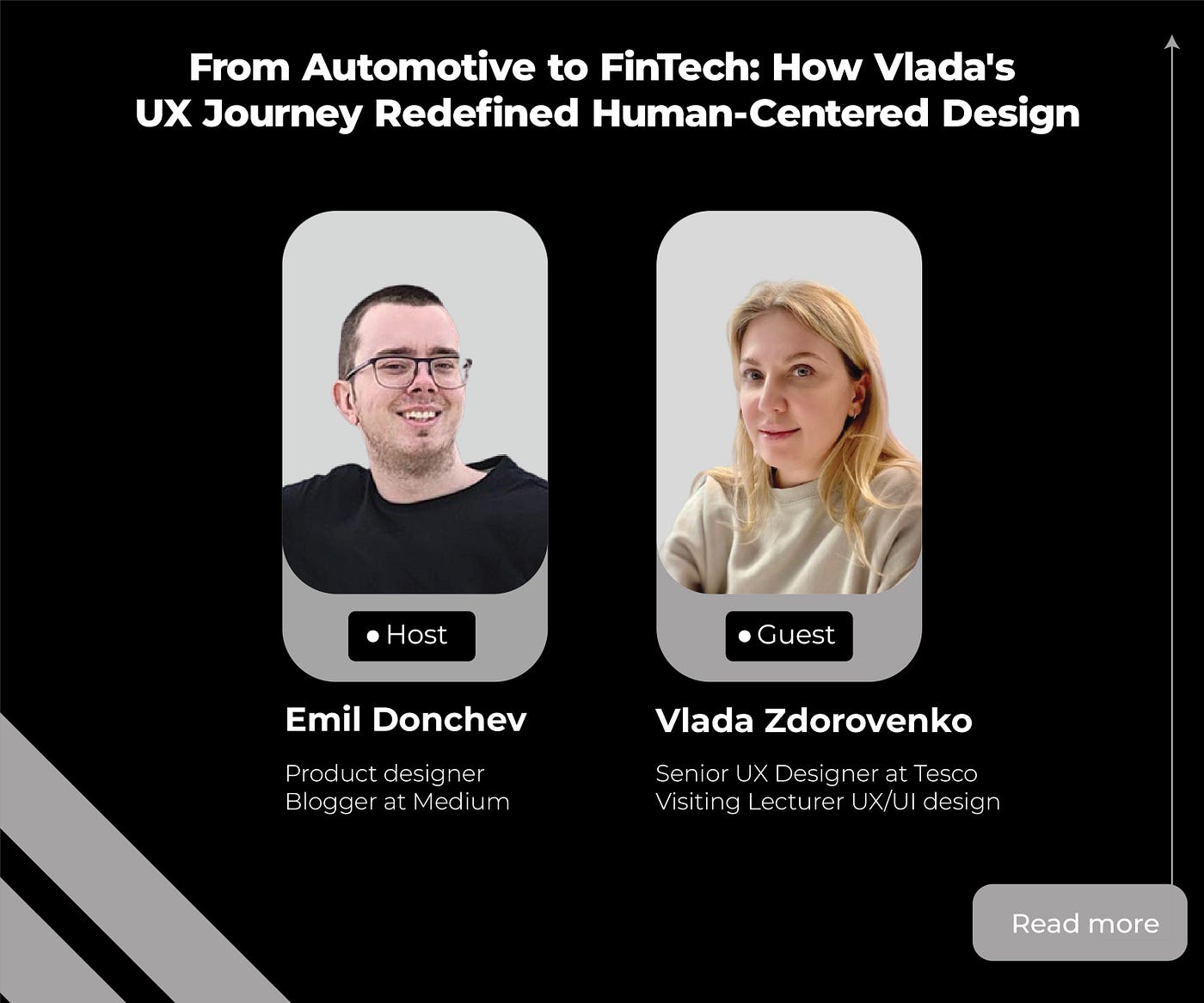
Meet Vlada, a senior UX designer with a rich background spanning automotive, FinTech, and data science. Her career journey has taken her from managing sales and marketing strategies to designing user-centered digital experiences. Driven by a passion for solving complex problems, Vlada shares her insights on building UX processes from scratch, designing for diverse industries, and embracing continuous learning in an ever-evolving design landscape.
Can you introduce yourself?
My name is Vlada, and I’m a senior UX designer with a background in the automotive industry, FinTech, and data science projects. My career has been diverse, spanning not only design but also sales, marketing, and academia. This variety has shaped my perspective and strengthened my skills across different fields. I’ve had the chance to work on some truly impressive projects in the past and am currently involved in an exciting new one.
What drives me is a passion for creating user-centered solutions across a range of industries. I love tackling complex problems and designing experiences that truly make a difference for users. Whether it’s in automotive, FinTech, or data science, my goal is always the same: to focus on the user and deliver designs that are both functional and impactful. Each project brings new challenges and opportunities to grow, and I’m always eager to explore innovative ways to improve the user experience.
What inspired you to pursue a career in UX design?
Even though I had a successful career in the automotive industry, I found myself wanting something more engaging. During my work, I was involved in various digital projects, and my inspiration started leaning toward more creative and human-centered fields. I decided to explore different design disciplines and began with a graphic design course. While it was great to learn tools like Photoshop and Illustrator, I quickly realized it wasn’t the right fit for me.
During COVID, I took an online UX/UI design course, and it was a game-changer. The instructor was incredibly inspiring, and I realized that UX/UI design was exactly what I wanted to do. However, since I already had an established career in the automotive industry, I didn’t want to start over as a junior designer. To bridge the gap, I enrolled in the British Higher School of Art and Design in Moscow. This experience helped me build connections in the design community and made me more visible in the industry.
Through this network and the skills, I gained, I started receiving exciting job offers from major companies. Eventually, I transitioned into FinTech and joined Sberbank, the largest bank in Russia. It was a pivotal moment in my career, allowing me to combine my previous professional experience with my passion for human-centered design. This shift not only solidified my expertise in UX/UI design but also opened doors to work on impactful projects, blending creativity and strategy in meaningful ways.
Photo by Sahand Babali on Unsplash
How has your experience in sales and marketing influenced your approach to design, particularly in understanding user needs and working with feedback?
In my sales role, I did not directly handle sales, but rather served as a regional sales manager overseeing sales for 18 dealerships. Meanwhile, in marketing, I was responsible for marketing strategy for multiple markets and worked with market analysis, among other responsibilities. This experience proved invaluable when transitioning into design. Both fields required a deep understanding of customer needs, user behavior, and how to effectively address them. The skills I gained in these areas naturally aligned with human-centered design, making the transition feel smoother than I initially expected.
Another key aspect was working with feedback. In sales, there’s a constant feedback loop between dealers and their customers. Metrics like NPS (Net Promoter Score) come into play, which is a service design tool for collecting and analysing feedback. This iterative process — receiving input, refining strategies, and implementing changes — was something I carried into design. It taught me how to adapt based on insights, a critical skill in creating user-centered solutions.
These experiences also emphasised the importance of soft skills, especially when collaborating with teams or conducting user interviews. Sales and marketing taught me how to build strong teamwork and communication, which directly translates to the design process. Whether it’s facilitating collaboration or understanding user needs, the knowledge gained from these fields has been incredibly valuable. For anyone transitioning into design, leveraging these transferable skills can create a solid foundation for success in the industry.
In your transition from sales and marketing to UX design, what unexpected challenges or strengths from your past roles surfaced?
In my experience, several key skills stand out: soft skills, understanding customer needs and behavior, leveraging feedback, and adopting an iterative approach. These all contribute to a more customer- and user-centric mindset. For instance, before taking any action, it’s essential to understand the context fully. This requires careful research and study, a skill I acquired in sales and marketing. In a nutshell, if you want to achieve your goals, you need to dig deeper and understand the context thoroughly. This mindset of exploration and research is just as crucial in design. It’s all about understanding the problem before jumping into a solution. Whether it’s gathering data, observing user behavior, or testing assumptions, this exploratory approach helps you create better, more effective solutions. These transferable skills have been invaluable as I transitioned into design.
Photo by Ofspace LLC on Unsplash
What did you find most challenging about establishing UX processes from scratch at Sberbank, especially with a large team of 100+ people?
Working in a large organization requires a balance between standardization and flexibility. When joining a team that hasn’t worked with design before, it can be challenging. Many may not immediately understand the value of design. In this case, you’re not only selling the value but also establishing new processes. You need to bring everyone onto the same page, aligning them with the concept of what design truly means. Managing communication is key, especially in a large team.
I was fortunate that we had already returned to the office, so most of our work was face-to-face. This made it easier to establish a common understanding of design within the team. I realized I needed to create clear guidelines and processes, and document them properly. So, I interviewed department heads, created a project roadmap, and integrated design into this roadmap. This helped everyone understand the value of design at each stage and the relevant deliverables, making it easier to align with other departments.
In a large organization like a bank, it’s not just about your immediate team. You need to communicate with other departments, such as cybersecurity, customer experience, finance, and many others, to ensure alignment across the board. Without this, nothing moves smoothly. So, establishing clear rules, creating a roadmap, and demonstrating the value of design were essential steps.
In addition, I conducted interviews and tests with users, sharing the results with the team. This helped them see how design and feedback contributed to a more user-centric approach. By sharing the results of user tests and feedback, I was able to demonstrate the tangible impact of design on our projects. It wasn’t just about aesthetics, but how it could improve the user experience and results. This helped other team members understand how UX design could impact the final product. Over time, it became clear that incorporating design early in the process was critical to creating a product that truly met the user’s needs, and this became a guiding principle for the team.
Given your extensive background in automotive UX (Kia, Nissan), how do you approach user testing and feedback differently in the automotive industry compared to fintech?
In my previous role at an agency working with a startup, we were focused on developing the HMI (Human Machine Interface) for a new premium electric vehicle (EV) brand. We focused on testing the HMI on physical prototypes with users. The testing was done in simulated environments that mimicked real-world driving conditions. It’s a unique process where you have to imagine yourself as part of the driving experience. HMI testing is very hands-on and specific to the user’s interaction with the vehicle’s screens and controls.
On the other hand, when I worked in FinTech, the focus shifted to a more data-driven approach. Here, the emphasis is on ease of use, accessibility, and security. While the goals may differ, both areas require a deep understanding of user behavior and context. In FinTech, you test on screens in apps or on websites, which is a different type of interaction compared to the hands-on experience of testing an HMI in a vehicle. Despite the differences, both require collecting user feedback to refine the design.
In your experience as a lecturer and mentor, what is one misconception that new UX/UI designers often have about the industry?
A common misconception among new designers is that they need to know everything all at once. They often feel overwhelmed, unsure of what to focus on or where to seek help. Many still believe that design is primarily about creating visually appealing interfaces. While aesthetics are certainly important, there’s much more to design than that. The research and strategic side of UX, which involves empathy-based research, data analysis, and testing, is often underestimated.
To truly understand user needs and behaviors, you need to dive deep into empathy-driven research. It’s not just about making things look good; it’s about solving real problems. Testing and data analysis play a huge role in UX, helping to shape the design in a way that resonates with users. For new designers, it’s important to embrace these aspects of the process, as they help build a deeper understanding of how to create meaningful, effective designs.
Photo by Steinar Engeland on Unsplash
You’ve worked with high-impact projects across automotive and fintech, both as an internal team member and a consultant. What advice would you give to designers about approaching product ownership and metrics in consulting versus full-time roles?
When you’re working as a consultant, the approach is quite different. You have to quickly adapt to the client’s goals, requirements, constraints, and metrics. The pace is fast, and you have to react immediately, focusing on delivering value as quickly as possible. The outcome is to provide results that show immediate value to the client.
In contrast, when you’re working in-house, you have more control over the design lifecycle. You can implement long-term goals and focus on UX improvements that align with the company’s vision. As a consultant, it’s important to work in an agile way, showcasing your value quickly. But in-house, the focus shifts to integrating UX metrics, aligning team members with design frameworks, and demonstrating the long-term value of design through continuous processes and collaboration.
Do you have some unique framework?
I believe there are many frameworks available for designers, but most tend to stick with the ones they’re familiar with, rather than exploring new ones. Common frameworks like Jobs to Be Done, personas, and customer journey maps are often used to better understand users and customers. These frameworks are useful because they provide clarity on the context and help you focus on the right aspects of your design.
The key is to try different frameworks and see which one suits the task at hand, or which one feels most comfortable for you to work with. It doesn’t matter which specific approach you use, as long as it helps you gather insights through methods like user interviews, testing, or deep research. The goal is to understand the user better and create solutions that truly meet their needs. Ultimately, the right framework is the one that helps you achieve those insights most effectively.
What’s a UX lesson you’ve learned from a ‘failed’ project or a challenging client situation that has shaped your approach to design or client communication today?
We worked on building a sales tool, following the guidelines of the European office and collaborating with an external development team. The process was challenging because we started designing the tool first and then conducting user research. This approach seemed inefficient and time-consuming. Ultimately, if the tool doesn’t provide value to users, you have to start all over again. I learned the importance of doing user research up front to identify pain points and the context in which users operate.
Starting with user research is crucial to the success of any design project. In our case, we followed the requirements of the head office, which led to difficulties later. Although we had some conversations with users along the way, they were not extensive enough. Often, companies rush to build tools because they think they are valuable, without fully understanding the needs of users. In retrospect, conducting contextual interviews or thorough research at the beginning would have made a huge difference, especially in understanding the systems that users were already using.
Another challenge was aligning the new tool with existing systems, especially since our dealers were using different platforms. This created friction, as not all users were happy with the new tool if it did not integrate smoothly with their current systems. Understanding the needs and context of users from the start would have saved time and avoided frustration later.
Photo by Annie Spratt on Unsplash
Since you’re also working with the Data Science team at Tesco, how do you approach designing for data tools that may not have had much UX focus initially? Any strategies for making complex data more user-friendly?
As with any tool, you need to start by understanding the users and their context. In data science, this is especially challenging because the context is incredibly complex, so it was important for me to first understand the basic specifics of the current projects that my data science and engineering team is working on since I am not a technical person. This means that it takes extra time and involves not only talking to users, but also engaging with stakeholders from the data science and engineering teams to better understand the area.
Articulating what the data science team needs and aligning their goals with frameworks and design processes is critical to me. This allows me to better understand the needs and translate them into a user-friendly solution. Research has two aspects: understanding both the users and the stakeholders. Furthermore, aligning their needs with the design processes is key. This is similar to what I did at Sberbank, where I developed the design process from scratch. In both cases, the challenge is to bridge the gap between the technical and design perspectives. By working closely with both users and stakeholders, I understand that I am not only meeting user needs, but also aligning with technical capabilities and constraints. This holistic approach helps create a balanced solution.
What are the challenges you face when working with a simulation platform in the context of data science, and how do you navigate the complexities of understanding users, stakeholders, and technical solutions?
We are currently working on building a simulation platform. Essentially, it is a tool that helps generate various “what if” scenarios in different business domains. Since I am the first designer on the team, I need to build knowledge from scratch. For example, how different types of users interact with processes in areas like transportation, fulfilment or replenishment, so that I can understand what they are doing, what decisions they need to make and how they interact with their current tools.
The challenge here is that my team works with big data, so I also need to explore what information they are collecting and how UX design can help create more human-centric solutions for users’ strategic decisions. The context is complex because it involves understanding not only the internal processes of the company and its users, but also its stakeholders. The data science approach focuses on the “human in the loop”, which is different from the human-centric thinking I am used to. While this approach can create brilliant solutions, the challenge is whether users will actually be able to easily interact with them. The solutions may be too complex for the average user as they are developed by experts who assume a high level of understanding of data science.
Thank you for reading! If you enjoyed this article and want to dive deeper into the world of UX design, innovation, and career growth, consider subscribing. It mean a lot for me and have a good day!
메타데이터
- post_id
- c3a6dbaaf75a
- slug
- from-automotive-to-fintech-how-vladas-ux-journey-redefined-human-centered-design-c3a6dbaaf75a
- url
- https://medium.com/design-bootcamp/from-automotive-to-fintech-how-vladas-ux-journey-redefined-human-centered-design-c3a6dbaaf75a
- canonical_url
- https://medium.com/design-bootcamp/from-automotive-to-fintech-how-vladas-ux-journey-redefined-human-centered-design-c3a6dbaaf75a
- author_url
- https://medium.com/@aemd2donchev
- status
- ok
- fetched_at
- 2026-06-24 23:31:39