The State of Sustainability at Facades 2025
Executive Summary
The State of Sustainability at Facades 2025
Executive Summary
This paper evaluates how sustainability was viewed by builders and manufacturers at the Facades 2025 Conference. It shares a tradeoff between publishing raw sustainability information versus integrating sustainability principles into high performance building design through durability, safety, and an aim for preserving resources while fostering human comfort. The paper is divided into two sections: “Builders” discusses how Studio Gang and Related’s presentations revealed sustainability as an inevitable result of designing high performance buildings; “Manufacturers” discusses how Kingspan and Longboard’s presentations were aimed for a sustainability reporting audience whereas Specified Technologies, Rockwool, and Building Components’ presentations yielded innovations which will help future high performance buildings. This conference proved sustainability is multi-dimensional and extends beyond publications for the sustainability industry.
Introduction
The Facades 2025 Conference was a current synthesis of environmental sustainability of materials, durability of buildings, and human comfort variables builders consider when making selections. I evaluated the presentations based on how sustainability was defined as a project aspiration by builders and manufacturers. My questions:
-
If a presentation featured a Lifecycle Assessment (LCA), were greenhouse gas emissions (as proxied by Global Warming Potential (GWP)) part of the decision making by builders?
-
For manufacturers, was sustainability used for marketing or was it a primary design feature? If a comparable product was at the expo, was it easy to tell which product would contribute more to a high performance building?
After attending the conference, I found that sustainability is featured during design stages in buildings and while materials that are better for the environment will be selected where possible, sustainability for high performance buildings is creating a safe and durable building that preserves resources intrinsically through building science.
Builders
The builder presenters at the Facades conference combined several high performance building attributes into one goal for building durability. They used the frame of building science to state sustainability as the consequential benefit of preserving natural resources while noting structure and safety considerations will inevitably take precedent in design. Per Pongiglione and Calderini (2016), sustainable construction was defined by Kibert (1994) as “minimize resource consumption; maximize resource use; use renewable or recyclable resources; protect the natural environment; create a healthy, non-toxic environment; and pursue quality in creating the built environment”. Given sustainability commitments are one of many considerations for facades, the definition above packs a lot into “pursue quality in creating the built environment”. In other words, supporting a one-sided view of prioritizing the environment (proxied in this paper by lower GWP materials) amongst several other factors to produce a durable facade is limiting. In contrast, Moghtadernejad et. al (2019) discuss the facade design process as design, construction, operation, rehabilitation, and demolition while including sustainability as a performance attribute of a building facade. The authors shared the following five-pronged framework to contextualize the whole footprint in building envelopes and shared a wider lens, more fitting of building project constraints.
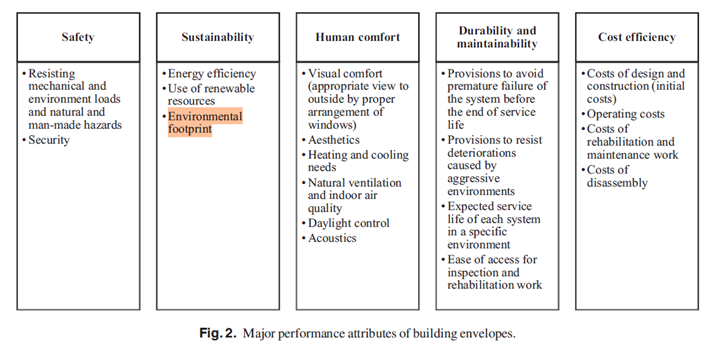
Moghtadernejad et. al (2019)’s framework is closer to the presentation “Populus: A Facade Informed by Nature” presented by Kristina Eldrenkamp (Studio Gang), Chris O’Hara (Studio Gang) and Jason Smith about building a hotel in Colorado. Studio Gang discussed climate and urban fabric as why they chose concrete — a high GWP material — from Holcim with 367 kgCO2e per 1 m3 of concrete[1]. An online search revealed that this is in the same range as other concrete produced by Holcim in other countries[2]. Based on Kibert (1994)’s approach to sustainability, Studio Gang produced an average facade. However, this approach doesn’t present the full picture and makes companies building high performance buildings without environmental documentation prepared to meet some compliance standard[3] appear to be worse offenders than they are. Rather than evaluating Studio Gang for paperwork, we should look at the sustainability of their entire design.
There are positive attributes of the Colorado Hotel that are not in the LCA. For example, Studio Gang shared Holcim from Colorado was selected, thereby reducing the logistical environmental footprint for the entire project. Similarly, the concrete facade pieces were made by local craftsmen rather than transported from elsewhere. Studio Gang’s presentation also stated how the building envelop was informed by building science. Since the essence of preventing leakage of resources used for human comfort is the preservation of resources for the next generation, building science is sustainability in practice. In other words, a narrow approach to sustainability is not sufficient to capture the durability benefit of using concrete (most notably in Studio Gang’s “Aspen windows”) or the logistics GWP benefit of having local builders construct facade portions on-site rather than having them transported from elsewhere.
Sustainability was not part of the presentation “Scaling Up: 400 North Lakeshore Drive” presented by Lucas Tryggestad (Related), Ann Thompson, Coty Sandberg. Related shared how the building facade used Rockwool insulation material, aluminum cladding, low emissivity coating on windows and showed how they were achieving desired resource preservation outcomes through building science. While specific sustainability aims were not discussed, Rockwool is known as a sustainable alternative to typical insulation. In other words, while no mention of greenhouse gases was made, the materials selected could yield a low GWP LCA for the overall building. Similarly, in “Material Trends in Design & Construction: Transforming the Supply Chain” by Juanita Garcia, Bill Zahner, Lauren Van Rekken (Harmon), Matt Dumich, Harmon discussed LCAs as an expense and did not view completing these calculations as a make-or-break point for their customers. Sustainability in the sense of creating a building adhering to Moghtadernejad et. al (2019)’s framework does not appear to need LCAs to foster sustainability.
Manufacturers
The builders’ presentations and tables at the Facades conference established sustainability in the building industry like Moghtadernejad et. al (2019)’s framework contextualizing constraints of building projects. The manufacturers shared more basic presentations that showcased their product with respect to where the product fit in the building envelope and either shared the compatibility of their product and business with sustainability standards like Leadership in Energy and Environmental Design (LEED) certifications and United Nations Sustainable Development Goals (UN SDG) or proved the existence of the product was to help a desired environmental outcome become more likely.
Kingspan and Longboard’s presentations were the most informed about sustainability frameworks and most explicit in stating the sustainability reporting benefits of using their products. Longboard stated that their facade product was 100% recyclable, made with recyclable aluminum, used Volatile Organic Compound (VOC)-free coatings, and their product line contributed to LEED certification. Kingspan’s insulation product promoted air tightness. Additionally, Kingspan has a website dedicated to LCAs produced in different factories to account for the logistics impact of their production[4]. Moreover, they have set company-level UN SDG goals to improve their production. While I am not yet an expert in the nuances of either LEED or UN SDG, I could not tell whether using these would create a more positive outcome to achieving a high performance building compared to a competing product from their presentations.
In contrast, some manufacturers were less explicit in stating the sustainability benefits of their products, but it was very clear how their innovation would contribute to high performance buildings. Specified Technologies innovated a fire containing product compatible with mass timber. While I don’t remember if the production mentioned using sustainable materials or avoiding PFAS, the product itself is intrinsically sustainable since it is to prevent a large fire event which would create tremendous environmental damage if the re-emerging material of mass timber for facades isn’t protected. Rockwool was featured in Related & Studio Gang presentations, and we had the chance to touch the insulation[5] and saw it wasn’t made with a plastic product. Finally, Building Components created a building skin product combining insulation and waterproofing to retrofit existing buildings that encouraged reuse of buildings. While these three examples were not discussing sustainability as a feature of their product, they were memorable contributors to sustainable materials for high performance buildings.
The manufacturer presentations communicated support for high performance buildings either through compliance and reporting benefits or through innovation. Given GWP and the phases of an LCA are the only standard indicators of environmental sustainability, a quantitative value as strong as U-factor or R-value needs to be created for a true benefit to come from calculating LCAs. Since there is currently a lack of comparability, a broader consideration of sustainability in the building industry is more useful.
Conclusion
Sustainability at the Facades 2025 conference reflected the context in which building design decisions are made. Rather than having using sustainable materials be a one-dimensional goal, the builder presentations shared how building science and durability were primary considerations that allowed for sustainable building materials when possible. While some manufacturers shared alignment with reporting frameworks and communicated sustainability through LCAs, others were better at sharing how their products contributed to durability, safety and building science without using these tools. This conference proved sustainability is multi-dimensional and extends beyond sustainability-industry friendly publications.
Bibliography
Holcim. (n.d.). Environmental Product Declaration. Retrieved from https://www.labelingsustainability.com/_files/ugd/20ebbe_5f2feace37f0450384bdeeadf5979852.pdf
Kingspan. (n.d.). Reducing the Embodied Carbon of Walls in Industrial Buildings. Retrieved from https://www.kingspan.com/us/en/campaigns/reducing-embodied-carbon/
Moghtadernejad, Saviz, M. Saaed Mirza, Luc E. Chouinard (2019). Façade Design Stages: Issues and Considerations. Journal of Architectural Engineering, 25. https://doi.org/10.1061/(ASCE)AE.1943-5568.0000335
Pongiglione, M., & Calderini, C. (2016). Sustainable Structural Design: Comprehensive Literature Review. Journal of Structural Engineering, 146. https://doi.org/10.1061/(ASCE)ST.1943-541X.0001621
Rockwool. (n.d.). Sustainability Spotlight 2024. Retrieved from https://www.rockwool.com/group/about-us/sustainability/sustainability-spotlight-2024/
[1] Moghtadernejad et. al (2019) also stated precast concrete facades cause the most “material failures”. While the overall building science benefit was discussed by Studio Gang, I did not understand whether this was considered.
[2] https://www.labelingsustainability.com/_files/ugd/20ebbe_5f2feace37f0450384bdeeadf5979852.pdf page 8/12 has a table with midpoint impact categories of 100-year GWP for Holcim concrete mixes in Ecuador.
[3] As an example, the EU Carbon Border Adjustment Mechanism (CBAM) announced they will no longer accept LCAs with default values, how many material LCAs would no longer be considered to have complete documentation per EU? https://oneclicklca.com/en/resources/articles/european-carbon-border-adjustment-mechanism#:~:text=(b)%20reporting%20based%20on%20equivalent,of%20the%20permanent%20CBAM%20system.
[4] https://www.kingspan.com/us/en/campaigns/reducing-embodied-carbon/
[5] Online search revealed Rockwool was achieving sustainability goals through capital investments like retrofitting factories to use electricity in a low carbon grid instead of coal to offset the most emissions intensive portion of the production of their insulation which is the high temperature required to melt rocks https://www.rockwool.com/group/about-us/sustainability/sustainability-spotlight-2024/
메타데이터
- post_id
- c3bb5d89fdd2
- slug
- the-state-of-sustainability-at-facades-2025-c3bb5d89fdd2
- url
- https://medium.com/@deniz.whittier/the-state-of-sustainability-at-facades-2025-c3bb5d89fdd2
- canonical_url
- https://medium.com/@deniz.whittier/the-state-of-sustainability-at-facades-2025-c3bb5d89fdd2
- author_url
- https://medium.com/@deniz.whittier
- status
- ok
- fetched_at
- 2026-07-22 09:32:34