Inclusive Design Should Be a Loop, Not a Line
Why “design with one, extend to many” needs to become bi-directional in the age of voice, AI, and multimodal technology
Inclusive Design Should Be a Loop, Not a Line
Why “design with one, extend to many” needs to become bi-directional in the age of voice, AI, and multimodal technology
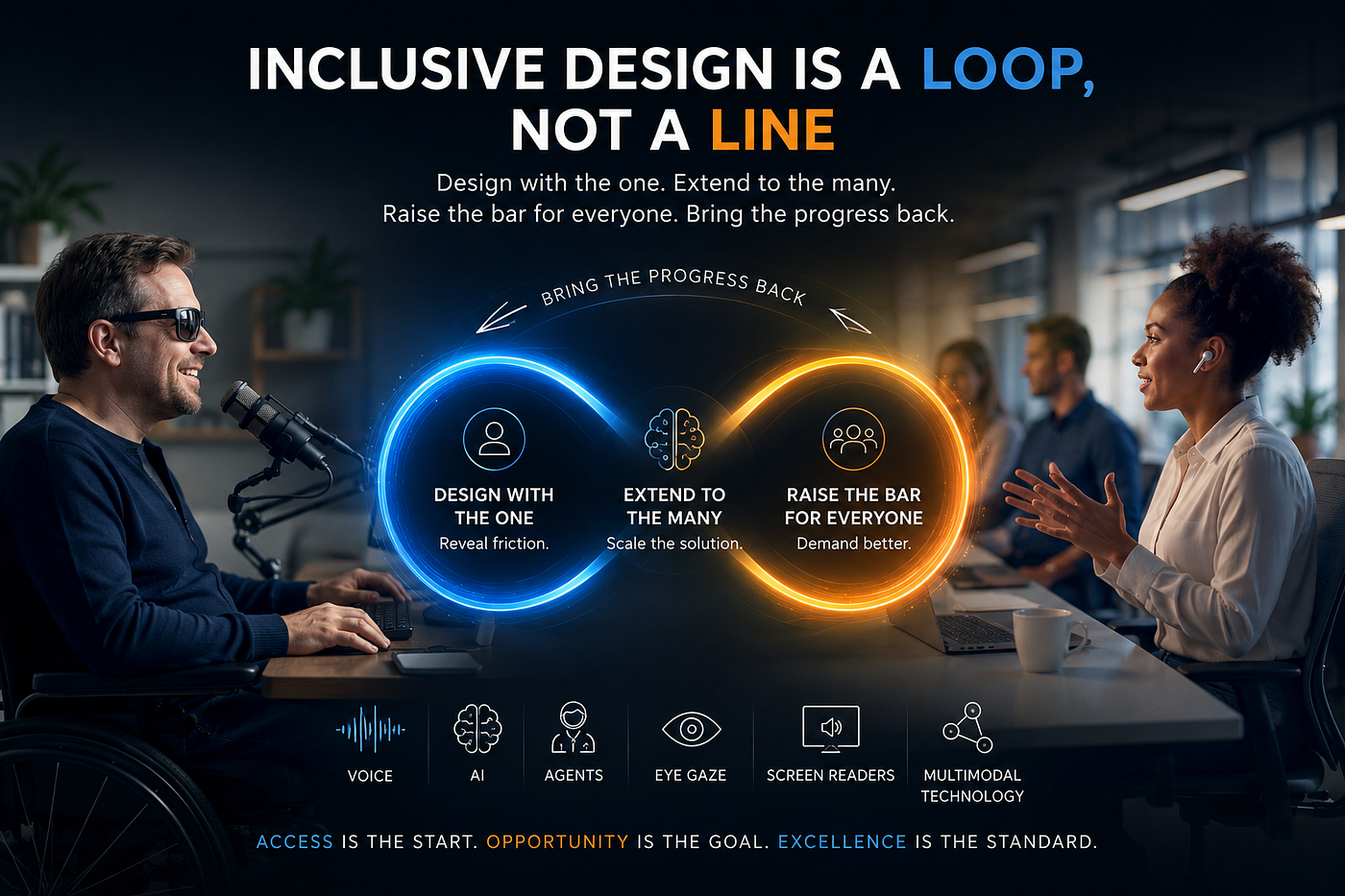
Inclusive design should not be a one-way path. Design with the one, extend to the many, raise the bar for everyone, and bring the progress back to the people who needed it first.
I used to think inclusive design moved in one direction.
Design with one person.
Extend the solution to many.
I still believe in that.
But I no longer think it is enough.
Inclusive design has a powerful principle: design for one, extend to many.
I believe in it.
Start with one person with a disability. Understand the need deeply. Solve the problem well. Then extend that solution so it benefits everyone.
But I also think there is a missing tension in how this works in the real world.
The tension inside inclusive design
People with disabilities are often used to putting up with technology that does not work well.
We are so used to being excluded that when something finally gives us access, even imperfect access, we can feel grateful just to have it.
That gratitude can unintentionally lower the bar.
Voice is a great example.
For many people with disabilities, voice input was life-changing, even when it was clunky. If typing was hard, painful, slow, or impossible, voice gave us another way in.
But early voice tools often required us to speak unnaturally, correct constantly, and adapt ourselves to the machine.
We accepted it because we needed it.
Voice changed my thinking
This hit me personally through a conversation with my friend Marcus Ash.
Marcus had worked on voice systems for years, going back to Cortana. So this was not someone unfamiliar with voice technology. But he told me that, for a long time, he still saw voice mostly through a command-and-control lens.
Open this. Click that. Start dictation. Send message.
Useful, but limited.
He also rarely used dictation because of the amount of time he had to spend correcting it. That friction shaped how he thought about voice. It was helpful in certain moments, especially for accessibility, but it did not feel like a natural way to do deeper work.
Then he saw me use voice differently.
Not for one-word or two-word commands, but for deep, critical, complex workflows.
He saw voice become a way to think out loud, shape ideas, work through ambiguity, and partner with AI.
He saw me use voice to brainstorm. To compose. To reason. To move work across documents, meetings, messages, spreadsheets, and plans.
That changed his perception.
He started to see voice not as an accommodation, and not just as command-and-control, but as a new way to think, create, and work with AI.
Voice gave him a different way to get ideas out before they were fully formed.
And when paired with AI, it became more than input.
It became a thinking partner.
That is the moment where inclusive design becomes bigger than access.
A tool that may have started as a way for someone like me to interact with a computer became a better way for someone like Marcus to explore ideas, direct work, and unlock new forms of productivity.
But once he started using it more seriously, he also noticed the friction.
The corrections.
The awkwardness.
The moments where the system still did not quite understand what he meant.
At one point, he asked me, “How did you put up with this for so long?”
My answer was simple.
“I didn’t have a choice.”
That moment confirmed something I had been feeling for a long time.
When people with disabilities depend on a tool, we often tolerate the parts that are broken because the alternative is worse.
But when that same tool extends to people who have other options, the expectations change.
They do not just want access.
They want quality.
That demand pushes the technology forward.
From commands to intent
For decades, we have been trained to interact with computers through graphical interfaces: buttons, menus, forms, tabs, commands, and screens.
That model gave us precision, but it also forced people to learn the structure of the software before they could get their work done.
Voice changes that relationship.
Others have described voice as becoming a new kind of user interface. I think that is right, but I would push it further: voice is becoming a way to express intent.
Instead of asking people to navigate the system step by step, voice lets them describe the outcome they are trying to achieve.
It shifts the interaction from “show me where the command is” to “help me accomplish this goal.”
That is a massive shift for everyone.
But for people with disabilities, it can be life-changing.
Because when the interface becomes more natural, the barrier becomes lower.
When the system can understand intent, context, and direction, the user does not have to physically manage every click, menu, field, or command.
They can focus more on the work and less on fighting the interface.
Now AI is changing voice from simple dictation into composition, reasoning, and orchestration.
You are not just saying words anymore.
You are expressing intent.
You can say:
“Summarize this meeting, send the follow-up, update the project plan, create the task list, and notify the team.”
Or:
“Help me brainstorm a product positioning document. Pull out the customer pain points, suggest three messaging angles, compare them against the competition, and turn the strongest one into a draft I can review.”
Or:
“Help me build a first-pass budget spreadsheet. Use last quarter’s spending as a baseline, identify the biggest changes, flag the risks, and create a version I can share with my leadership team.”
That is not typing replacement.
That is workflow orchestration across documents, spreadsheets, meetings, calendars, messages, and collaboration tools.
I am not saying we take out precision commanding, but now we can compliment it with intent.
Multimodal access is professional power
When you add multimodal access, it becomes even more powerful.
Voice lets you think out loud.
Eye gaze lets me direct attention and show where I want my voice input or command to focus.
A screen reader or AI assistant can talk back to you and explain what is happening.
Visual interfaces still matter because they help us review, compare, refine, and approve what AI creates.
Touch, keyboard, gesture, haptics, and visual feedback can all become different ways into the same experience.
The future is not voice replacing the screen.
It is voice becoming one of the primary ways we express intent, with AI, visuals, eye gaze, screen readers, and other modalities helping complete the loop.
That does not just help people with disabilities interact with a device.
It helps people compete.
It helps someone become a stronger finance professional. A better business leader. A sharper programmer. A more effective insurance representative. A more creative product maker. A more confident student. A more independent worker.
Whatever your profession is, multimodal technology can give you more ways to participate, contribute, and perform at your best.
Disabled people are not a separate user group
There is another mistake I see too often.
People talk about people with disabilities as if we are a separate user group.
I have seen projects where the user groups were listed like this:
People with disabilities. Information workers. Developers. Business users.
But that framing misses the point.
A person with a disability can also be an information worker.
A developer.
A designer.
A finance professional.
A student.
A leader.
A creator.
A customer.
A parent.
A colleague.
Disability is not a separate lane beside all the other user groups.
It intersects with every one of them.
That matters because if we only design for disability as a separate category, we risk solving for basic access and stopping there.
But if we recognize that disabled people are also professionals, creators, builders, and decision-makers, then we design for capability, productivity, ambition, and excellence.
We stop asking, “Can this person use the tool?”
And we start asking, “Can this person use the tool to do great work?”
That is the bigger promise.
Accessibility is not just about helping someone use a computer.
It is about helping someone build a life.
It is about giving people the tools to pursue employment, grow their careers, create value, and go after the future technology was supposed to make possible.
Inclusive design should be a loop
This is where accessibility and innovation stop looking like separate conversations.
They are different lines in the same thread.
Accessibility reveals the friction first.
Innovation scales the solution.
And when we do it right, the progress comes back to the people who needed it from the beginning.
But this cannot be a one-way path.
It should be a loop.
The one helps us see the friction.
The many help raise the bar.
The improved technology must return to the people who needed it first, better than before.
And then we keep learning from them to shape what comes next.
That is the power of making inclusive design bi-directional.
We do not design with disabled people, extend to everyone else, and move on.
We design with disabled people, extend to many, learn from broader use, raise the quality, and bring that progress back into the lived experience of disability.
Then the cycle begins again.
The real promise of technology
Technology has been a vehicle for me.
It has helped me communicate.
It has helped me work.
It has helped me build a career, create relationships, travel, lead teams, and experience a life that many people once assumed would not be possible for someone like me.
That is why I care so deeply about this.
I do not just want technology to give people with disabilities access to a device.
I want it to give people opportunity.
The opportunity to communicate. The opportunity to contribute. The opportunity to work. The opportunity to create. The opportunity to experience more of life.
And now, with agentic AI, voice, multimodal interaction, and tools that can understand intent, that opportunity can scale in ways we have never seen before.
To me, that is true inclusion.
Not just making things accessible.
Going beyond accessibility and helping people become more active, more productive, more independent, and more economically powerful.
Because the goal was never just to help people use technology.
The goal was to help people use technology to build the life they deserve.
Design with the one. Extend to the many. Raise the bar for everyone. Then bring the progress back to the people who needed it first.
That is how accessibility becomes innovation.
메타데이터
- post_id
- c3c4523540d1
- slug
- inclusive-design-should-be-a-loop-not-a-line-c3c4523540d1
- url
- https://medium.com/@ddame/inclusive-design-should-be-a-loop-not-a-line-c3c4523540d1
- canonical_url
- https://medium.com/@ddame/inclusive-design-should-be-a-loop-not-a-line-c3c4523540d1
- author_url
- https://medium.com/@ddame
- status
- ok
- fetched_at
- 2026-07-06 19:19:11




