The Real Win With AI in Design Isn’t Speed. It’s Parallelism.
Most teams adopting AI in design are measuring the wrong thing. They track minutes saved per task and feel underwhelmed. The number that…
The Real Win With AI in Design Isn’t Speed. It’s Parallelism.

Most teams adopting AI in design are measuring the wrong thing. They track minutes saved per task and feel underwhelmed. The number that actually changes how a design team operates is harder to see on a stopwatch: how much work can run at the same time.
Here’s the distinction, and why it matters for anyone trying to bring AI into a creative workflow.
Speed vs. parallelism
Speed asks: how much faster is one task? Parallelism asks: how many things can happen without my full attention?
A practical example. Picture a day with two demands: several hours of detailed product-photo editing (the kind AI can’t do well yet) and a batch of recurring pieces — social posts, emails, blog headers.
In a manual workflow, those compete for the same person. It’s either the photos or the pieces. With production automated, the batch runs in the background while the human does the work only a human can do. Both ship the same day.
The lesson: AI’s biggest leverage in design isn’t replacing the designer on a task — it’s freeing the designer to run a second front of work in parallel. If you’re evaluating AI for a creative team, measure capacity, not just speed.
What it actually takes to make this work
The interesting part is that the gains don’t come from a clever prompt. They come from structure. Four things that consistently separate “AI demo” from “AI in production”:
- A single source of truth per brand. A structured spec the model reads before every job — identity, tone of voice with positive and negative examples, color rules, typography, image criteria, approved templates. Without it, the model invents the brand. With it, the output is predictable.
- Abstraction over brittle details. Custom fonts break, file paths change, tools update. Wherever possible, have the AI work against a stable abstraction (a named style, not a raw font) and let the deterministic tool resolve the rest. Fewer moving parts, fewer broken deliverables.
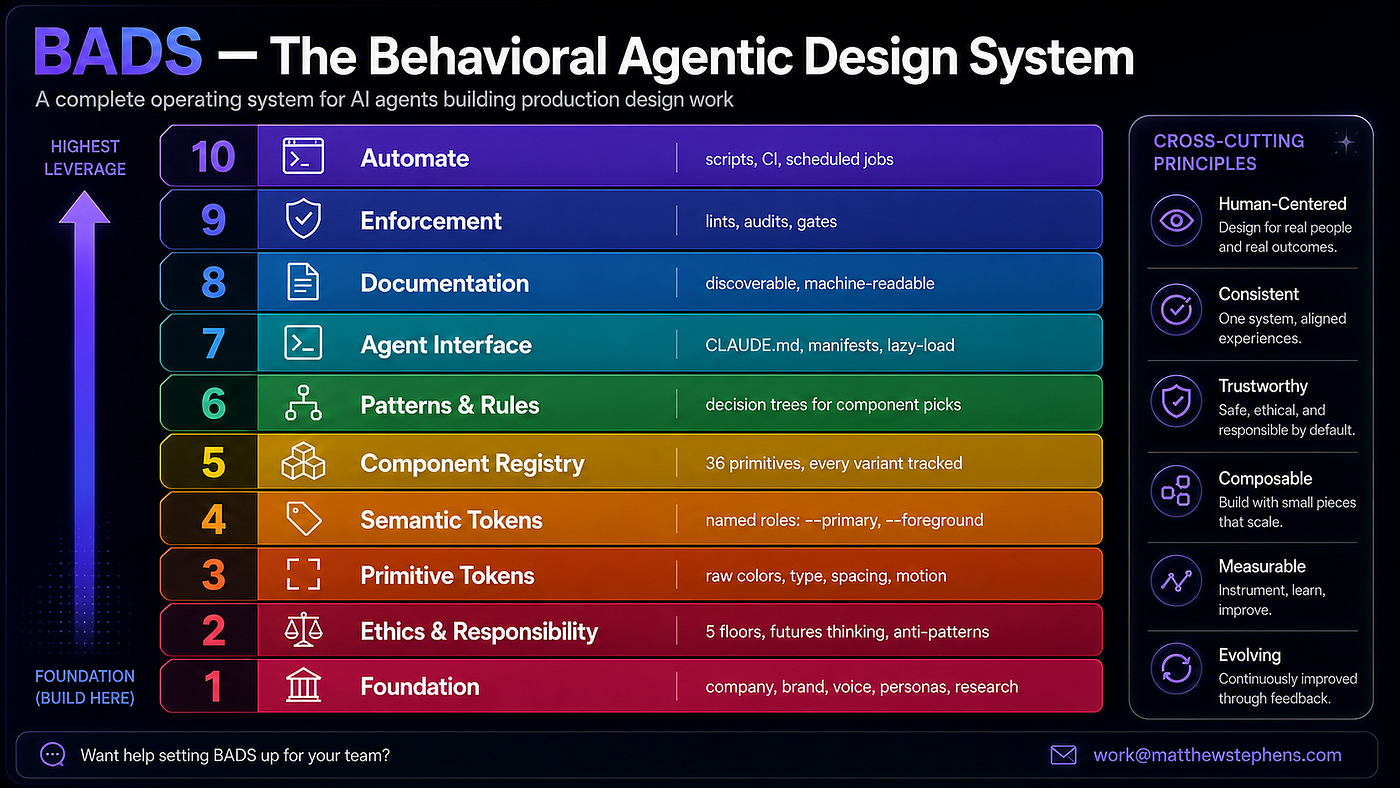
- Layered architecture for cost and accuracy. Lightweight, on-demand rule files per format beat one giant prompt. Named workflows handle the repetitive day-to-day. Isolated sub-agents are reserved for the few cases with real payoff — parallel variations, independent quality checks, batch reprocessing.
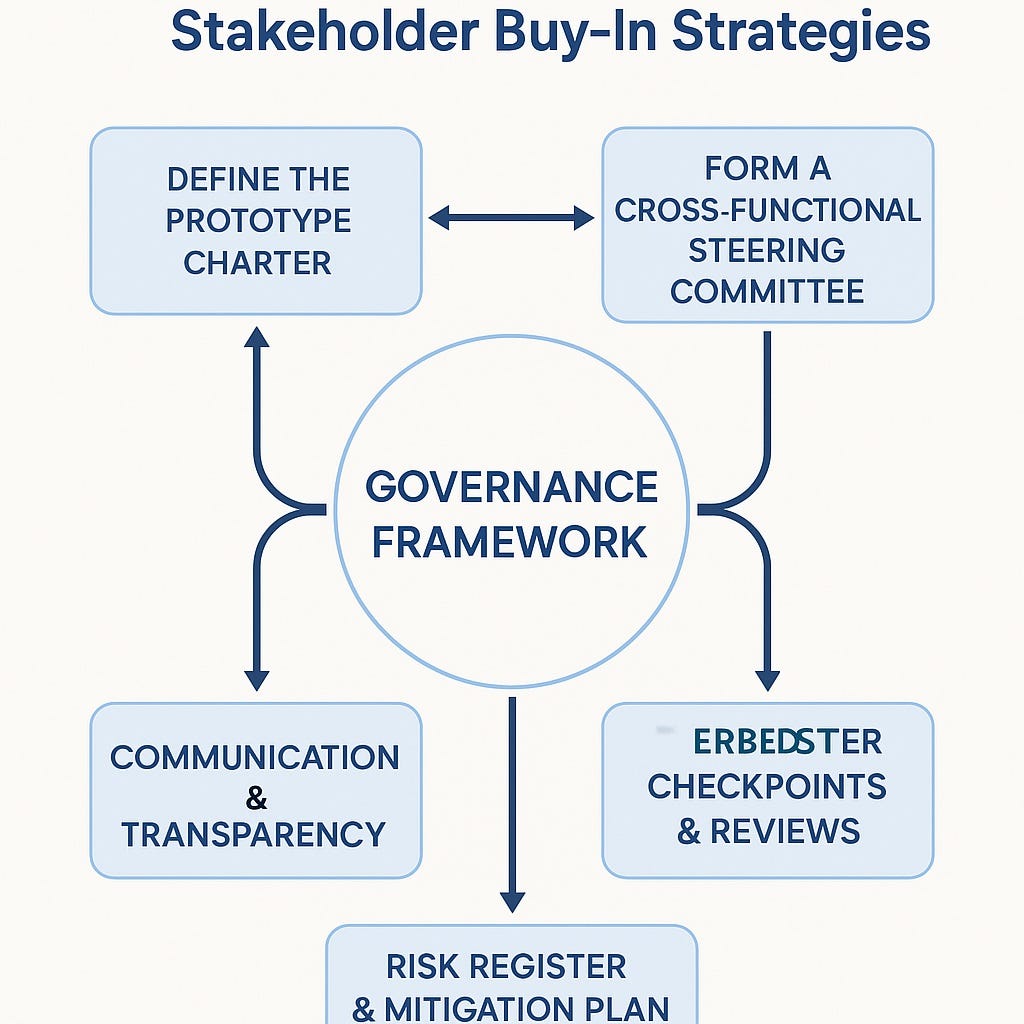
- Governance in three tiers. Global non-negotiables, per-client overrides, documented exceptions. This is what lets a single system stay consistent across very different brands instead of collapsing into one-off hacks.
Be honest about the ceiling
The fastest way to lose a team’s trust in AI is to oversell it. So it’s worth being explicit about what still doesn’t work:
- Fine visual craft — photo retouching, detailed compositing — stays human.
- Some tools have no clean API, so parts of the pipeline remain manual.
- Final review and approval should stay human — by design, not by limitation.
- Net-new concept and layout is human work. Automation produces variations from approved templates; it doesn’t invent the idea.
And a measurement caveat worth repeating in any internal report: time-saved-per-task is usually a conservative, noisy metric. Throughput and parallelism tell the truer story.
The quieter benefit nobody puts in the deck
Everyone pitches speed. The benefit that actually compounds is consistency. Keeping brand identity uniform across many clients is one of the hardest problems in a busy studio — a piece made in a Friday rush rarely matches one made calmly on Tuesday.
A well-governed system follows the same rule every time. It doesn’t get tired, doesn’t forget the spacing, doesn’t improvise on an approved layout. Quality stops depending on the designer’s energy level that day.
The takeaway for designers
If the AI conversation makes you anxious, the move isn’t to out-produce the machine. It’s to become the architect of it: map your most repetitive work, encode the rules that make it safe, automate that — and keep your hands on the parts that are actually design.
The teams that win with AI won’t be the ones who replaced designers. They’ll be the ones whose designers learned to design the systems.
I’m building in this space every week and still figuring it out as I go. If you’re automating part of a creative workflow — or pushing back on the idea — I’d genuinely like to hear how you’re approaching it.
메타데이터
- post_id
- c3d060bd6085
- slug
- the-real-win-with-ai-in-design-isnt-speed-it-s-parallelism-c3d060bd6085
- url
- https://medium.com/@grupoppuniara/the-real-win-with-ai-in-design-isnt-speed-it-s-parallelism-c3d060bd6085
- canonical_url
- https://medium.com/@grupoppuniara/the-real-win-with-ai-in-design-isnt-speed-it-s-parallelism-c3d060bd6085
- author_url
- https://medium.com/@grupoppuniara
- status
- ok
- fetched_at
- 2026-06-09 15:37:30