Asteroids, Volcanoes and Trees, Oh My!
Leading Causes of the Late Devonian Mass Extinction
Asteroids, Volcanoes and Trees, Oh My!
Leading Causes of the Late Devonian Mass Extinction
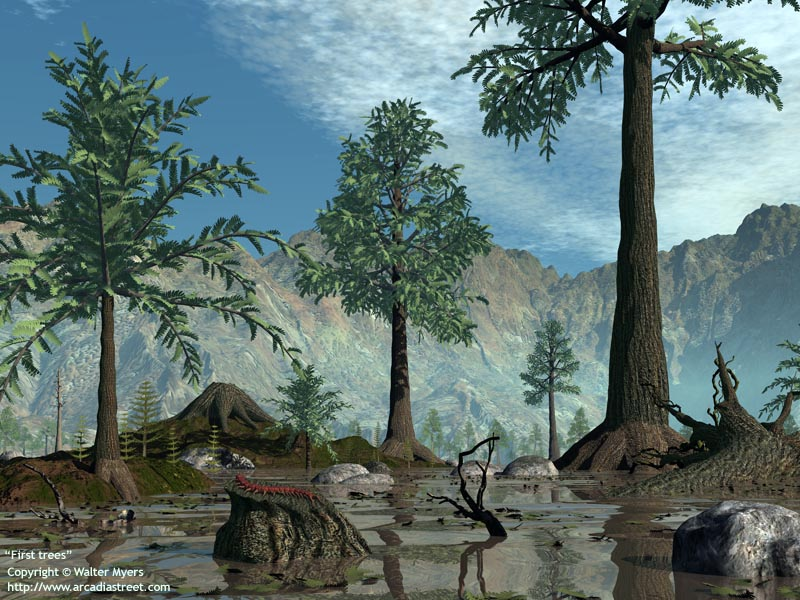
Image Credit: Walter Myers
Okay, maybe trees evoke a smaller sense of evolutionary calamity than asteroids and volcanoes, but they played possibly a greater role in killing off 75% of life on Earth some 375 million years ago…
The Age of Fish
The Devonian period is characterised by the prevalence of aquatic life, often being dubbed “the Age of Fish”. Devonian oceans consisted of an abundance of different species of fish, sharks, ammonites, brachiopods and vast coral systems. This period also saw the rise of the first jawed fish- the giant placoderms- which, with their bony armour making them almost invincible, quickly rose to the top of the aquatic food chain. Placoderms, or plate-skinned fish, were unique in that they possessed hard, bony plates rather than conventional teeth.
A formidable example of this plated predator goes by a suitably formidable name: Dunkleosteus. Although its size was initially overestimated at up to ten metres, it is still believed to have ruled the open sea at an impressive five metres. Its ferocity comes not from its chunkiness or length, but from its powerful bite force of 11,000 psi- comparable to that of a T.rex! With the ability to eat sharks and smaller placoderms, it’s no wonder this mighty sea monster was the apex predator of the Devonian period.

An artist’s impression of the armoured Devonian fish, “Dunkleosteus.” | MR1805 / iStock / Getty Images Plus
What are mass extinctions?
Since the earliest recorded extinction event (the Ordovician-Silurian) 444 million years ago, they have occurred at frequent rates. Indeed, revered palaeontologist D.M. Raup defined a “natural” extinction rate of 0.25 species per million years. The balance of extinction with speciation (the emergence of new species) allows for a healthy evolution of life on Earth. It is when levels of extinction are significantly higher than this natural background rate that a mass extinction can be defined.
To qualify, at least 75% of all species must go extinct in a relatively short timescale (in geological standards)- typically on the order of millions of years. The Late Devonian (LD) extinction event is the second-oldest, having occurred between 383 and 359 million years ago, leading to grand-scale changes in the Earth’s marine and terrestrial life.

Image credit: Earthhow.com. Image Description: A timeline of the “Big Five” Mass Extinctions in Earth’s history.
A Series of Unfortunate Events…
Out of the “Big Five” mass extinctions known to date (listed above), the LD is generally believed to be the least devastating, partially due to its graduality. With 75% of species wiped out, it just meets the qualifying threshold.
Unlike the other four events, it is believed to have occurred in several “pulses” across approximately 24 million years. As a result, the definitive cause for this mass extinction is subject to debate. The most significant pulse is known as the “Kellwasser” event- named after the locality in which the sedimentary records (black shale layers) were found, and occurred about 372 million years ago.
There are a plethora of events- geological, biological and astronomical- which are commonly believed to be the main drivers of the pulses and therefore the overall crisis. These include the effects of evolutionary advancements in land plants, volcanic activity which enriched atmospheric and terrestrial environments, and the impact of asteroids.

Black shale fossil of the lung fish Dipterus, which lived and died during the Devonian period. Black shales are formed in anoxic (oxygen-poor) conditions and are therefore evidence of oceanic anoxia. Image courtesy Nigel Trewin.
Treacherous Trees
The LD epoch saw a remarkable diversification in land plant species, such as the Archaeopteris Tree (an indirect ancestor of today’s trees). Renowned for its substantial vascular system and strong arborescence (branching ability), the roots of Archaeopteris and many other plants in this epoch were larger and stronger than previous species. This had two ramifications: wider geographical placement and more successful weathering of rocks.
With expansive roots, land plants eliminated their need to remain close to the moist ground or near a water source; they took advantage of this and spread widely across the planet. Having made use of the stem-strengthening compound lignin, they were also growing larger and stronger- their maximum height increased from ~30cm to up to 30m! Thus, the Devonian period saw the rise of the first multi-storied forests, which facilitated a grand-scale transformation in Earth’s climate.

A depiction of Earth’s earliest forests. Image credit: Richard Jones/Science Source
An increase in tree size and population resulted in an increase in CO2 being absorbed from the atmosphere via photosynthesis. This revolutionary change in climate ultimately led to global cooling and the expansion of the polar ice caps. It also had a more interesting effect on the Devonian rocks and subsequently the oceans: weathering!
Suffocating Oceans: Weathering and Eutrophication
Having grown stronger, more penetrative roots, plants perpetuated a higher rate of weathering- both physical and chemical. Physical weathering is the process of rocks being broken down, such as by roots growing into cracks and widening them as they grow.
Roots also draw out minerals in rocks, breaking them down further via chemical weathering. These minerals eventually flow into the Devonian oceans with the rain. As a result, the significant increase in land plant population led to nutrient-rich water- conditions ripe for the rapid growth of algal blooms.

Tree Roots causing the breakdown of rocks via physical weathering. Image Credit: Bio Explorer
The decomposition of primary producers such as algae requires oxygen-consuming bacteria. These bacteria eventually starve the oceans of oxygen- leaving sinister-sounding “dead zones” in their wake: regions of no marine life. The anoxic (oxygen-poor) conditions of the oceans resulting from these processes were fatal to marine life. Hence, the role of land plants in the LD mass extinction is undeniably significant.
Volcanism Like You Never Imagined…
Among the most extreme displays of volcanic activity are what are known as large igneous provinces, or LIPs. These are enormous regions of igneous rock formed from magma; they cover an area of at least 100,000km² and form over one to five million years. They form when part of the Earth’s mantle is hotter than the surrounding regions- causing it to rise and undergo decompression melting. This generates large amounts of magma, which accumulates beneath the crust, making it highly susceptible to mass volcanic activity.
LIP eruptions can lead to flood basalts such as the famous Deccan Traps in west-central India, the formation of which coincides with the extinction of the non-avian dinosaurs.

Deccan Traps in west-central India- flood basalts. Image Credit: Shrikant Daji Limaye
As destructive as volcanic eruptions may seem, they play a vital role in the rejuvenation of the land.
There were three significant LIP eruptions during the LD period: the Kola LIP in modern-day Siberia, the Pripyat-Dneiper-Donets (PDD) LIP in Eastern Europe, and the Viluy Traps also in Siberia. The latter is commonly thought to have had the most significant contribution to the mass extinction, erupting in two pulses (375 and 363 million years ago). Large volcanic eruptions such as this release hundreds of thousands of square kilometres of lava into the surrounding area.
With such eruptions come greenhouse gas emissions and vast amounts of sulfur dioxide released into the atmosphere. This results in acid rain, which is harmful to marine life and causes further weathering of rocks and soils.
As destructive as volcanic eruptions may seem, they play a vital role in the rejuvenation of the land on which they sit- renewing terrestrial nutrients. This is another source of excess nutrients, which inevitably make their way into the oceans and cause dead zones via the eutrophication process described earlier. Thus, the oceanic anoxia cycle is further perpetuated.
Out of this World
The scenic Lake Siljan in Sweden forms a significant part of the famous 380-million-year-old Siljan Ring. 50 kilometres in diameter, this gargantuan asteroid impact crater is the largest in Europe and one of the top 20 largest craters in the world.

Image Credit: NASA
Its correlation with the LD epoch, as well as a sudden increase in iridium in this area (an element which is rare on Earth but is common in extraterrestrial objects), are so far the only solid evidence of asteroid impacts contributing to the LD mass extinction. Considering the episodic nature of the event, it seems plausible that a massive impact crater is the mark of a contributing factor, rather than the singular cause.
Team Work
When it comes to the question of what exactly wiped out 75% of life on Earth in the LD period, there is no one correct answer. Over 24-million-years, a succession of ill-fated events all contributed to the changing of the climate. The known facts are that most marine organisms became extinct due to anoxia of oceans and the creation of dead zones resulting from eutrophication.
There are many contributions to this process: the weathering of rocks from biologically advanced land plants, and the weathering and nutritious rejuvenation of soils due to the acid rain caused by LIP eruptions. The asteroid impact in Sweden is observed to have occurred in the same timeframe, suggesting a link to the mass extinction.
Whilst the evolution of land plants was inevitably catastrophic for aquatic species such as brachiopods and placoderms, it was undeniably fortuitous for future terrestrial life. The development of forests across the globe paved the way for true land-dwelling species in the next period of Earth’s history: the Carboniferous.
Step into the Devonian forests and experience what the Earth was like 375 million years ago with this immersive YouTube video from the Colorado Interactive Geology Project:
[embed]
메타데이터
- post_id
- c3daf6c4036b
- slug
- asteroids-volcanoes-and-trees-oh-my-c3daf6c4036b
- url
- https://medium.com/@caitlyndwyer/asteroids-volcanoes-and-trees-oh-my-c3daf6c4036b
- canonical_url
- https://medium.com/@caitlyndwyer/asteroids-volcanoes-and-trees-oh-my-c3daf6c4036b
- author_url
- https://medium.com/@caitlyndwyer
- status
- ok
- fetched_at
- 2026-08-22 21:19:36