Platform Engineering vs DevOps: Why Modern Tech Companies Are Building Internal Developer Platforms…
The shift from “you build it, you run it” to “we build the platform, you ship on it.”

Platform Engineering vs DevOps: Why Modern Tech Companies Are Building Internal Developer Platforms (IDPs)
The shift from “you build it, you run it” to “we build the platform, you ship on it.”
The Moment Everything Changed
Imagine it’s 2 AM and a critical production service suddenly goes down.
Three teams join an emergency war-room call. One believes the problem lies in the CI/CD pipeline. Another suspects a Kubernetes configuration issue. A third team thinks networking or infrastructure might be the cause.
Hours pass while engineers investigate different layers of the system.
Eventually the root cause is identified.
But a deeper issue becomes clear: no single team owns the platform experience.
If you have worked in a modern engineering organization, this situation probably sounds familiar.
This isn’t a failure of DevOps.
It’s a scaling problem.
As systems grow more complex, asking every development team to manage infrastructure, deployment pipelines, observability, and security becomes unsustainable.
This is where Platform Engineering enters the picture.
Instead of every team managing infrastructure complexity independently, organizations create platform teams that build Internal Developer Platforms (IDPs) for everyone to use.
DevOps: The Promise and the Reality
Over the last decade, DevOps fundamentally changed how software systems are built and operated.
It broke down traditional silos between development and operations teams and introduced automation practices such as:
- Continuous Integration and Continuous Deployment (CI/CD)
- Infrastructure as Code (IaC)
- Automated testing and deployment
- Shared responsibility for reliability
The philosophy behind DevOps was simple:
You build it, you run it.
For smaller organizations and early-stage teams, this model worked extremely well.
But as companies scaled to hundreds of engineers and thousands of services, new challenges began to appear.
Tool Sprawl
Every team began choosing its own tools and workflows.
One team used Terraform, another preferred Pulumi. Some teams used GitHub pipelines, while others relied on GitLab CI.
Over time, organizations ended up with dozens of different deployment processes.
Cognitive Overload
Developers were suddenly expected to understand far more than application development.
They needed knowledge of:
- Kubernetes
- Observability systems
- Security policies
- Infrastructure provisioning
- Networking
- Cloud cost optimization
This created significant cognitive load, which ultimately slowed development velocity.
Inconsistent Reliability
When every team builds its own path to production, reliability becomes inconsistent.
Some deployments become highly automated and stable. Others remain fragile and difficult to debug.
DevOps didn’t fail — it simply reached its scaling limits.
Organizations needed a way to retain DevOps practices while simplifying the developer experience.
What Is Platform Engineering?
Platform Engineering focuses on building and maintaining Internal Developer Platforms (IDPs).
An Internal Developer Platform is a self-service system that allows developers to build, deploy, and operate applications without becoming infrastructure experts.
Platform engineering sits at the intersection of:
- Developer productivity
- Site Reliability Engineering (SRE)
- Cloud-native infrastructure
- Automation
Instead of every team managing infrastructure independently, a platform team builds standardized workflows that developers can easily use.
Think of it as the difference between raw tools and a complete product.
DevOps vs Platform Engineering
DevOps
- Provides tools and practices
- Teams assemble their own workflows
- Requires deeper infrastructure expertise
- Multiple ways to deploy applications
- Teams manage pipelines and infrastructure themselves
Platform Engineering
- Provides a complete internal developer platform
- Teams follow standardized workflows
- Infrastructure complexity is abstracted away
- A consistent golden path for deployments
- Platform teams manage infrastructure and tooling
Platform teams treat the platform as a product, where developers are the customers.
What Does an Internal Developer Platform Look Like?
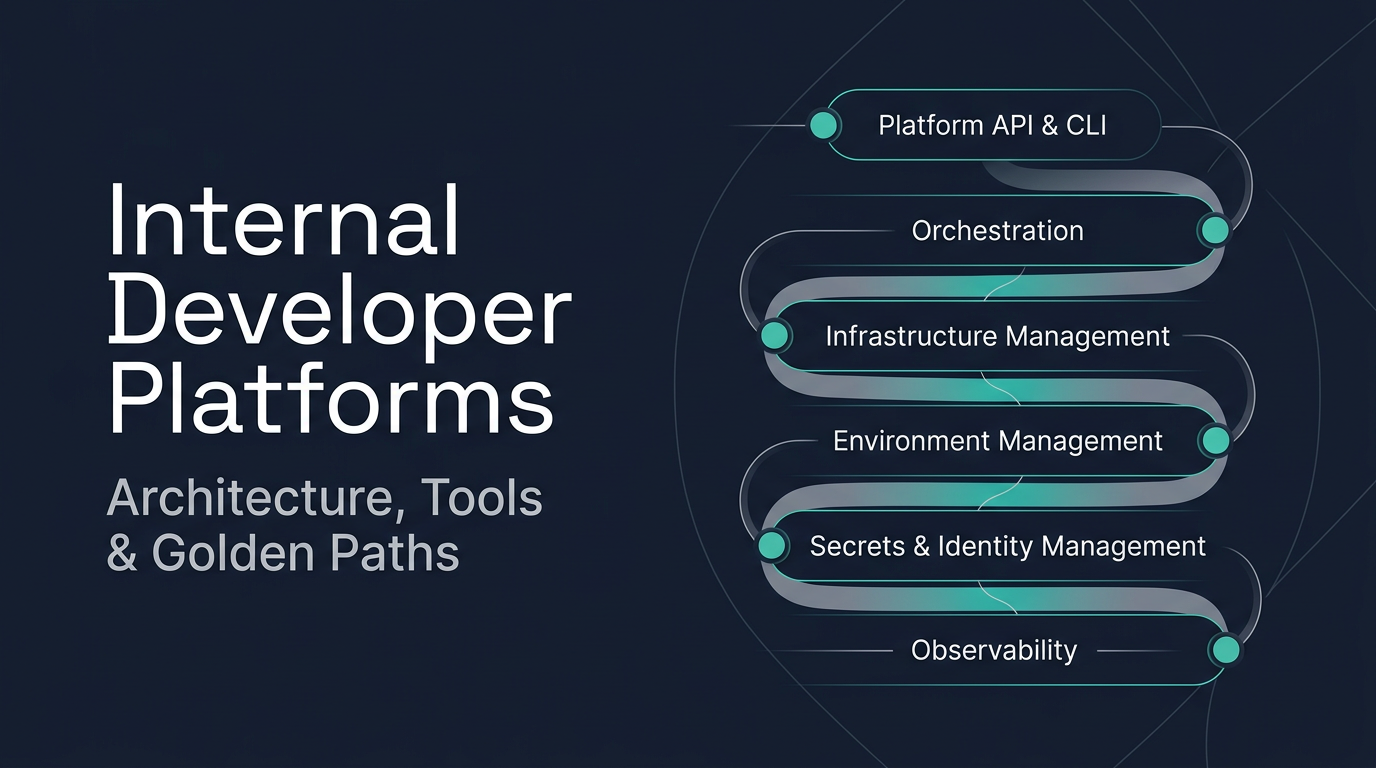
A modern Internal Developer Platform (IDP) integrates multiple infrastructure and automation systems into a unified developer workflow.
A typical architecture may include:
- Container orchestration using Kubernetes
- Infrastructure provisioning with Terraform
- CI/CD automation using GitHub Actions
- Developer portals powered by Backstage
Typical workflow
Developer
     ↓
Developer Portal
     ↓
CI/CD Pipeline
     ↓
Kubernetes Cluster
     ↓
Observability Platform
Developers interact with simple interfaces and automated workflows, while the platform team manages the underlying infrastructure complexity.
Why Organizations Are Moving to Platform Teams
Developer Experience Is Now a Competitive Advantage
Developers often spend significant time navigating deployment pipelines, permissions, and environment inconsistencies.
Platform teams improve Developer Experience (DX) by making deployments simple, repeatable, and self-service.
Better developer experience leads directly to faster innovation and delivery speed.
Consistency Improves Reliability and Security
When every team builds infrastructure differently, systems become harder to secure and maintain.
A unified platform ensures:
- Standardized deployments
- Consistent security policies
- Easier incident response
- Improved observability
Scaling Engineering Organizations
Hiring thousands of engineers who all understand complex infrastructure systems is unrealistic.
Instead, organizations build platform teams that manage infrastructure complexity, allowing product teams to focus on building applications.
Cost Efficiency
Platform teams help reduce:
- Tool duplication
- Infrastructure waste
- Operational overhead
Centralized platforms also improve cloud cost visibility and resource optimization.
Real-World Examples of Platform Engineering
Several leading technology companies have adopted platform engineering principles to improve developer productivity and operational scalability.
Spotify created the open-source developer portal Backstage, which allows engineers to manage services, documentation, and infrastructure through a unified platform.
Netflix built a collection of internal infrastructure platforms and automation tools that manage deployment pipelines, cloud infrastructure, and service reliability at massive scale.
Uber developed internal developer platforms that standardize infrastructure management, deployment workflows, and developer tooling across engineering teams.
These platforms enable engineers to focus on building products rather than managing infrastructure complexity.
What Does a Platform Team Actually Do?
Platform teams focus on building systems that empower developers.
Building the Internal Developer Platform
Providing self-service provisioning for environments, databases, secrets, and deployment pipelines.
Defining the Golden Path
A golden path is the recommended and fully supported way to deploy and operate applications.
Developers follow this standardized workflow instead of designing infrastructure from scratch.
Abstracting Infrastructure Complexity
Platform teams manage complex technologies such as Kubernetes clusters, networking systems, and compliance frameworks while exposing simplified workflows for developers.
Treating the Platform as a Product
Platform teams continuously collect developer feedback and improve the platform experience.
Success metrics often include:
- Time to first deployment
- Deployment frequency
- Incident recovery time
- Developer satisfaction
Common Platform Engineering Mistakes
Even platform engineering initiatives can fail if implemented incorrectly.
Common mistakes include:
- Building overly complex platforms before developers need them
- Ignoring developer feedback
- Creating rigid workflows instead of flexible systems
- Treating the platform purely as infrastructure rather than as a product
Successful platform teams start small and focus on solving real developer problems.
DevOps vs Platform Engineering: A Simple Way to Think About It
DevOps and Platform Engineering are not competing approaches.
They complement each other.
DevOps defines how teams should work. Platform Engineering provides the systems that make those practices scalable.
In simple terms:
- DevOps defines the culture and practices of collaboration and automation
- Platform Engineering provides the systems that implement those practices at scale
The Bottom Line
Modern engineering organizations are not abandoning DevOps.
They are evolving it.
Instead of asking every team to manage infrastructure complexity independently, companies are building Internal Developer Platforms that standardize workflows and reduce operational friction.
The result is:
- Faster development cycles
- More reliable systems
- Better developer experience
The future of software engineering is not just automation — it is platform-driven development.
Organizations that invest in strong internal developer platforms enable developers to spend less time managing infrastructure and more time building impactful products.
About the Author
Sri Valli Sista is a VP Engineering leader focused on cloud architecture, platform engineering, and scalable systems. She writes about modern software architecture, developer productivity, and engineering leadership.
Discussion
How is your organization approaching Platform Engineering or Internal Developer Platforms today?
Are platform teams replacing DevOps — or evolving it?
메타데이터
- post_id
- c3dc603f3a3a
- slug
- platform-engineering-vs-devops-why-modern-tech-companies-are-building-internal-developer-platforms-c3dc603f3a3a
- url
- https://medium.com/infradecodedops/platform-engineering-vs-devops-why-modern-tech-companies-are-building-internal-developer-platforms-c3dc603f3a3a
- canonical_url
- https://medium.com/infradecodedops/platform-engineering-vs-devops-why-modern-tech-companies-are-building-internal-developer-platforms-c3dc603f3a3a
- author_url
- https://medium.com/@srivallisista
- status
- ok
- fetched_at
- 2026-06-13 00:08:42