How I Spent a Year Chasing Views — Until I Learned That RPM Was the Number That Actually Mattered
There was a time when I thought YouTube success could be boiled down to one number: views.
How I Spent a Year Chasing Views — Until I Learned That RPM Was the Number That Actually Mattered
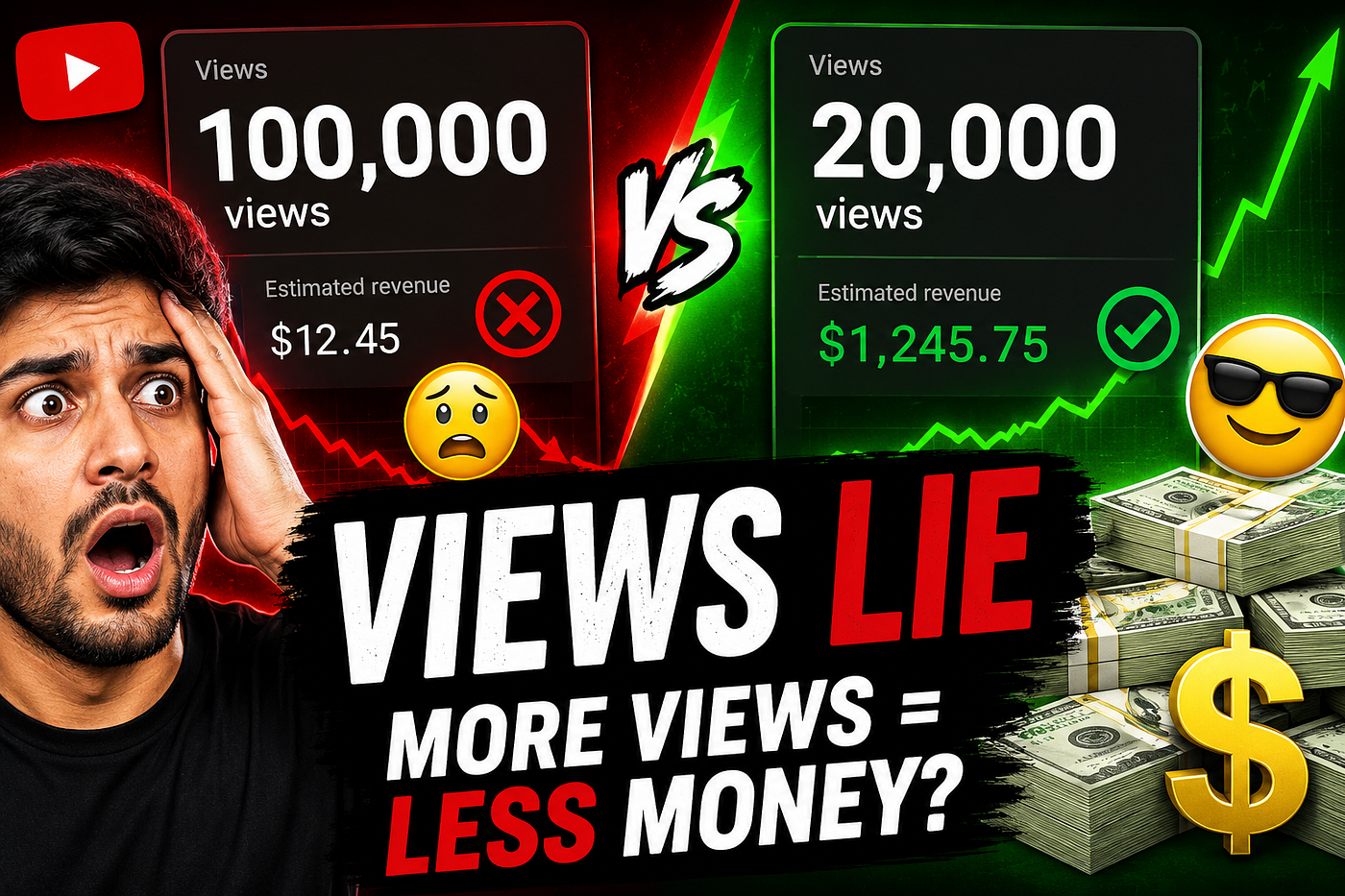
There was a time when I thought YouTube success could be boiled down to one number: views.
Every morning, before I’d even properly woken up, I’d open YouTube Studio. If a video had crossed another thousand views overnight, I felt great. If it hadn’t, I’d spend half the day wondering what I’d done wrong. Looking back, I wasn’t really building anything — I was just refreshing a scoreboard and hoping the numbers went up.
It took me almost a year to figure out that views don’t pay the bills. The number that actually matters — quietly, in the background — is RPM. Once I understood that, it changed how I made content entirely.
If you’re a small creator, especially one making tutorials, coding lessons, finance breakdowns, or tech content, this might save you the months of frustration it cost me.
The Day I Thought I’d Finally Made It
A friend called me one evening, practically shouting: my video had almost hit 100,000 views. I couldn’t stop smiling. For someone who’d started out filming on a budget mic with free editing software, that felt like proof I was doing something right. I pictured the payout — surely a number that big had to mean real money.
Then I checked my earnings, and the excitement drained out of me almost instantly. The amount was so much smaller than I’d imagined that I refreshed the page three or four times, convinced there had been a mistake. There hadn’t been. That was the day I learned that not all views are worth the same.
What RPM Actually Is
Most beginners mix up RPM and CPM. I did too, for longer than I’d like to admit.
CPM is what advertisers pay per thousand ad impressions — it’s their side of the equation. RPM (Revenue Per Mille) is yours: it’s what you actually take home per 1,000 views, after YouTube’s cut, combining every source of revenue — ads, memberships, Super Thanks, Premium watch time, all of it.
Picture two restaurants. One is packed every single day but earns very little per meal. The other has a fraction of the customers but makes far more on each order. More often than not, the quieter restaurant is the one actually making money. That’s RPM in a nutshell.
The Creator Who Changed How I Thought About All This
Around that time I came across a creator with fewer subscribers than I had. His videos rarely broke 20,000 views — mine sometimes hit 100,000. I assumed, without really thinking about it, that he was earning less than me.
He wasn’t. Not even close. His RPM was nearly five times mine.
When I looked closer, the reason was obvious. He made tutorials on cloud computing, productivity software, and business tools. I was uploading whatever tech news or gaming clip happened to be trending that week. My views were bigger. His audience was simply worth more to advertisers.
Why Educational Channels Tend to Earn More
Advertisers spend where people are likely to buy something. Someone watching a coding tutorial might go on to buy a course, a hosting plan, or new hardware. Someone watching a viral clip, probably not — at least not right away. Advertisers know this, which is part of why tech, finance, business, and education channels tend to out-earn entertainment channels on a per-view basis.
That doesn’t mean entertainment creators can’t do well. It just means they usually need a lot more views to land in the same place.
The Mistake I Kept Repeating
For months I chased whatever was trending. New gadget everyone was talking about — I made a video. Popular game — gameplay upload. Viral challenge — I jumped in. The views came fast, and then they vanished just as fast. None of it built anything lasting.
Then one day I uploaded a plain tutorial on a programming concept. No flashy editing, no trending audio, just useful information laid out clearly. Months later, people were still finding it, still watching it, and it was still earning. That video taught me something no trend ever had: evergreen content wins.
Why RPM Differs Between Pakistan and Places Like the US
A lot of creators ask why their RPM seems lower than what creators in the US or Canada report. It’s not always about content quality — it’s largely about where your audience lives. A software company in the US might spend far more per customer acquired, because each customer is worth hundreds or thousands of dollars to them. In Pakistan, advertising budgets are generally smaller, and that shows up directly in RPM.
That doesn’t mean a Pakistani creator can’t build something profitable — it means reaching an international audience matters more here than it might elsewhere. A lot of successful South Asian creators make content in English specifically because it opens the door to viewers in the US, UK, Canada, Australia, and parts of Europe, where ad rates run higher. It’s not about ditching your local audience — it’s about widening the funnel.
The Small Shift That Roughly Doubled My RPM
I stopped asking “will this go viral?” and started asking “would someone search for this six months from now?” That single shift changed my whole approach. Tutorials instead of reactions. Guides instead of gossip. Solutions instead of trends.
My RPM crept up steadily, and the videos kept pulling in views long after I’d published them. For the first time, I felt like I was building a library, not chasing a spike.
A Story About Two Friends
I know two creators — I’ll call them Ali and Sarah — who started around the same time. Ali posted funny clips daily and blew up fast: millions of views, thousands of subscribers in no time. Sarah posted one detailed tutorial a week, and her growth looked painfully slow by comparison.
A year in, Ali had far more views. Sarah had a much higher RPM, and brands had started reaching out to her directly because they trusted her audience. A few years later, Sarah’s channel had become a sustainable business, while Ali was still on the treadmill, constantly hunting for the next trend to stay relevant.
Neither path is wrong. But if you’re after long-term income, educational content tends to give you sturdier ground to stand on.
Five Things I Wish I’d Known Sooner
Stop comparing your numbers to creators in other countries — audience location alone can explain a huge gap in RPM. Pick topics advertisers actually value, like tech, programming, software, business, finance, and education. Make videos people search for, not ones they’ll forget by tomorrow. Build trust before chasing views, because loyal viewers stick around longer and bring others with them. And remember YouTube rewards consistency over time, not a single lucky break.
What I’d Tell My Younger Self
Don’t obsess over subscriber counts. Don’t panic when growth feels slow. Don’t measure success by views alone. Build something that actually solves a problem for someone, because a genuinely useful tutorial becomes an asset that keeps earning for years — some of the best-performing educational videos on YouTube were uploaded years ago and are still pulling in thousands of views a month, simply because people keep searching for the same answers.
What a High RPM Really Means
These days, I don’t get excited when a video gets lucky. I get excited when someone comments, “I’ve been looking for this answer all week” — because I know that one video will probably keep working long after I’ve forgotten I made it.
A high RPM isn’t really about the money. It’s a sign you’ve made something valuable enough that people, and the businesses trying to reach them, are willing to invest their attention in it.
If you’re just starting out, don’t aim for the next viral moment. Aim to be the creator people trust when they actually need an answer. The views might come slower — but eventually, when you open YouTube Studio and notice your RPM quietly ticking upward, you’ll understand what took me a year to learn: a thousand meaningful views are worth far more than a hundred thousand forgotten ones.
메타데이터
- post_id
- c3eafa2c2d2e
- slug
- how-i-spent-a-year-chasing-views-until-i-learned-that-rpm-was-the-number-that-actually-mattered-c3eafa2c2d2e
- url
- https://medium.com/@wa617894/how-i-spent-a-year-chasing-views-until-i-learned-that-rpm-was-the-number-that-actually-mattered-c3eafa2c2d2e
- canonical_url
- https://medium.com/@wa617894/how-i-spent-a-year-chasing-views-until-i-learned-that-rpm-was-the-number-that-actually-mattered-c3eafa2c2d2e
- author_url
- https://medium.com/@wa617894
- status
- ok
- fetched_at
- 2026-07-11 05:04:50