Artificial Turf Market Growth, Opportunities, and Trends
Market Overview
Artificial Turf Market Growth, Opportunities, and Trends
Market Overview
Industry Evolution
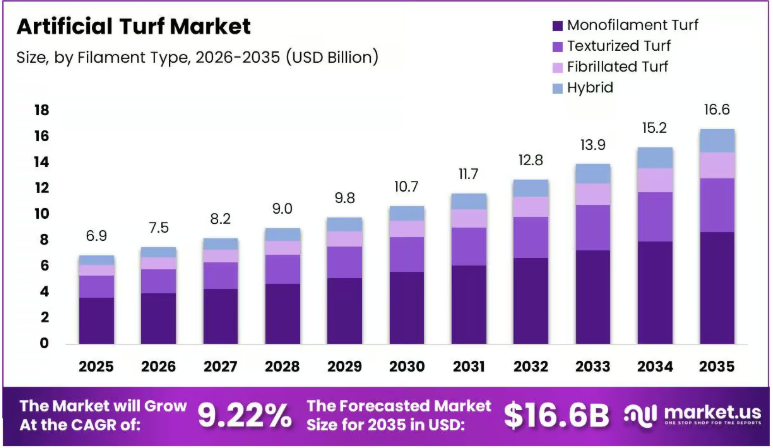
The **Artificial Turf Market Industry** has become an important part of the global landscaping and sports infrastructure industry, offering a practical alternative to natural grass for a wide range of applications. Artificial turf is designed using advanced synthetic fibers that closely resemble natural lawns while requiring considerably less maintenance. Over the years, improvements in manufacturing technology have enhanced its appearance, durability, and overall performance, making it suitable for sports fields, residential landscapes, commercial properties, educational institutions, and public recreational spaces.
The growing emphasis on sustainable land management has encouraged organizations and property owners to adopt solutions that reduce water consumption and maintenance expenses. Urban development projects, changing lifestyle preferences, and increasing investments in recreational facilities have further strengthened demand. As cities continue to expand and green spaces become more valuable, synthetic turf provides an efficient solution for maintaining visually appealing environments throughout the year.
Get Sample PDF: https://market.us/report/artificial-turf-market/request-sample/
Key Growth Factors
Several interconnected factors continue to support market expansion. One of the primary contributors is the growing investment in sports infrastructure, where durable playing surfaces are essential for accommodating frequent use and varying weather conditions. Synthetic turf offers consistent performance, faster drainage, and lower maintenance costs, making it an attractive choice for professional stadiums, schools, universities, and community sports facilities.
Commercial landscaping has also emerged as a major area of adoption. Hotels, office complexes, shopping centers, airports, and hospitality venues increasingly utilize synthetic grass to create attractive outdoor environments without the recurring expenses associated with natural lawns. Residential consumers are similarly embracing these products for gardens, rooftops, balconies, and backyard spaces due to their long lifespan and minimal upkeep requirements.
Continuous technological innovation has further enhanced product quality. Modern manufacturing techniques have introduced softer fibers, improved drainage systems, UV-resistant materials, and recyclable components that increase durability while addressing environmental concerns. These developments continue to broaden the range of applications across multiple industries.
Market Landscape
Segmentation and Regional Insights
The industry can be categorized by material type, application, and geographic region. Polyethylene, polypropylene, and nylon remain the most commonly used materials, each providing distinct advantages depending on performance requirements and installation environments. Applications extend beyond sports facilities to include residential landscaping, commercial developments, playgrounds, municipal parks, educational campuses, airports, and hospitality projects.
Regional demand varies according to infrastructure development, climate conditions, and environmental policies. North America continues to benefit from established sports facilities and commercial landscaping investments. Europe emphasizes sustainability, product quality, and environmental compliance. Meanwhile, the Asia-Pacific region is experiencing rapid expansion due to urbanization, construction activity, and increasing public investment in recreational infrastructure. Emerging economies across Latin America and the Middle East & Africa are also creating new opportunities through modernization projects and expanding urban landscapes.
Competitive Environment and Future Outlook
Competition remains highly dynamic as manufacturers focus on innovation, product differentiation, and geographic expansion. Companies continue investing in research and development to improve product performance, enhance durability, and introduce environmentally responsible manufacturing processes. Strategic collaborations, acquisitions, and expanded distribution networks have become common approaches for strengthening market presence and reaching new customer segments.
Looking ahead, long-term prospects remain favorable as governments, businesses, and homeowners increasingly prioritize sustainable landscaping and resource-efficient infrastructure. Advancements in recyclable materials, improved fiber engineering, and environmentally conscious production methods are expected to shape future product development. Continued urbanization, rising infrastructure investments, and growing awareness of water conservation will further support industry expansion, creating new opportunities for manufacturers, suppliers, and investors in the years ahead.
메타데이터
- post_id
- c3ec54731bf2
- slug
- artificial-turf-market-growth-opportunities-and-trends-c3ec54731bf2
- url
- https://medium.com/@kathrynjlemos/artificial-turf-market-growth-opportunities-and-trends-c3ec54731bf2
- canonical_url
- https://medium.com/@kathrynjlemos/artificial-turf-market-growth-opportunities-and-trends-c3ec54731bf2
- author_url
- https://medium.com/@kathrynjlemos
- status
- ok
- fetched_at
- 2026-08-10 21:30:30