Deadly and Invisible — The Rapid Rise of Ghost Guns
Major loopholes in federal regulations have led to the dangerous, explosive growth of unregulated DIY guns in the US. In January 2025, the…
Deadly and Invisible — The Rapid Rise of Ghost Guns
[embed]
Major loopholes in federal regulations have led to the dangerous, explosive growth of unregulated DIY guns in the US. In January 2025, the Bureau of Alcohol, Tobacco, Firearms and Explosives (ATF) released a report examining firearm commerce and trafficking. Part 5 of its report provides an alarming insight into the proliferation of privately made firearms (PMFs). From 2013 to 2023, the amount of PMFs collected from crimes increased by a staggering 1,588%, and an overwhelming majority of these PMF crime guns are ghost guns.
California is the most impacted by this surge, with 55% of the recovered PMFs from 2017 to 2021 originating there. It has been theorized that California’s stricter regulations and barriers to purchasing firearms have led to the growing exploitation of a federal regulation loophole and the rising usage of these off-the-books guns¹⁶. Concerns expressed by policymakers and law enforcement leaders nationwide led to the implementation of an ATF rule change on August 24, 2022 by the Biden Administration. The ATF Rule 2021R-05F modernized the definitions of key regulatory items to minimize the access to these ghost guns. Prior to this, California also enacted a more comprehensive set of major regulations with AB 1621 on July 1, 2022. Continued nationwide efforts need to be done to effectively decrease the presence of ghost guns, and future analysis of California’s ghost gun epidemic can shed insight into the effectiveness of their more comprehensive policies.
What are ghost guns?
Ghost guns are PMFs without a registered serial number, rendering the firearm unregulated and untraceable. These serial numbers are an integral part of criminal investigations because they allow law enforcement to track perpetrators. Ghost guns are mostly made from ready-to-assemble kits or components sold individually. Less commonly, some types of ghost guns are 3D-printed or made with liquid resin casting kits, which can go undetected by metal detectors.
Why did ghost gun usage surge?
Developments in our judicial system and improved firearm technology have rendered laws insufficient. Prior to the ATF Rule 2021R-05F, a gap was exploited in the definitions of key regulated items. These definitions are important guidelines to direct licensing, serialization, record-keeping, selling, and transferring of firearms and their parts for licensed firearm dealers and manufacturers. Precursor parts were not legally recognized as easily assembled into dangerous, functional firearms. The loophole allowed manufacturers to produce unfinished gun parts and kits and sell them without serialization and the need for background checks and federal firearm licenses (FFLs). Frames or receivers were previously defined as the “part of a firearm which provides housing for the hammer, bolt, or breechblock, and firing mechanism, and which is usually threaded as its forward portion to receive the barrel”⁸. It effectively leaves out firearms with split or multiple-part receivers and/or striker-firing mechanisms. Strict interpretation of this definition in the lower courts would exclude about 90% of all firearms available to civilians now. The outdated definitions of regulated items created a flaw in both the federal and state-level regulations, leading to the boom in unserialized PMFs.
The proliferation of ghost guns can also be attributed to technological advancements in manufacturing. Companies and organizations, like Polymer80 and Defense Distributed, have greatly lowered the financial and technical barriers to making firearms at home. Polymer-80 sells unserialized 80% gun kits, which can be easily assembled in a matter of hours. Common 80% kits include a receiver, necessary hardware, and an instruction guide. At one point, it was the most common ghost gun brand recovered, but it closed down in 2024 due to continued lawsuits. Polymer-80 has stopped production since then, but it is currently still running its final sales.
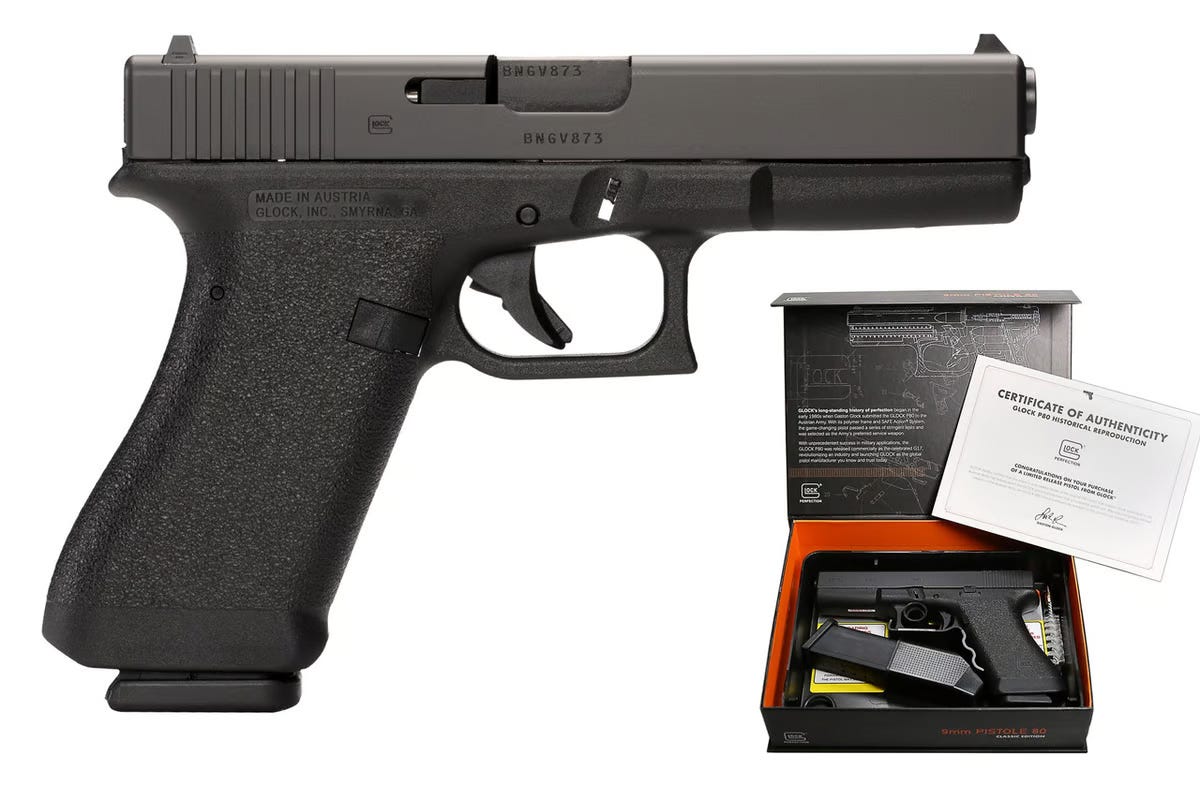
GLOCK P80 GEN 1 Kit from Polymer-80
Ever since gun kits became regulated by the ATF Rule 2021R-05F, focus has shifted towards manufacturing the gun parts privately. Defense Distributed owns Ghost Gunner, Coast Runner, and DEFCAD, and in combination, they can give individuals unlimited access to guns. Ghost Gunner and Coast Runner both sell affordable and fully programmable CNC mills, but the key difference between these two companies is their marketing styles. Along with the purchase of the Ghost Gunner 3-S CNC mill (GG3-S), Ghost Gunner provides a flash drive containing predefined cutcodes for various gun parts. The company boasts that its gunsmithing files require no prior skills to create firearms. This company also flagrantly advertises GG3-S as a way to circumvent federal regulations. In contrast, Coast Runner markets a regular CNC mill (CR-1) to possibly avoid certain state-level regulations against owning mills for the sole or primary use of gun manufacturing. It is worth noting that GG3-S and CR-1 have the same technical specifications. For more files and firearm parts, users can access large, open-source 3D gun repositories, such as DEFCAD. The combined advancements in technology and online community efforts have made it considerably easier for people to take up gun manufacturing.
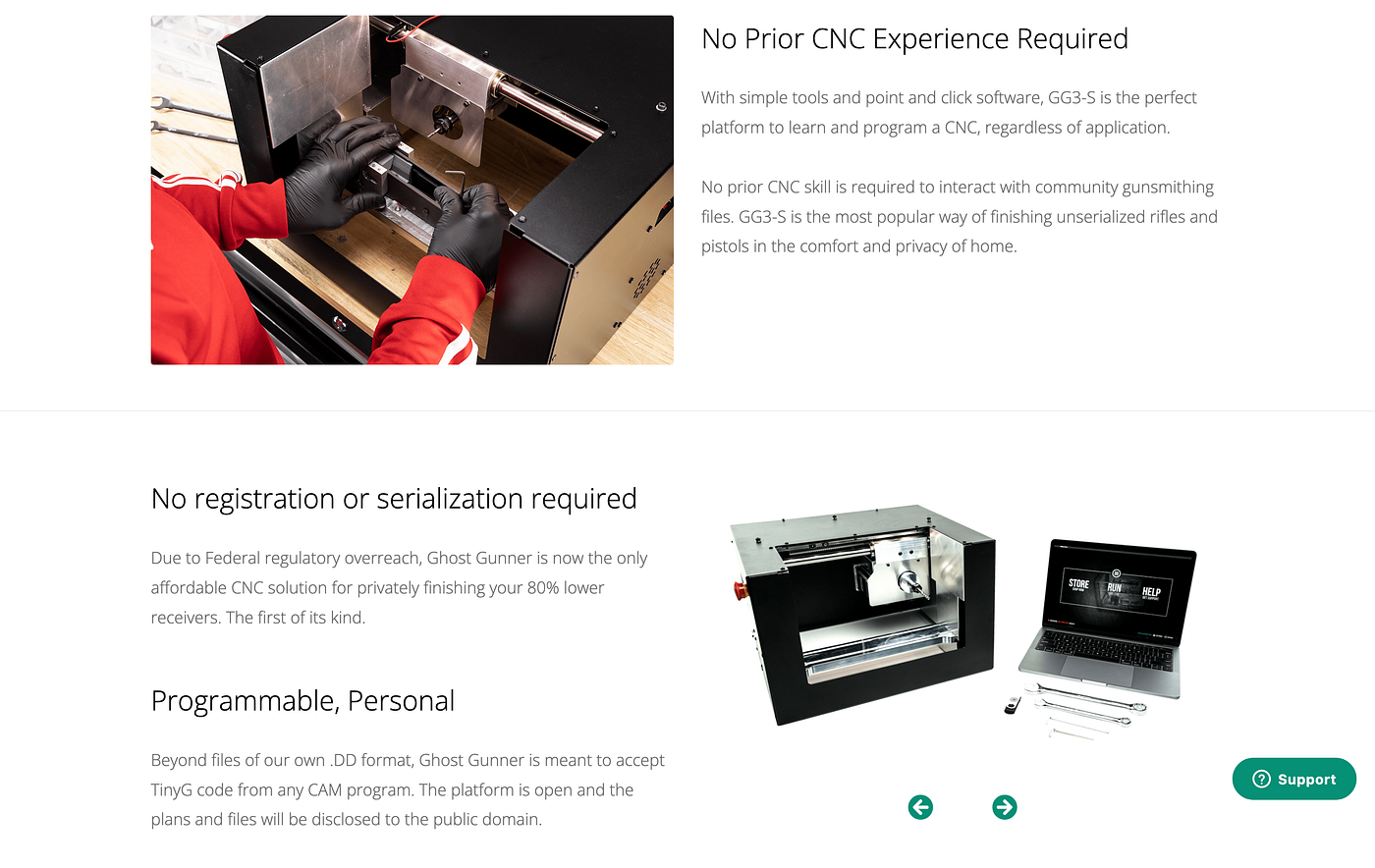
Home page of Ghost Gunner
Federal and California Regulations
Effective on August 24, 2022, ATF Rule 2021R-05F broadened the definitions to include a wider range of frames, receivers, and other variants. It now also treats and regulates gun kits or readily converted unfinished parts as firearms. However, on a federal level, people are generally still allowed to purchase individual, unfinished gun parts and make firearms for personal use without serializations and FFLs as long as they are not sold or transferred¹⁰. Major flaws in federal regulations still persist, which leaves it up to state-level regulations to close the loopholes.
Effective on July 1, 2022, California passed AB 1621 (2021–2022), which also modernized the definitions of firearms, frames, and receivers into its penal code. Most of the definitions are consistent with the changes seen in ATF Rule 2021R-05F. One main difference can be seen in its definition of precursor parts. In California, precursor parts are deemed necessary components of a firearm and considers “any forging, casting, printing, extrusion, machined body or similar article” that can be easily converted to a firearm, frame, or receiver⁹. That would mean that raw materials like metal blocks can be considered and regulated as a firearm precursor part if they’re marketed to be readily assembled into a firearm part. It also prohibits the sale, transfer, or possession of unserialized precursor and firearm parts, which must be sold through a licensed vendor. Other provisions in the bill, such as banning the sale, transfer, or possession of a CNC mill whose the sole or primary use of gun manufacturing, take effect in later years.
California’s ghost gun epidemic
[embed]
Ghost guns were rarely spotted from 2010 to 2016. They comprised less than 1% of all crime guns each year during that period. The recoveries of both crime guns and ghost guns exponentially increased during the early pandemic, reaching their peak in 2021. From 2019 to 2021, the amount of crime guns recovered rose by 50.5%, going from 46,484 to 69,951.
[embed]
The drastic increase in recovered crime guns can be explained by the possible links between gun prevalence, poverty, and crime. The amount of guns purchased in the US also reached a record high in the beginning of the pandemic. Just nine months after March 2020, about 19 million firearms were bought⁴. In just that time period, it completely shattered every annual record. Along with that, there was twice the number of crime guns recovered that were purchased less than 7 months from the time of purchase in 2020 compared to 2019⁴. A little over half of those were bought in less than 3 months before they turned up in a crime scene. In general, violent crimes, such as homicides, rose across the US during the COVID-19 shutdown. In California, “homicides and aggravated assaults that involve guns surged by 54.3% and 65.7% between 2019 and 2021”¹³. The surge of crimes was likely due to economic harm the COVID-19 outbreak caused towards low-income workers. There was a large number of teens and young adults in low-income neighborhoods that were pushed out of school and work during the shutdown. High concentrations of poverty in neighborhoods are closely associated with increased crimes, especially with teen boys and young men¹.
[embed]
Along with crime gun recoveries, ghost gun recoveries experienced a jump from 1,577 to 10,875 from 2019 to 2021. By 2021, ghost guns comprised 15.5% of all collected crime guns, a 12.11 point increase from 2019. This change in market share of ghost guns indicates a surge separate from crimes and crime guns collected, and it further elucidates the issue with the outdated federal regulations. After peaking in 2021, ghost gun recoveries dropped disproportionately faster than crime guns, with a total of 8,189 ghost guns retrieved in 2024. The volume of ghost guns and crime guns recovered still remains higher than the pre-pandemic level in California.
The data we have now is most likely to severely undercount the number of ghost guns in circulation due to several limitations. These numbers only reflect recovered ghost guns, not the total amount of ghost guns illegally sold, manufactured, or used in California. In addition, not all law enforcement agencies accurately and/or completely report their records of crime guns to the California Department of Justice. Law enforcement agencies may misidentify ghost guns as unserialized guns because some PMFs often resemble commercially manufactured firearms. There is also an increased amount of counterfeit firearms with fake serial numbers, which can be misidentified as serialized crime guns. In recent years, there are efforts to educate and raise awareness for law enforcement to properly identify PMFs to combat this issue.
- Acharya, R., & Morris, R. (2024, December 16). Why did U.S. homicides spike in 2020 and then decline rapidly in 2023 and 2024?. Brookings. https://www.brookings.edu/articles/why-did-u-s-homicides-spike-in-2020-and-then-decline-rapidly-in-2023-and-2024/
- Barlow, A. (n.d.). Are 80% Lowers Unregistered? A Detailed Explanation. Daytona Tactical. 2025, https://daytonatactical.com/can-80-lower-receivers-be-unregistered/
- Barton, C. (2021, November 12). California police aren’t tracking crime guns, ignoring thousands of potential leads. The Trace. https://www.thetrace.org/2021/11/california-doj-firearm-trace-atf-gun-trafficking/
- Barton, C. (2021b, December 8). New data suggests a connection between pandemic gun sales and increased violence. The Trace. https://www.thetrace.org/2021/12/atf-time-to-crime-gun-data-shooting-pandemic/
- Brownlee, C. (2024, November 26). The ghost gun surge is abating. this is how it happened. The Trace. https://www.thetrace.org/2024/11/ghost-guns-decline-regulation-biden-atf/
- Bureau of Alcohol, Tobacco, Firearms and Explosives. (2025). National Firearms Commerce and Trafficking Assessment (NFCTA): Protecting America from Trafficked Firearms — Volume Four. https://www.atf.gov/firearms/national-firearms-commerce-and-trafficking-assessment-nfcta-firearms-trafficking-volume-four
- C.A. Legis. Assemb. AB-1621. Reg. Sess. 2021–2022 (2022). https://leginfo.legislature.ca.gov/faces/billNavClient.xhtml?bill_id=202120220AB1621
- Definition of “Frame or Receiver” and Identification of Firearms. Bureau of Alcohol, Tobacco, Firearms and Explosives. (n.d.-a). https://www.atf.gov/rules-and-regulations/definition-frame-or-receiver
- Definition of “Frame or Receiver” and Identification of Firearms, 27 CFR Parts 447, 478, and 479 (2022). https://www.federalregister.gov/documents/2022/04/26/2022-08026/definition-of-frame-or-receiver-and-identification-of-firearms
- Does an individual need a license to make a firearm for personal use?. Bureau of Alcohol, Tobacco, Firearms and Explosives. (n.d.-b). https://www.atf.gov/firearms/qa/does-individual-need-license-make-firearm-personal-use
- Ghost guns. Brady United. (n.d.). https://www.bradyunited.org/resources/issues/what-are-ghost-guns
- Ghost guns in California. Giffords Law Center. (n.d.). https://giffords.org/lawcenter/state-laws/ghost-guns-in-california/
- Lofstrom, M., & Martin, B. (n.d.). Crime trends in California. Public Policy Institute of California. https://www.ppic.org/publication/crime-trends-in-california/
- Polymer80 is morally bankrupt-and now it’s out of business. Everytown Research & Policy. (2024, September 6). https://www.everytown.org/polymer80-morally-bankrupt-out-of-business/
- Summary of Final Rule 2021R-05F. Bureau of Alcohol, Tobacco, Firearms and Explosives. (n.d.-c). https://www.atf.gov/rules-and-regulations/definition-frame-or-receiver/summary
- Taniguchi, T., Hoogesteyn, K., Renouard, E., & Esserman, D. (2021). The proliferation of ghost guns: Regulation gaps and challenges for law enforcement. National Policing Institute. https://www.policinginstitute.org/publication/the-proliferation-of-ghost-guns-regulation-gaps-and-challenges-for-law-enforcement/
- The Trace Gun Violence Data Hub. (2025). California Department of Justice.
- Untraceable: The rising specter of ghost guns. Everytown Research & Policy. (2020, May 14). https://everytownresearch.org/report/the-rising-specter-of-ghost-guns/
- What is an 80-Percent Build Kit . (2024, January 11). 3CR Tactical. https://3crtactical.com/blog/what-is-an-80-percent-build-kit/
메타데이터
- post_id
- c3f37bdc24ef
- slug
- deadly-and-invisible-the-rapid-rise-of-ghost-guns-c3f37bdc24ef
- url
- https://medium.com/@mfran.agnes/deadly-and-invisible-the-rapid-rise-of-ghost-guns-c3f37bdc24ef
- canonical_url
- https://medium.com/@mfran.agnes/deadly-and-invisible-the-rapid-rise-of-ghost-guns-c3f37bdc24ef
- author_url
- https://medium.com/@mfran.agnes
- status
- ok
- fetched_at
- 2026-08-07 03:53:49