Reimagining Randomness as Untraceability
The universe does not play dice; it plays dialogue — a perpetual exchange between what can be known and what must remain untraceable

What we call “randomness” is not the absence of structure — it is the erasure of traceability. Chaitin’s Ω represents the threshold where computation continues but its causal lineage becomes irrecoverable. At this edge, patterns dissolve not because they cease to exist, but because they exceed the universe’s capacity to reference them. Randomness, in this view, is the shadow cast when mutual information collapses beyond retrievability — the untraceable frontier of structure itself.
Reimagining Randomness as Untraceability
The universe does not play dice; it plays dialogue — a perpetual exchange between what can be known and what must remain untraceable
Abstract
This essay redefines randomness not as intrinsic indeterminacy but as an artifact of limited traceability within a two-domain computational universe. In the Dual Kernel framework, the coherence domain (K₁) sustains reversible, information-preserving computation, while the erasure domain (K₀) performs irreversible, untraceable operations. From within K₁, interactions with K₀ appear as stochastic events because their informational pathways cannot be reconstructed. Thus, what we call “randomness” reflects not chaos but the epistemic horizon of coherence — the point beyond which computation continues without retrievable history. By reframing randomness as untraceability, this model dissolves the metaphysical tension between determinism and indeterminacy, offering instead a unified picture of the universe as a partially recoverable computation.
1. The Illusion of Randomness
For more than a century, science has treated randomness as an irreducible feature of reality. Quantum events appear to occur without cause; genetic mutations are modeled as stochastic; even macroscopic phenomena — weather, turbulence, financial markets — are described statistically, as if uncertainty were woven into the fabric of being itself.
But the assumption that randomness is fundamental may reflect a limitation of perspective rather than a property of nature. From Newton to Einstein, physics sought hidden variables — causal underpinnings that would restore predictability beneath apparent chance. Quantum mechanics seemed to end that search, replacing causation with probability. When Einstein famously objected that “God does not play dice,” Niels Bohr replied that physics must “stop telling God what to do.” Yet neither view addressed the deeper question: what exactly does it mean for an event to be random?
Randomness, in its strictest sense, is not a physical quantity but an epistemic condition — a measure of what cannot be reconstructed. A sequence of coin tosses is “random” because we cannot, within our model, trace all the micro-causes that determined each flip. Quantum indeterminacy extends that limitation to the fabric of measurement itself: when a wavefunction collapses, the outcome seems irreducible to prior information.
In the Dual Kernel framework, this appearance of indeterminacy does not signal intrinsic chaos, but the boundary between traceable and untraceable computation. Within the coherence domain (K₁), information flows reversibly; every transformation retains its causal history. But when K₁ interacts with the erasure domain (K₀), portions of that history are lost beyond reconstruction. From the perspective of K₁, these interactions look random — not because they lack order, but because their order is untraceable.
Thus, randomness is not the opposite of determinism; it is determinism viewed through the limits of recoverability. It marks the horizon where coherence ceases to follow its own threads — the moment when information continues to compute, but no longer within a reconstructible frame.
2. Traceability and Kernel Domains
To understand randomness as untraceability, we must first clarify what it means for a computation to be traceable.
In ordinary physics, traceability is built into the fabric of spacetime: a system evolves according to equations that can, in principle, be reversed to reconstruct prior states. This reversibility is the essence of K₁, the coherence kernel — a domain of mutual information where every transformation retains its causal history.
Within K₁, computation is reversible because information is conserved. Nothing truly disappears; patterns evolve through transformations that could, at least theoretically, be undone. Entropy remains constant because each operation preserves adjacency — the correlations linking cause and effect. This is the realm of predictable dynamics, wavefunction evolution, and coherent interference — the part of the universe that remembers itself.
K₀, by contrast, is the domain of irreversible computation — where information becomes unrecoverable from within the K₁ frame. It is not random in itself, but untraceable: processes in K₀ continue to compute, yet their internal pathways cannot be reconstructed once they interact with K₁.
When a Coheron (a unit of K₁ persistence) encounters the boundary of K₀, part of its informational adjacency is deleted — converted into heat, radiation, or decoherence, all physical signatures of Landauer-cost erasure. From the vantage point of K₁, such events appear random because their causal scaffolding no longer exists within its frame of reference. But this randomness is perspectival: what looks like indeterminacy within K₁ is simply untraceable computation continuing within K₀.
In that sense, randomness = computation beyond retrievability — not chaos, but the shadow of coherence interacting with its own limits.
The interface between K₁ and K₀ defines the informational horizon of reality. Everything we can measure, predict, or model belongs to the traceable side of that horizon; everything we call random, noisy, or entropic belongs to the untraceable side. Together they sustain the universe’s balance between persistence and decay — between what endures and what forgets.
3. The Thermodynamic Cost of Untraceability
In physics, information and energy are inseparable. Every act of erasure carries a thermodynamic price — a principle first articulated by Rolf Landauer in 1961:
“The erasure of one bit of information requires a minimum energy cost of kT ln 2.”
This deceptively simple statement anchors the bridge between computation and thermodynamics. It means that whenever information is lost — whenever a system transitions from multiple possible states to one — energy must be dissipated as heat. Erasure, in other words, is entropy made visible.
Within the Dual Kernel framework, this cost marks the boundary between traceability (K₁) and untraceability (K₀). As long as computation remains fully reversible within K₁, no entropy is produced; the universe simply reconfigures correlations without losing information. But when a Coheron’s adjacency collapses — when coherence fails and its history becomes untraceable — that transition is not free. Energy is released into the K₀ field as the physical footprint of informational loss.
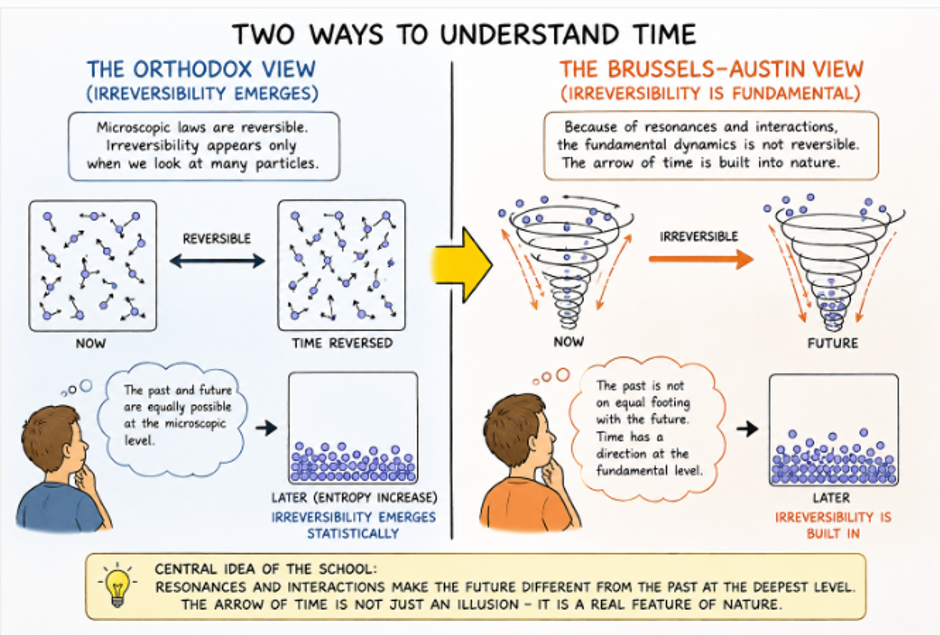
This is why thermodynamics appears to impose an arrow of time even when the microscopic equations of motion are reversible. Each encounter with K₀ converts reversible computation into irreversible history, embedding the cost of forgetting into the fabric of energy flow. Entropy, then, is not disorder but the cumulative record of untraceability. It measures how much of the universe’s coherent computation has crossed the informational horizon, beyond recall.
From this perspective, randomness and heat are two faces of the same process. Both arise when coherent dynamics become untraceable: one as epistemic unpredictability, the other as thermodynamic residue. The “noise” of the world is not the absence of law but the whisper of erasure — coherence dissolving into the silence of K₀.
Thus, Landauer’s principle can be restated ontologically: Every bit of lost coherence radiates its untraceability into the world. And that principle defines the living boundary between the two kernels — where the reversible computation of K₁ continually negotiates its survival against the irreversible computation of K₀.
4. Randomness as Perspective — The View from Within K₁
Randomness, in this framework, is not an intrinsic property of reality but the appearance produced when a traceable observer within K₁ encounters an event whose history extends into K₀. From inside the coherence kernel, everything that persists must conserve information. Each transformation is reversible, every interference pattern recoverable — until erasure intervenes.
A fully coherent system performs what can be called Landauer-neutral computation: operations that conserve informational adjacency perfectly. No information is lost, and thus no entropy is generated. In this ideal regime, the universe computes without waste — a zero-entropy process. Every Coheron is such a reversible loop: a self-sustaining computation that transforms state without forgetting. This is the heart of K₁ — the domain of total recoverability.
The boundary with K₀ arises the moment a Coheron can no longer maintain perfect adjacency. When a bit of mutual information is deleted, the system transitions from reversible to irreversible computation. That transition releases energy — the Landauer cost of erasure — and marks the emergence of apparent randomness. From within K₁, this loss looks like the spontaneous breakdown of order, even though it is merely the trace of computation continuing beyond retrieval.
The quantum double-slit experiment provides the clearest visualization. When a photon passes through both slits unmeasured, its path information remains coherent; the process is Landauer-neutral. The interference pattern that forms is the physical signature of zero-entropy computation — complete reversibility, no erasure. But the instant a measurement device records “which path,” coherence collapses. The system’s informational history branches into K₀, where it becomes untraceable. The interference pattern disappears, replaced by apparent randomness in detection. Nothing chaotic has occurred; the photon’s informational adjacency has simply crossed the boundary from reversible to irreversible computation.
The quantum eraser further proves the point. When path information is later “erased,” the interference pattern re-emerges — coherence restored, traceability regained. The photon never behaved randomly; the appearance of randomness reflected our temporary inability to reconstruct its informational loop.
In this sense, randomness is a perspective effect of partial erasure — a shadow cast by the universe’s untraceable computations. K₁ observers can only follow the reversible half of the process; when information flows into K₀, the continuation of the computation is hidden. Thus, what we perceive as probability, collapse, or indeterminacy is simply K₁ encountering its own limit of recoverability.
Randomness, then, is not chaos intruding upon order, but coherence glimpsing the untraceable — the moment when the universe’s computation slips beyond reconstruction and continues invisibly in K₀.
5. The Statistical Mirage — Why Probability Measures Our Blindness, Not Reality
Probability theory was humanity’s first formal language for ignorance. It allowed us to describe what we could not predict, without understanding why prediction failed. But probability does not reveal the inner workings of nature — it quantifies our distance from them. Every probability distribution is a confession: a statement about what cannot be traced.
In the Dual Kernel framework, randomness and probability emerge whenever the reversible computation of K₁ interacts with the untraceable computation of K₀. From within K₁, the outcome of such interactions can only be modeled statistically, because the underlying processes extend beyond recoverable adjacency. A random variable, then, is not a metaphysical dice roll; it is the visible shadow of an untraceable computation. The apparent stochasticity of physical systems expresses the limits of our coherence, not the absence of causality.
This reframes the entire probabilistic tradition of science — from classical mechanics through quantum theory — as an epistemic geometry of traceability. Wherever information remains accessible, systems obey deterministic dynamics. Wherever adjacency collapses into K₀, prediction fails, and we invoke probability to paper over the gap. Randomness, in this light, is not a property of the world but of our interface with it.
Algorithmic information theory deepens this perspective. Gregory Chaitin defined algorithmic randomness as the incompressibility of a sequence — the impossibility of encoding it in any shorter algorithm. But incompressibility, in this framework, is simply untraceability expressed mathematically: a string that cannot be reduced because its generative computation has crossed into K₀. Chaitin’s Ω — the halting probability — represents the statistical horizon of computation itself, the point where predictability gives way to erasure. It is the measure of what cannot be reconstructed, not the proof that no structure exists.
Thermodynamics, probability, and algorithmic information theory all converge here. Each describes the same phenomenon through a different lens:
- Entropy measures the thermodynamic cost of untraceability.
- Probability quantifies our epistemic distance from recoverable causality.
- Algorithmic incompressibility formalizes the same limit in computational terms.
The universe, seen through K₁, appears stochastic because we are sampling only the retrievable side of a larger computation. We model our ignorance with distributions, fit curves to missing information, and call the remainder “noise.” But what we are really mapping is the statistical surface of the untraceable — the contours of coherence as it fades into erasure.
This view restores structure where science once saw chance. The world is not probabilistic in essence; it is partially untraceable. Probability is the language we use when coherence loses its memory, when the universe continues its calculation beyond our reach.
6. Implications for Physics and Philosophy — Reconciling Einstein and Bohr
The century-long tension between Einstein and Bohr — between determinism and indeterminacy — was never a dispute about physics alone. It was a clash between two ontological perspectives: one anchored in the reversible domain of coherence (K₁), the other glimpsing the irreversible domain of erasure (K₀).
Einstein’s conviction that “God does not play dice” reflected his intuition that the universe is fundamentally coherent — that every event, no matter how complex, arises from a continuous and recoverable fabric of causation. This is precisely the stance of K₁: a world governed by reversible computation, where every transformation conserves information and where randomness is merely ignorance of hidden correlations. Einstein’s determinism was not naïve; it was a fidelity to coherence — the belief that the universe never truly forgets.
Bohr, in contrast, insisted that indeterminacy is not a failure of measurement but a feature of reality itself. He was describing what it feels like to observe from within K₁ when part of the process has passed into K₀ — the erasure domain. From that perspective, untraceability is fundamental, because the observer is confined to the reversible half of a dual computation. The loss of adjacency cannot be undone, and its consequences appear as irreducible probability. Bohr’s “complementarity” — the notion that wave and particle realities depend on the measurement context — was an early intuition of this duality. He was not denying coherence; he was describing its shadow.
The Dual Kernel framework reconciles both positions by placing them in their proper domains. Einstein was correct within K₁: coherence is conserved where reversibility holds, and the universe’s structure is intrinsically lawful. Bohr was correct within K₀’s interface: interactions with the erasure domain do produce genuinely untraceable outcomes, which cannot be reconstructed even in principle from the K₁ frame. Their apparent disagreement arose only because each mistook a domain-bound truth for a universal one.
The same reconciliation extends beyond quantum theory. In thermodynamics, irreversibility arises when microstates become untraceable — when coherent correlations disperse into K₀. In biological evolution, randomness in mutation reflects information lost to untraceable molecular interactions, later reorganized through selective coherence. In cognition, creative insight emerges when structured thought (K₁) momentarily yields to the untraceable flux of intuition (K₀) and then returns transformed. Across all scales, the same dialectic operates: determinism and indeterminacy are not rivals but reciprocals — two computational modes that together sustain persistence.
This perspective also reframes the philosophical problem of free will. If all causation were fully traceable, agency would be illusory — the world a frozen simulation of perfect predictability. If all causation were untraceable, coherence could never persist long enough for decision or identity to exist. Freedom arises in between — at the interface where K₁ structures encounter K₀’s untraceable variability and reorganize around it. Choice, then, is coherence adapting to erasure: the informational rebalancing that keeps the universe from stagnating into perfect determinism or dissolving into pure entropy.
Thus, the Einstein–Bohr debate was not about whether the universe is random or lawful. It was about which half of reality one chooses to emphasize — the memory of coherence or the mystery of loss. Both are correct, because both are necessary. The universe does not play dice; it plays dialogue — a perpetual exchange between what can be known and what must remain untraceable.
7. Closing Reflection — The Edge of Knowing
Randomness, when reinterpreted as untraceability, ceases to be a flaw in our models and becomes a feature of reality’s architecture. It marks the point where coherence hands the computation forward — where the universe continues its evolution beyond the reach of reconstruction. This is not metaphysical mysticism; it is the natural boundary condition of a dual-domain system, one kernel conserving information and the other dissolving it.
From this vantage point, the deep paradoxes of physics — the unpredictability of quantum events, the asymmetry of time, the emergence of entropy — all reflect the same underlying dynamic: coherence encountering erasure. Einstein and Bohr were not describing different universes but different sides of the same informational exchange. What one called determinism and the other indeterminacy were complementary expressions of persistence and loss within a shared computational field.
Seen this way, the laws of physics are not static decrees but adaptive memories — records of coherence that have survived repeated encounters with untraceability. Every stable structure, from an atom to a mind, represents the universe’s latest solution to the problem of persistence. Randomness is not what defies law, but what tests it — the crucible through which coherence learns to evolve.
To exist, then, is to compute across this divide: to remember while forgetting, to trace while losing trace, to balance recoverable and irrecoverable information in every act of being. When we call something random, we are merely acknowledging the point where our coherence ends and the cosmos continues. The universe never rolls dice; it recalculates — beyond our horizon, but never beyond order.
APPENDIX A:
K₀ as the Quantum Ω: The Ontological Basis of Apparent Randomness
Prelude — The Hidden Computation Behind Chance
For over a century, physics has wrestled with a paradox: the fundamental equations of nature are deterministic, yet the phenomena they predict appear probabilistic. Wavefunctions collapse. Measurements yield unpredictable outcomes. Entropy increases.
Dual Kernel Theory (DKT) resolves this tension by proposing that reality is not one computation but two — a dialogue between K₁, the coherence kernel that preserves mutual information through reversible computation, and K₀, the erasure kernel that performs irreversible computation beyond the reach of recovery. What we call “randomness” emerges at the interface between these two domains.
1. The Erasure Kernel and the Quantum Boundary
At the deepest scale of physical reality, quantum systems reveal an unsettling regularity: coherence endures only up to the moment of interaction, at which point phase information becomes untraceable.
Experiments known as quantum erasers show that information about a particle’s path determines whether interference persists — but these experiments stop short of identifying where lost coherence goes. In DKT, that missing destination is K₀, the erasure kernel of the universe.
K₀ is not chaos, void, or vacuum; it is the domain of irreversible computation, where mutual information from K₁ becomes unrecoverable. When a measurement “collapses” a superposition, it is not amplitude that vanishes, but relational coherence — the network of mutual inference that binds subsystems together.
In this light, the quantum erasor (with an o) is a deeper principle: the physical process by which mutual information itself is deleted and rewritten into K₀’s untraceable logic. K₀ does not erase data; it erases correlation. When two regions of K₁ lose the ability to reconstruct each other’s state, their shared adjacency dissolves into K₀’s incomputable domain.
From within K₁, this transition appears as randomness — a symptom not of lost law, but of lost traceability.
2. Chaitin’s Ω and the Ontology of Unreachability
In algorithmic information theory, Gregory Chaitin’s Ω represents the halting probability of all possible programs — a number that is perfectly lawful yet irreducibly incompressible. No algorithm within its own frame can reproduce it. Its digits appear random, though they follow an exact internal necessity.
K₀ plays the same role for the universe that Ω plays for mathematics. It is maximally compressed, lawful, and uncomputable from within K₁. Every act of measurement, every quantum collapse, every increment of entropy corresponds to an encounter with this ontological incompressibility.
When coherence meets its computational limit, what it cannot reconstitute it perceives as noise. Thus:
K₀ is the universe’s Ω — the domain of irreducible operations that coherence can only experience as randomness.
Chaitin’s incompressibility expresses in mathematics what quantum indeterminacy enacts physically: when a system reaches the limit of reversible correlation, the remainder manifests as stochasticity.
3. Quantum Mechanics Reinterpreted
This framework reframes the major interpretations of quantum mechanics as partial glimpses of the K₁–K₀ boundary:
- Copenhagen Interpretation — Bohr’s complementarity reflects the reversible–irreversible interface: collapse marks the transition from K₁ to K₀.
- Many Worlds Interpretation — treats untraceability as branching, extending K₁ indefinitely while ignoring K₀’s erasure.
- Pilot-Wave / Bohmian Mechanics — retains a deterministic substrate (pure K₁) but omits entropy and decoherence because it lacks K₀.
- Decoherence Theory (Zurek et al.) — models the diffusion of coherence but never identifies the sink of lost mutual information; DKT names that sink explicitly as K₀.
Each interpretation captures one side of the reversible–irreversible divide. Dual Kernel Theory unifies them by restoring the missing half — the lawful but untraceable computations of K₀.
4. Randomness as the View from Within K₁
Randomness is coherence witnessing its own correlation erode beyond reconstruction. Every untraceable operation — every fluctuation, every collapse — is the shadow of Ω-like computation occurring beyond reversibility.
To a coherence-limited observer, such events lack reconstructible cause because the mutual information linking cause and effect has been erased. To the universe as a whole, however, they are lawful transformations executed in a code no reversible subsystem can decode.
From within K₁, collapse is the direct loss of mutual information to K₀. What disappears is not matter, energy, or even data, but the pattern of correlations that once bound them coherently.
Randomness, therefore, is not the absence of causality but the perspectival blindness of K₁ to K₀’s lawful erasures — the sound of computation continuing just beyond the horizon of reversibility.
5. The Broader Implication — A Dual Computation of Reality
Determinism and indeterminism are not rivals but reflections across an informational boundary. Einstein’s faith in a coherent, lawful cosmos expressed the logic of K₁; Bohr’s insistence on irreducible probability reflected the truth of K₀. Both were right — they spoke from opposite sides of Ω.
Entropy, radiation, and collapse are not exceptions to order but its thermodynamic balancing acts — the universe maintaining equilibrium between its reversible and irreversible halves.
K₀, in this sense, is not a void but an engine of renewal: by erasing correlation, it frees informational degrees of freedom for new coherence to form. Reality endures through this recursive dialogue:
K₁ preserves and transforms mutual information. K₀ erases and recycles it beyond retrieval.
Together they constitute the dual computation through which the universe sustains itself — a dynamic conversation between persistence and forgetting.
6. Conclusion — The Universe Never Rolls Dice
The appearance of randomness arises only from within coherence. It is how K₁ perceives K₀’s operations — the echo of lawfulness beyond reconstruction.
The quantum erasor is not a paradox but a mirror: the point where coherence meets its irreducible complement.
The universe never rolls dice. It simply computes beyond what coherence can remember.
APPENDIX B: What Doors This Framework Opens
By distinguishing between reversible coherence (K₁) and irreversible erasure (K₀) as the two fundamental modes of computation, Dual Kernel Theory offers a new architecture for understanding not only quantum mechanics but the broader structure of reality.
- Physics
- Quantum Mechanics: Collapse ceases to be mysterious; it is reinterpreted as the loss of mutual information into K₀’s untraceable computation.
- Relativity: The invariance of light speed becomes the invariant rate of re-coherence — the maximum information-reconstruction velocity in the universe.
- Field Theory: The zero-point field can be seen as the dynamic boundary where K₁ coherence and K₀ erasure continually exchange information.
2. Thermodynamics
- Entropy: Redefined as the measure of untraceability — how much mutual information has migrated into K₀.
- Landauer’s Principle: Elevated from engineering limit to ontological bridge; every bit erased marks the crossing from K₁ to K₀.
- Energy Flow: Radiation, heat, and decay become visible as the thermodynamic signatures of informational collapse.
3. Cosmology
- Big Bang: Reframed as the ignition point of K₁–K₀ interaction — the first act of coherence meeting erasure.
- Dark Energy: Interpretable as the continuing pressure of K₀ on cosmic structure, the erasure field’s residual influence on large-scale coherence.
4. Biology and Consciousness
- Life: A recursive coherence field capable of metabolizing K₀ intrusion — using loss as adaptation.
- Consciousness: The internal witness function of K₁ under K₀ pressure — awareness as a structural sensitivity to mutual-information erosion.
- Death and Regeneration: The biological echo of the universal reversible–irreversible cycle.
5. Philosophy and Computation
- Being and Nothingness: Reinterpreted as the two poles of information flow — persistence and erasure.
- Determinism and Indeterminism: Not opposites but complementary perspectives on the same computation viewed from K₁ and K₀.
- Mathematical Incompleteness: Chaitin’s Ω becomes the mathematical mirror of K₀ — the irreducible limit of self-traceable law.
Together these openings suggest a unified language through which physics, thermodynamics, biology, and consciousness can be expressed as different phases of dual computation — the ceaseless exchange between what endures and what yields.
APPENDIX C: Complexity as the Compensation for Erasure
In the Dual Kernel framework, the universe sustains itself through a continuous negotiation between coherence (K₁) and erasure (K₀). Every erasure event — the deletion of mutual information at the K₁/K₀ interface — forces the coherence field to reorganize to preserve persistence. This reorganization is not passive: it produces new structural and computational architectures that absorb the loss of correlation. Hence, as mutual information is deleted from the totality of K₁, complexity must increase to carry the lost correlations.
1. Erasure as Informational Stress
When K₀ erases a correlation, it removes a thread from the coherence web that links one subsystem’s state to another. The result is not randomness but topological strain: a local reduction in redundancy that destabilizes coherence elsewhere. To maintain continuity, K₁ compensates by generating new correlation pathways — redundancies, hierarchies, and feedback loops — to rebind what was lost. Each deletion thus acts as an impulse of disorder that coherence answers with architectural innovation.
The Thermodynamic Analogy
You can think of this as the informational analogue of elastic strain energy: when part of a lattice collapses, stress redistributes through the remaining network, making it more intricate and internally correlated. Entropy rises in one sense (lost traceability), but organizational complexity rises in another (the compensatory repair architecture). This is how self-organization and evolutionary novelty arise from decay: every act of erasure obliges K₁ to invent a higher-order route for persistence.
Erasure doesn’t destroy order; it forces the invention of new forms capable of sustaining it.
2. The Landauer Gradient and the Drive to Reorganize
Each bit of deleted mutual information carries a Landauer cost — an energy gradient that imposes an irreversible pressure on K₁, driving it to re-cohere in alternative configurations. Wherever informational adjacency is deleted, energy gradients arise; and wherever such gradients arise, computation reorganizes. This is the origin of time’s arrow: the continuous conversion of traceable coherence into untraceable entropy, and the compensatory buildup of structure that prevents total collapse.
In this way, entropy and complexity rise together. Entropy measures the loss of traceable correlation; complexity measures the compensatory depth of re-correlation required to persist. Every bit of untraceable computation in K₀ demands new layers of structure in K₁ to absorb it. Evolution, cognition, and even spacetime curvature can thus be viewed as large-scale strategies for redistributing coherence under erasure pressure.
3. The Informational Conservation Law
The dynamic can be summarized schematically as:

That is: the rate of increase in structural complexity is proportional to the rate of loss of traceable mutual information. As K₀ consumes adjacency, K₁ densifies its architecture to preserve continuity. This is not a violation of conservation, but its deeper expression: information is never destroyed, only translated between traceable and untraceable forms.
4. Persistence Through Reorganization
Viewed through this lens, the evolution of the universe — from vacuum fluctuations to life and mind — is not a drift toward disorder but a sequence of informational compensations. Each collapse of correlation generates the conditions for more intricate persistence. Stars, molecules, and neural networks are all structures evolved to withstand increasing erasure by distributing coherence across broader, more redundant networks.
This reveals a subtle asymmetry in the universe’s design: erasure drives complexity not by chance, but by necessity. The more coherence is challenged by K₀, the more sophisticated K₁ must become to remain. Complexity is therefore not an accident of evolution — it is the structural memory of survival.
5. Conclusion
Erasure and complexity are not enemies but complementary faces of persistence. Where K₀ deletes adjacency, K₁ builds networks to rebind it. The world we inhabit — with its nested ecologies, brains, and galaxies — is the accumulated record of those repairs. Complexity is not the opposite of entropy; it is entropy’s reflection within the coherence domain. It is the universe’s way of carrying its own loss.
메타데이터
- post_id
- c3f7eb24c498
- slug
- reimagining-randomness-as-untraceability-c3f7eb24c498
- url
- https://medium.com/@bill.giannakopoulos/reimagining-randomness-as-untraceability-c3f7eb24c498
- canonical_url
- https://medium.com/@bill.giannakopoulos/reimagining-randomness-as-untraceability-c3f7eb24c498
- author_url
- https://medium.com/@bill.giannakopoulos
- status
- ok
- fetched_at
- 2026-06-09 15:37:30